
See the difference Pure can make for your institution

Unfortunately we don't fully support your browser. If you have the option to, please upgrade to a newer version or use Mozilla Firefox, Microsoft Edge, Google Chrome, or Safari 14 or newer. If you are unable to, and need support, please send us your feedback.
How universities centralize research data, meet compliance requirements, and demonstrate their global research impact.
Last updated: April 2026

A RIMS gives universities a single, governed view of their research activities – connecting research outputs, funding, compliance, and researcher profiles in one place.
Without one, fragmented data across disconnected systems limits strategic decision-making, delays reporting, and makes it harder to demonstrate impact to funders and rankings bodies.
With a RIMS, institutions can advance research performance, improve compliance, increase global visibility, and make confident, data-driven decisions.
The academic landscape is becoming increasingly complex, with globalized competition, increased strain on faculty and researchers, and rapid technological and regulatory change. To remain resilient, universities need a solution that offers coordinated and comprehensive insights into their research activities. Such a solution should help them understand and manage the diverse stakeholders, use cases, and systems involved in research information management, enabling them to:
Advance research performance
Nurture global reputation
Develop funding streams
Expand local & international collaboration
Research Information Management Systems are commonly referred to by a few names and acronyms, including Current Research Information Systems (CRIS) or sometimes “profile system” or “networking tool.” These systems are designed to enhance the efficiency and effectiveness of research information management activities by integrating and connecting the various elements and processes that comprise the research ecosystem. They also serve as a centralized data repository for analysis, reporting and research promotion activities.
Research information management involves the collection, organization and effective use of data related to research activities. It enables tracking and reporting of research impact, showcasing of research outputs and scholarly profiles, compliance with legal and ethical standards like open access mandates, and ensures the long-term preservation of research and related data.
Given the growing complexity of the research ecosystem, managing data created during just one research project alone is challenging. Managing research data across your university without a solution is both impractical and infeasible.

Multiple stakeholders are involved in each element of the research ecosystem and subsequently face each research challenge. When access to good quality data and research management is available, stakeholders have the power to advance their contributions to their institution and beyond.
Categories of stakeholders include:
Category | Description |
|---|---|
Decision-makers | Includes institutional leaders who use research information data to make strategic decisions on internal funding allocations, staffing, facilities, equipment, public relations and internal policies that govern workflows related to research. |
Enablers | Includes the libraries and research management offices that provide critical support for the management of research. |
Supporters | Internal departments or teams that contribute to research information management, including: • Information technology • Finance • Human resources • Registrar • Legal • Risk management • Ethics board • Communications |
Researchers | Includes individuals involved in research execution, publication and promotion: • Faculty • Staff • Higher degree research students • Research support staff |
External stakeholders | Includes funding bodies, government or commercial partners who have an interest in the research. It also can consist of community members either being studied or impacted by the research and results. |
We need 'good data' to help us understand our research landscape and to formulate sensible research strategies. Yet, fragmented data had adversely limited our capability to derive timely insights to respond to the increasingly competitive research environment... Bringing in an integrated RIM solution was a strategic move to rectify the long-existing data problem.
Joshua Mok Ka Ho
Professor, Provost and Vice President (Academic & Research) at Lingnan University
Research Information Management Systems operate by integrating and connecting a wide array of data, systems, and entities to create a unified view of an institution's research activities. They provide a set of features for managing these disparate elements, ensuring that all components work together efficiently. Data is processed to ensure accuracy and usability prior to storage and application.
A RIMS centrally store related data for:
Analysis
Reporting
Research showcasing and communication
Managing information in one place through one interface
When analyzing and reporting, RIMS help identify patterns in research data, supporting informed decision making.
In turn, having this centrally located data and interface helps drive:
Research performance
International collaboration
Funding
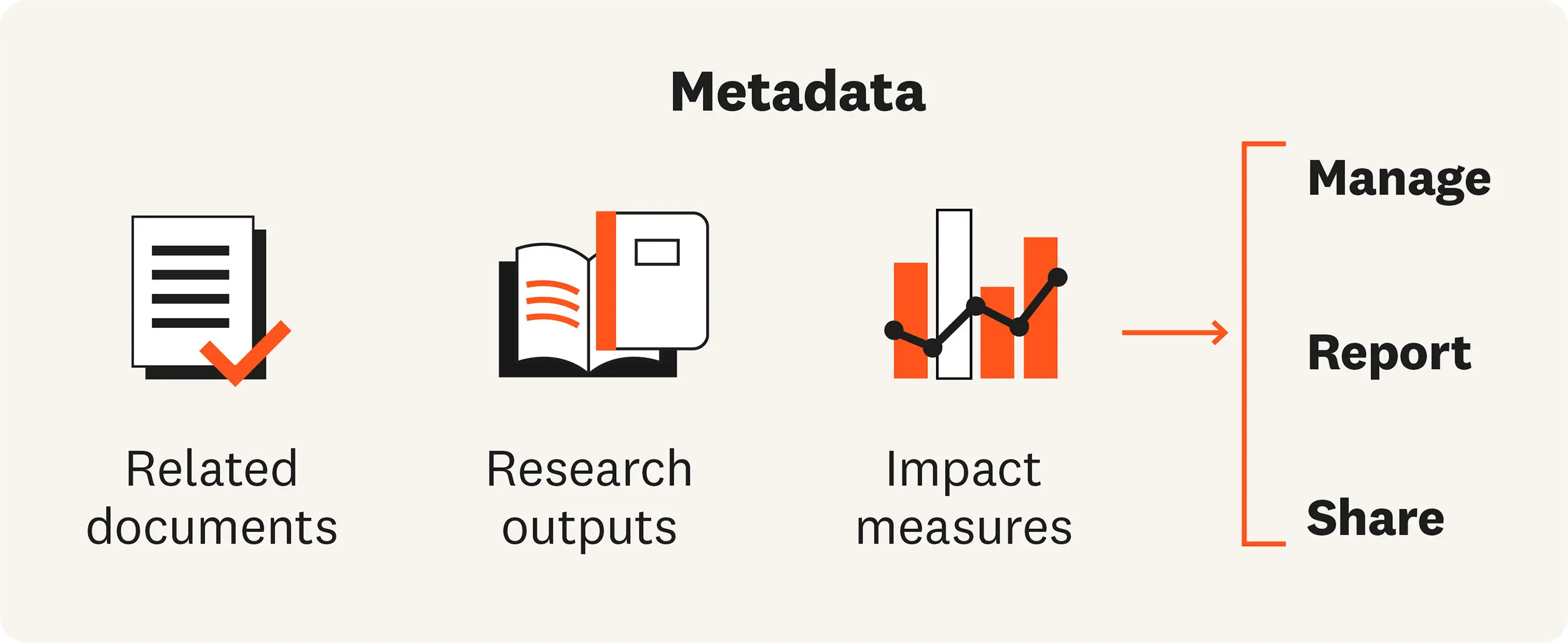
Research-related entities fall into three broad categories — research outputs, impact measures and related documents. Linking these elements together in an interoperable system enables universities to break down data silos and transition from fragmented, manual record-keeping to a unified, automated and strategic overview of their research enterprise.
Disconnected data sources with inconsistent identifiers can complicate research management, hinder timely decision making, and result in missed opportunities.
Connected and linked data with unique identifiers facilitates streamlined research management, simplified reporting processes and numerous additional benefits.
Transitioning from a landscape of disconnected systems and data to a connected, linked data environment within a unified system facilitates:
Informed decision making
Enhanced communication
Improved research performance
Increased collaboration
Increased visibility and impact
Improved compliance
Reduced administrative burden
In a disconnected environment, gaining a clear understanding of what is happening is challenging. Universities often rely on accessing multiple systems and managing complex spreadsheets and documents, hoping to piece together entities and data to form a coherent picture.
In this new connected world, universities can leverage accurate and timely information to make better-informed decisions. Many RIMS customers have reported a range of benefits they experienced following system implementation.

Wiebke Thormahlen, Director of Research, Royal Northern College of Music, on moving from manual spreadsheet-based compliance reporting to capturing the full scope of RNCM's research — grants, knowledge exchange, industry partnerships, and the non-standard artistic outputs that define a specialist conservatoire.
Why you need a Research Information Management System (RIMS)?
Download now opens in new tab/windowVisibility Enhance the global visibility of institutional research and researchers by showcasing dynamic researcher profiles on international platforms, highlighting their research output, expertise and impact.
Strategic decision-making Leverage comprehensive analytics to make informed strategic decisions regarding resource allocation and goal setting.
Collaboration Enhance your collaboration opportunities on an international scale by increasing visibility of your research, researchers, laboratories and equipment.
Societal impact Demonstrate your societal impact and highlight your contributions to the UN Sustainable Development Goals (SDGs).
Research management Expertly manage all facets of research administration using configurable communication and workflow tools.
Reporting Improve the accuracy, rapidity and cost-effectiveness of reporting for individual and academic program evaluations, funding applications, national performance assessments and global rankings submissions.
Performance Amplify researchers' efficiency and impact by providing access to top-tier resources along with advanced search and analytics tools.
Funding Discover new funding sources and collaboration opportunities to advance your research initiatives.
Open Science Foster open science practices and ensure compliance with relevant mandates and regulations.
Assessments Streamline faculty and program assessments.

The Confederation of Open Access Repositories (COAR) outlines how RIMS and institutional repositories (IR) differ.
Broad research activity vs. research outputs A RIMS focuses on all institutional activity around research. In comparison, an IR emphasizes research outputs.
Reporting vs. dissemination Since a RIMS collects comprehensive information about research activities, it can be used to describe or report on research. By contrast, an IR – originally designed to support the open access movement – aims to provide access to research publications and other outputs.
Internally vs. externally focused Because these systems were developed with alternative goals, RIMS typically serve as internally-focused tools, while IRs are generally externally-oriented. However, as both product categories mature, this is beginning to shift. Many RIMS now feature an externally accessible component, such as a public portal showcasing research outputs. Similarly, IRs are evolving to provide internal reporting capabilities.
In the white paper "Buy or build: An exploration of the total cost of ownership for a RIMS”, the research firm KnowledgeE looked at both one-time and ongoing costs.
KnowledgeE defined these costs as:
One-time costs | Annual operational costs |
|---|---|
• Software licensing • Implementation | • Infrastructure • Ongoing maintenance • Operations staff |
KnowledgeE found that the purchase of a commercial solution could provide a saving of more than 50%. RTI Internationalopens in new tab/window is an independent nonprofit research institute dedicated to improving the human condition. It was founded in 1958 as a collaboration between government, industry and three North Carolina Universities. This partnership necessitated multiple parties working in collaboration to achieve shared goals and make informed decisions.
RTI implemented the Elsevier Pure RIMS and found that transitioning from a DIY solution to Pure struck the ideal balance between system stability and customization.
Whether you decide to buy or build, our long-standing proficiency with RIMS implementations enables us to provide the following insights and best practises for ensuring a successful deployment.
Identify key players Identify the key individuals across the university essential for a successful RIMS implementation.
Choose the right technology Ensure that whatever platform you choose meets your current and anticipated future needs.
Understand the benefits Implementing a RIMS requires firm buy-in from stakeholders and key players. For success, it is essential that everyone understands the value of accurate and timely information and is committed to achieving this shared goal.
Rigorous project management Effective project management is crucial when implementing a RIMS, with risk management being a primary reason. Project managers must identify potential risks, develop strategies to mitigate them, and establish contingency plans to address any issues should they arise.
Training Changing established workflows and adopting a new system can be challenging, even when it simplifies employees’ tasks. Effective and timely training is essential for overcoming this hurdle. Developing a comprehensive training plan, securing stakeholder buy-in, and executing it effectively are critical factors for the project's success.
Plan for feedback Anticipating potential obstacles and maintaining open, transparent communication throughout the process will amplify the prospect of a successful deployment.
Ongoing support While the bulk of your resources will be dedicated to implementing your RIMS, ongoing support remains vital. This support includes both technical and user-centric assistance. Utilizing a vendor’s cloud solution can help reduce the technical support burden, while continuous vendor training, support websites, and FAQs also provide invaluable support.
Plan for growth After completing the initial implementation, it’s common for momentum to fade. There may be features that were not addressed initially or new functionalities released by the vendor, especially in commercial products. To ensure your RIMS remains effective and fully leveraged, plan for continuous improvement through ongoing projects that keep the system agile and current.
Plan for change Stakeholders, university initiatives and reporting requirements are continually evolving. Since a RIMS serves as the foundation for many reporting and operational processes, these changes will demand a flexible and agile approach to addressing them.
The following resources provide extended coverage of RIMS evaluation, acquisition and implementation, including:
What are Research Information Management Systemsopens in new tab/window (Association of College and Research Libraries)
You can explore Elsevier’s RIMS, Pure, here.
CRIS — Current Research Information System — is a term widely used in Europe and aligned with international standards such as CERIF. RIMS — Research Information Management System — is a broader term more commonly used in North America. In practice, both describe the same type of platform: a system that centralizes and manages an institution's research information. Whether referred to as a RIMS or a CRIS, the core purpose is identical — to aggregate, quality-assure, and leverage research data for reporting, compliance and strategic decision-making.
An institutional repository is primarily a storage and preservation system for research outputs, typically full-text publications and datasets. A RIMS is a far broader platform that manages the full research lifecycle: people, projects, funding, outputs, and impact. While a RIMS can integrate with or include repository functionality, it goes much further, connecting data across the institution, enabling compliance workflows, powering reporting and driving a public-facing research portal. Many institutions use both: a RIMS as their system of record and a repository for long-term content preservation.
In many institutions research data is hosted across multiple disconnected systems — HR, finance, publication databases and more. Without a RIMS, this information is often incomplete, duplicated, and difficult to use. A RIMS combines everything in a single authoritative source, enabling institutions to report accurately on research activity, demonstrate impact to funders and government bodies, meet open access and compliance mandates and reduce the administrative burden on researchers. As funding competition intensifies and reporting requirements grow more complex, a RIMS has become essential infrastructure for research-active universities.
No, a quality Research Information Management System (RIMS) provides essential support for AI. Many universities and research institutions are building AI systems to tackle local challenges and counter security risks like hallucinations, bias or threats to data privacy. However, even the best AI system will be compromised if it is not trained on consistent, high-quality data. A RIMS helps institutions create a source of centralized, standardized and secure data. Without making "legacy" research content coherent, institutions may struggle to realize the full potential of AI.
Institutional AI tools are only as reliable as the data they’re built on. Pure gives institutions a structured, quality-assured foundation — publications, funding, projects, and researcher profiles — that AI systems can draw on without the hallucination risk that comes from fragmented or inconsistent inputs. Pure’s REST API lets AI platforms access and write institutional research data in real time, supporting use cases from automated impact reporting to AI-assisted research strategy.