
See the difference Pure can make for your institution

Unfortunately we don't fully support your browser. If you have the option to, please upgrade to a newer version or use Mozilla Firefox, Microsoft Edge, Google Chrome, or Safari 14 or newer. If you are unable to, and need support, please send us your feedback.
Discover how Elsevier's Pure RIMS drives university digital transformation with integrated research management, data security, and smarter decision-making.

Elsevier’s Pure is a leading Research Information Management System (RIMS) that enables academic, corporate and government institutions to collect, manage and showcase their research activities. It acts as a secure, centralized source for tracking research outputs, researcher profiles, projects and datasets to facilitate reporting, compliance (e.g., open access) and performance analysis. As such, Pure can make a key contribution to a university’s digital transformation strategy, helping to support what a seminal Educase Review articleopens in new tab/window describes as the “deep and coordinated culture, workforce and technology shifts that enable new educational and operating models.” In a very direct way, Pure drives the shift from disconnected, manual processes to an integrated, digital-first approach, connecting research information and content, reducing administrative burden and providing reliable data to support strategic decision-making.
While self-built RIMS can often struggle to combine safeguarding and managing internal data and external functions like showcasing research, Pure deftly handles this crossroads, maintaining smooth user workflows and avoiding security risks. Alaa AlSaleh of the Kuwait Foundation for the Advancement of Sciencesopens in new tab/window (KFAS), which sits at the nexus of researchers and academia, governments and corporations, has highlighted this interchangeopens in new tab/window: “Digital Transformation is really important, whether it is aligning our internal systems with the Pure system or those of our external stakeholders. As a funding agency, we have to do a lot of work getting data from external institutions, so unifying our systems makes it easier for everyone.” This capacity to work fluently in conjunction with other systems has also been emphasized by Eoin Kilfeather of TU Dublinopens in new tab/window. Highlighting Pure’s “really great scope for integrationopens in new tab/window,” he noted that, “its API offering is so much further ahead than anything else we see. That’s a commitment Elsevier has made to this extensibility and transparency of data — it’s your data and you can get it out.”

Benefit | Explanation |
|---|---|
One platform | Pure combines information from disparate sources on one easy-to-use platform, creating a holistic view of an institution’s research activities. |
Automated data management | Pure reduces administrative workload by automating data integration, validation and reporting, a key component of operational digital transformation. |
Support for strategic decision making | Pure provides actionable data to inform research strategy, funding and collaboration through real-time dashboards and analytics. |
Showcasing research impact | Pure helps build public-facing, searchable portals that enhance an institution’s visibility and enable it to demonstrate academic and real-world impact to stakeholders. |
Research workflow improvement | Features like Pure Award Management help users to navigate the full research lifecycle, from finding opportunities to managing grants, aligning with digital transformation objectives for research operations. |
Integration with institutional IT infrastructure | Pure integrates with existing systems to break down data silos, a critical aspect of digital maturity in higher education. |
Kilfeather’s word “extensibility” means “the ability to be extended or stretched,” although a computer specialist might understand the term as “the quality of being designed to allow the addition of new capabilities or functionality.” In a way, these two definitions capture different aspects of Pure – the system’s technical versatility as a RIMS and its broader role as a foundational tool in a digital transformation strategy. But where exactly does it fit in at the university level?
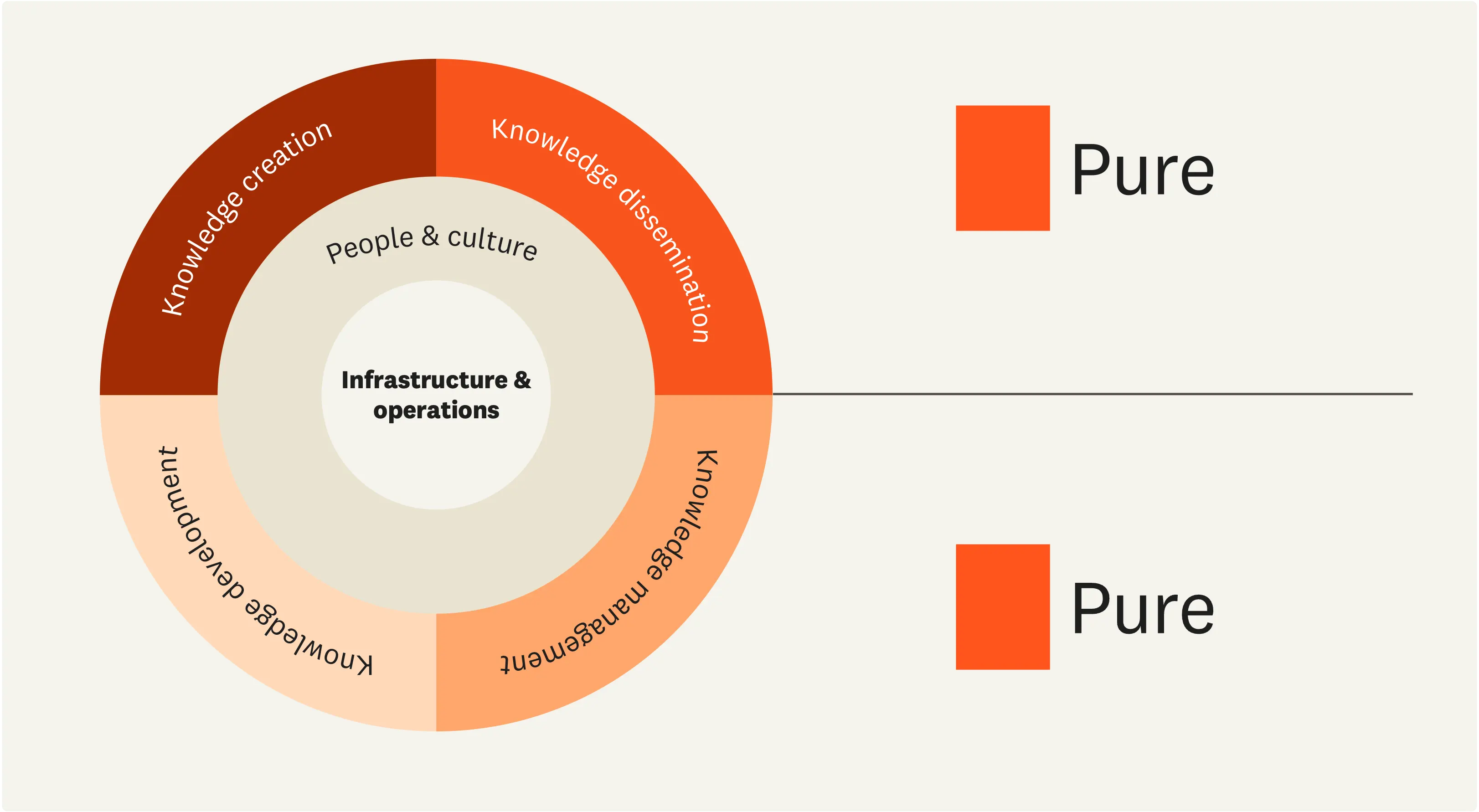
Note: this diagram is freely adapted from the visualization contained in the JISC Digital Transformation Toolkit hereopens in new tab/window
Above is a simplified overview of some of the key elements of a university’s digital transformation, with Pure highlighted in the Knowledge Dissemination and Knowledge Management quadrants. Knowledge Dissemination concerns tracking the impact of institutional research outputs across the research community and society, as well as how a university showcases its research and its impact on the world. Knowledge Management encompasses effective data analysis and management to support decision-making across research strategy, collaboration, funding and recruitment. Although Pure does not cover all the jobs to be done in these sectors – the first might also include institutional repositories or bibliometric databases, while the second could feature more specialized research analytics platforms – a RIMS can provide the vital connective tissue between all these elements. Indeed, Pure interfaces fluently with an enormous range of internal (HR systems, financial systems, authentication systems) and external (databases, identifier services, patent offices, repositories, metrics, reporting systems) systems.

Security has been described as “the cornerstone of the digital transformationopens in new tab/window” and underpins all the areas highlighted above. If anything, this is an understatement — the rise of digital transformation and the rise of cybercrime are directly related and even positively correlated (see, for example, this study from Chinaopens in new tab/window). In other words, as digital transformation becomes more widespread, so does the scope and sophistication of its “evil twin.” For both research institutions and corporations, transformation increases risks by increasing the number of potential entry points an unauthorized user can exploit to access a system, especially through the adoption of cloud computing.
At the same time, the speed of innovation in areas like AI constantly threatens to outpace security provision. This is especially true at data-rich universities where resources are often limited, legacy and shadow ITopens in new tab/window systems abound, and where an open, decentralized culture creates peculiar vulnerabilities. The education sector is among the most frequently targeted by cyberattacks, with over 90% of universities in the UKopens in new tab/window reporting a breach or attack in 2025, according to a government survey. The consequences of these crimes can be profound, including the theft of sensitive data, operational shutdowns, financial losses and reputational damage.
Therefore, any system playing a central role in a digital transformation strategy must have robust security credentials. There follows a brief summary of how Pure handles the related areas of data privacy, knowledge security and cybersecurity (more detailed information is available here):
Data privacy — the proper handling, processing, storage and use of personal information. Elsevier maintains and secures the infrastructure for Pure, including the data it stores. Customers upload and maintain their own data within the system and benefit from its features and functionality. Crucially, customers always retain ownership and control of their data, being free to extract it whenever they like. All personal data handling is conducted in line with Elsevier’s public Privacy Principles.
Knowledge security — the protection of sensitive knowledge from unauthorized transfer or interference that might compromise national security, economic competitiveness, or academic freedom. To safeguard against this risk, customer data uploaded to Pure always resides in the geographical location agreed with the customer and documented in the contract. This will usually be in whichever of our regional data centers is closest to a customer’s location.
Cybersecurity — the practice of defending critical systems, data and networks against digital attacks, unauthorized access, or disruption. Pure is ISO/IEC 27001opens in new tab/window and ISO/IEC 27701opens in new tab/window certified, while third partiesopens in new tab/window audit our compliance with these standards. We apply a range of security measures to protect our customers’ data, including encryption technologies that render data unreadable to unauthorized users, network security technologies to identify and prevent unwanted traffic, and physical security at our data hosting locations.

Pure can be a foundational component of any institution’s digital transformation strategy, but how resilient will the system be in the face of rapid change in the higher education sector? To answer this question, we must take a brief glance at what the future of digital transformation might look like. Based on current trendsopens in new tab/window, progress will likely lead to more operational complexity, cultural stress and a corresponding rise in cybercrime. What universities hope to get in return, besides long-term savings of time and resources, depends on the area under consideration.
In Infrastructure and operations, the emphasis is firmly on modernization and operational efficiency, with futurologists talking of smart campuses and an Internet of Things (IoT) infrastructure. Sustainability will remain a priority, while it is hoped that the adoption of more autonomous agentic AI will streamline administration, handling low-stakes decision-making or managing complex processes.
In People and culture, technology is already redefining the roles and expectations of academics, staff and students. As in society, we can probably expect a bumpy ride, but the pay-off could be more streamlined processes and the breakdown of departmental silos, making the university more agile, accessible and collaborative.
In Knowledge creation, universities hope to increase research outputs by streamlining workflows through the introduction of AI tools. In some Western countries, geopolitical tensions have led to limitations on the range of international collaborationopens in new tab/window, meaning technological support in this area could become more significant.
In Knowledge development, the focus is squarely on improving the student experience. Student enrollments are falling in many countries, leading to revenue shortfalls. Consequently, institutions are looking at using AI-powered chatbots and predictive analytics to create customized learning paths, facilitate more flexible course structures, and improve student support services.
In Knowledge management, the emphasis remains on breaking down information silos, facilitating 24/7 information access and moving to data-driven strategic decision-making. Some major research nations (like the USopens in new tab/window) have seen a steady decline in government funding, while funding from industry remains difficult for many universities to source, so analysing existing grant data and locating new opportunities is increasingly important.
A key theme in Knowledge dissemination is the growing need for universities to demonstrate the real-world (societal, economic, health) impact of their research outputs. The immediate catalyst for this is pressure from government funders, eager to show a clear return on taxpayers’ money, but there are also larger issues around universities’ accountability to society. Thinking around University 4.0 ecosystemsopens in new tab/window posits impact through collaboration with industrial partners, while focusing on regional growth and sustainability.
As the political and economic floodwaters rise, a quality RIMS can form a secure and highly integrated part of a university’s digital estate, centralizing information and supporting the data-driven decision-making crucial to its ongoing success. Many of the key use cases Pure supports directly address some of the most significant challenges currently facing the higher education sector: fundingopens in new tab/window, collaboration and real-world impactopens in new tab/window. Underlying these, however, are a set of principles — optimizing the power latent in existing information, organizational transparency, mediating securely between internal and external stakeholders — that are also liable to be central to the new relationship higher education is working to build with society. Viewed in this way, Pure is not simply a key piece of IT infrastructure, or even just a highly powerful tool, but a statement of strategic intent. Digital transformation will be critical to the long-term survival and relevance of universities and Pure is positioned right at its heart.
Pure creates a single authoritative source for all research information. By eliminating manual data reconciliation, automating compliance workflows, and surfacing research intelligence through dashboards and reporting tools, Pure frees institutional capacity for strategic work rather than administrative overhead. For institutions embarking on digital transformation, Pure is a foundational investment — because reliable, centralized research data is the prerequisite for many other digital capabilities, including AI systems.
Compliance requirements in research — open access mandates, national assessment frameworks, funder reporting standards — change regularly and often at short notice. Pure is continuously developed to reflect these changes; updates to support requirements like the UK REF2029, Plan S, and evolving ORCID standards are delivered as part of the platform rather than requiring custom development. This means institutions avoid the compounding technical debt that in-house or legacy systems accumulate as the regulatory landscape shifts, and can respond to new requirements without disrupting existing operations.
Pure integrates with the full range of systems a research institution relies on — institutional (HR, finance, student records), global bibliometric databases (Scopus, Web of Science, PubMed, Dimensions), researcher identity infrastructure (ORCID, ResearcherID), funding databases, and open access infrastructure. It exposes a REST API and supports standards-based data exchange, enabling connection with adjacent platforms including electronic lab notebooks, grant management systems, and institutional repositories. This interoperability means Pure functions as a hub rather than a silo — strengthening the value of every connected system rather than replacing them.
Pure is a cloud-hosted platform, so there is no on-premise infrastructure to deploy. Implementation is structured around a dedicated onboarding program covering data migration support, configuration, integration setup with existing institutional systems, and user training. Timelines vary depending on institutional complexity and the number of system integrations required, but Elsevier's implementation team works to a structured project plan with defined milestones. Many institutions run Pure alongside legacy processes during transition to minimize disruption to researchers and administrative staff. Elsevier also provides ongoing customer success support post-launch.
Elsevier provides structured data migration support as part of the Pure onboarding process. This includes guidance on data extraction from legacy systems, mapping existing data structures to Pure's data model and validation to ensure data integrity post-migration. For institutions with large volumes of historical research records — publications, grants, researcher profiles — Pure's automated data enrichment can supplement migration by pulling validated records from external sources such as Scopus and ORCID, significantly reducing the burden of retrospective data entry. Throughout the process, data remains under the institution's full ownership and control.