
7th International Conference on Applied Surface Science
1-4 June 2026 │ Grand Mercure Chengdu East, Chengdu, China
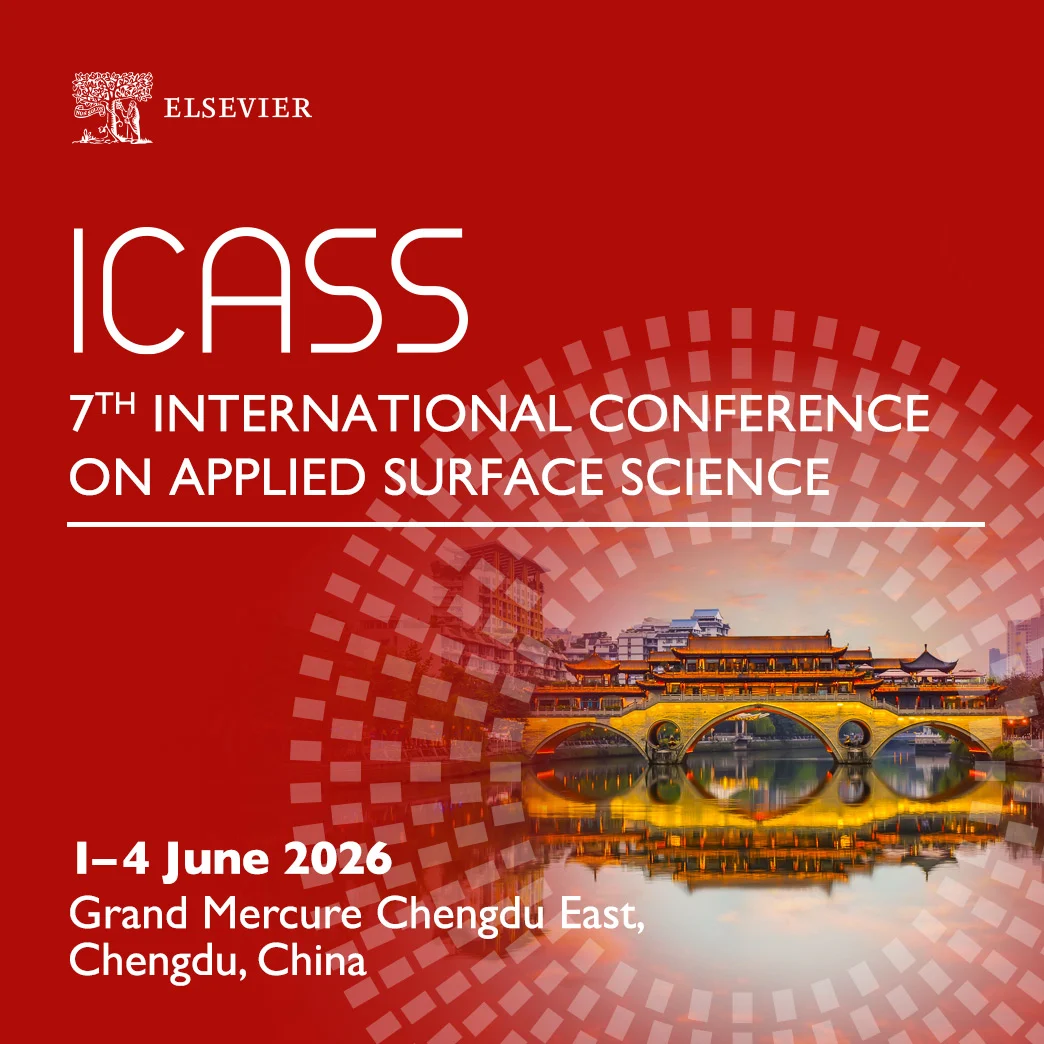
7th International Conference on Applied Surface Science
The conference is organized by the journal Applied Surface Scienceopens in new tab/window and will provide a forum for researchers in all areas of applied surface science to present their work.
ICASS will report on and discuss current research on the role and use of surfaces in chemical and physical processes, related to catalysis, electrochemistry, energy, new/functional materials and nanotechnology. Also, the various techniques and characterization methods will be discussed. There will also be opportunity to participate in workshops specially focused on early- and mid-career researchers. These workshops will be free of charge and take place in the afternoon prior to the beginning of the conference.
ICASS 2026 will host a Young Scientists Development Session during the conference. The purpose is to encourage talented young scientists to present their research in an effective and efficient manner and improve their professionalism for future positions in the academic and/or business fields. The session committee will provide constructive feedback to the selected presenters, and the presenters will also have the chance to be selected with Best Oral Presentation Award.
This is a significant opportunity for you to hear from leading scientists in the area and to network with colleagues in industry and academia to ensure you keep abreast of recent developments in this fast-evolving field.
There will be a Virtual Special Issue associated with the ICASS 2026 conference published in Applied Surface Science.
Workshops
On the afternoon of the first day of the conference, prior to its official commencement, four workshops will be presented by editors from the Applied Surface Science journal. The topics include current issues in surface science such as nano-tribology, nanomechanical testing, DFT calculations, and a session on scientific paper writing. These workshops are intended for graduate students and early-career researchers and are offered free of charge.
Workshop 1: Density Functional Theory & Simulation Modelling for Experimentalists, 10:30-13:00
Workshop 2: Nanomechanical Testing of Thin Films: From Fundamentals to Advanced Techniques, 10:30-13:00
Workshop 3: Generative AI in scientific writing and scholarly publishing, 14:00-16:30
Workshop 4: Tribology: from macroscale to nanoscale, 14:00-16:30
Full details below.
Workshop 1: Density Functional Theory & Simulation Modelling for Experimentalists, 10:30-13:00
Coordinated by: Prof. dr. Alfredo Juan, Departamento de Fisica and IFISUR, Universidad Nacional del Sur (UNS) & CONICET, Bahia Blanca, Argentina
This workshop on theoretical calculations and molecular modelling is intended for experimentalists in the field of surface science. The most frequently used theoretical methods in the discipline will be presented, including those based on density functional theory (DFT), Molecular Dynamics (MD) and the application of modern artificial intelligence (AI) techniques.
The emphasis of the workshop will be the conceptual understanding of the computational techniques, without going into details of theoretical or numerical implementation.
The main motivation is that an experimentalist can know the limits of the simulations and what data are essential to build a realistic model that can answer some of the unresolved questions or in situations where the experimental measurement still leaves unanswered questions. It is intended that they can dialogue with theoretical groups to develop joint work and have analysis elements to understand how adsorption and reaction geometries, surface chemical bonding, electronic structure, vibration frequencies and various calculated physical and chemical properties are obtained. Specific cases of application of theoretical calculations in the simulation and interpretation of results of ultra-high vacuum (UHV), thermal, magnetic and optical spectroscopic techniques will also be presented.
Workshop 2: Nanomechanical Testing of Thin Films: From Fundamentals to Advanced Techniques, 10:30-13:00
Presented by Dr. Rainer Hahn, Institute of Materials Science and Technology, Technische Universität Wienopens in new tab/window, Austria and Prof. dr. Alejandro Borroto Ramírez, GREMI, Université d'Orléansopens in new tab/window, France
This workshop provides a comprehensive introduction to nanomechanical testing methods with a focus on thin film materials. The first part will cover the fundamentals of instrumented nanoindentation, including measurement principles, data interpretation, and strategies to avoid common pitfalls when testing coatings and thin films. Building on these foundations, the second part will introduce advanced micromechanical approaches, such as micropillar compression, microcantilever bending, high-temperature nanoindentation, and AFM-based nanomechanical measurements. The workshop is designed to give both newcomers and experienced users practical insights into best practices and recent developments in the field.
Workshop 3: Generative AI in scientific writing and scholarly publishing, 14:00-16:30
Coordinated by: Franca Driessen, Publisher, Elsevier
Generative artificial intelligence (GenAI) has a growing impact on scientific writing and scholarly publishing. Participants will learn how Large Language Models (LLMs) can be used responsibly in research, aiding tasks such as manuscript drafting, language improvement, literature discovery, and peer review support. The session highlights both the benefits—such as increased efficiency, accessibility, and new research insights—and the challenges, including accuracy issues, ethical concerns, bias, and confidentiality. Attendees will be informed of current policies and best practices for responsible GenAI use, emphasizing the need for transparency and human oversight. Additionally, the workshop introduces Elsevier’s AI-powered tools that enhance research efficiency. This concise session equips researchers with practical knowledge to responsibly integrate GenAI technologies into scholarly communication.
Workshop 4: Tribology: from macroscale to nanoscale, 14:00-16:30
Prof. Dr. Carlos A. Figueroa - UCS (Brazil) Prof. Dr. Mario G. Sandoval - UNS (Argentina)
Tribology is an applied science that studies phenomena such as friction, wear, adhesion and lubrification, which are related to surface and interface events. One singularity of tribology is its multiscale range of operability. In this workshop, we will show the fundamentals for macrotribology, microtribology and nanotribology involving theory, experiments and computational simulations. Physical laws and chemical insights can be used to understand tribology, in particular friction forces and wear at multiscale. Moreover, adhesion of coatings can be predicted by Hertzian contact theory (microscale) and quantum computational simulations (nanoscale). Also, several technological applications will be introduced and discussed. Finally, a current frontier of knowledge in tribology is the active control of friction and/or wear. Generally, a tribological configuration of surface materials can be easily fixed, however, it is difficult to modify this configuration after technological implementation. The external and intelligent control of tribological parameters as friction in solid and liquid media may allow the modification of the friction forces during technological applications. Recently, electric and magnetic fields as well as light could be used to tune friction at the nanoscale.
Consequently, the objective of this workshop is to provide the fundamentals and applications of tribology at multiscale for undergraduate and graduate students and early career researchers.
Conference topics
Surface science of catalysis, electrocatalysis and photocatalysis
Surface engineering and functionalization
Functional surfaces and coatings
Surface science applied to energy conversion and storage
Surface nanotechnology and devices
Biointerfaces
Electrochemistry at surfaces and interfaces
Advances in surface characterization tools
Environmentally-friendly materials
Semiconductors – surface and interface
2D layered materials and assembling
Virtual special issue
There will be a Virtual Special Issue associated with the ICASS 2026 conference published in Applied Surface Science. The virtual part means that paper will be published as soon as they have been accepted and not wait for a complete issue. Only work accepted and presented at the conference and with at least one participant from the conference as a co-author, will be considered for the virtual special issue. All the submissions will go through the same rigorous peer-review process as all other submissions to the journal. The submission portal for the special issue will open a little closer to the date of the conference. Presenters will be informed when the submission portal is open and ready to receive your submission – this will be as soon as possible after the conference has concluded.
Conference deadlines
Abstract submission deadline - still accepting late abstracts
Author registration/Early bird deadline - 27th March 2026
Special Issue
There will be a Virtual Special Issue associated with the ICASS 2026 conference published in Applied Surface Science. The virtual part means that paper will be published as soon as they have been accepted and not wait for a complete issue. Only work accepted and presented at the conference and with at least one participant from the conference as a co-author, will be considered for the virtual special issue. All the submissions will go through the same rigorous peer-review process as all other submissions to the journal. The submission portal for the special issue will open a little closer to the date of the conference. Presenters will be informed when the submission portal is open and ready to receive your submission – this will be as soon as possible after the conference has concluded.
Organizers
This conference is organized by Elsevier.
Co-organizer
School of Chemistry and Materials Science, University of Science and Technology of China

State Key Laboratory of Precision and Intelligent Chemistry

Institute of Fundamental and Frontier Sciences, University Of Electronic Science and Technology of China

Supporting publication
Conference history
ICASS 2024 – 6thInternational Conference on Applied Surface Science 17-20 June 2024 | Wuzhen, Zhejiang, China 186 oral and 196 poster presentations. 433 participants from 29 countries. 2 exhibitors Oral programopens in new tab/window | Poster programopens in new tab/window
ICASS 2022 – 5th International Conference on Applied Surface Science 25-28 April 2022 | Palma, Mallorca, Spain 118 oral and 191 poster presentations. 306 participants from 45 countries. 1 exhibitor Oral programopens in new tab/window | Poster programopens in new tab/window
ICASS 2021 – 4th International Conference on Applied Surface Science 29-30 June 2021 | Online – Live and on-demand 24 oral and 69 poster presentations. 156 participants from 41 countries. 1 exhibitor Oral programopens in new tab/window | Poster programopens in new tab/window
ICASS 2019 – 3rd International Conference on Applied Surface Science 17-20 June 2019 | Pisa, Italy 188 oral and 321 poster presentations. 483 participants from 51 countries. 5 exhibitors Oral programopens in new tab/window | Poster programopens in new tab/window
ICASS 2017 – 2nd International Conference on Applied Surface Science 12-15 June 2017 | Dalian, China 123 oral and 210 poster presentations. 324 participants from 33 countries. 9 exhibitors Oral programopens in new tab/window | Poster programopens in new tab/window
ICASS 2015 | 1st International Conference on Applied Surface Science 27-30 July 2015 | Shanghai, China 192 oral and 160 poster presentations. 389 participants from 33 countries. 4 exhibitors Oral programopens in new tab/window | Poster programopens in new tab/window