
Reviewers' Update - information for reviewers about relevant Elsevier and industry developments, support and training.

Unfortunately we don't fully support your browser. If you have the option to, please upgrade to a newer version or use Mozilla Firefox, Microsoft Edge, Google Chrome, or Safari 14 or newer. If you are unable to, and need support, please send us your feedback.
September 14, 2026
|
4 min read
By Lipsa Panda

Peer review has always involved an exchange of judgment between reviewers, authors and editors. It has evolved from paper correspondence to email and online submission systems, with each step making the exchange faster and more accessible.
As the process moved online, reviewer comments, author responses and supporting files typically still sat on separate screens. Editors and reviewers needed to piece the discussion together from different places to understand how a reviewer suggestion, response and decision connected.
Today, Elsevier is using the latest technology to take that further, making it easier for reviewers to work effectively, helping authors better understand and act on the feedback they receive, and supporting editors in making informed decisions with greater clarity. The aim is to strengthen peer review while preserving the trust, quality and expert judgment at its centre.
For reviewers across thousands of Elsevier journals, including a growing number of Society-owned titles, our new peer review experience is designed to make feedback clearer and easier to follow .
Reviewer comments and author responses can now be assessed together, allowing the discussion around a manuscript to be understood in context rather than reconstructed across separate files and screens. Editors can follow the reasoning that connects a reviewer’s input with the author’s response, helping them consider the exchange in context when making their decision.
Sabir Ed-Dayabopens in new tab/window, Product Manager of the new peer review experience explains the design choice: “We wanted the review to read like a natural conversation, with the reviewer’s comments and the author’s responses presented together. This approach promotes a clearer flow of contextual information and provides the editors everything they need to make informed decisions.”

Sabir Ed-Dayab, Product Manager
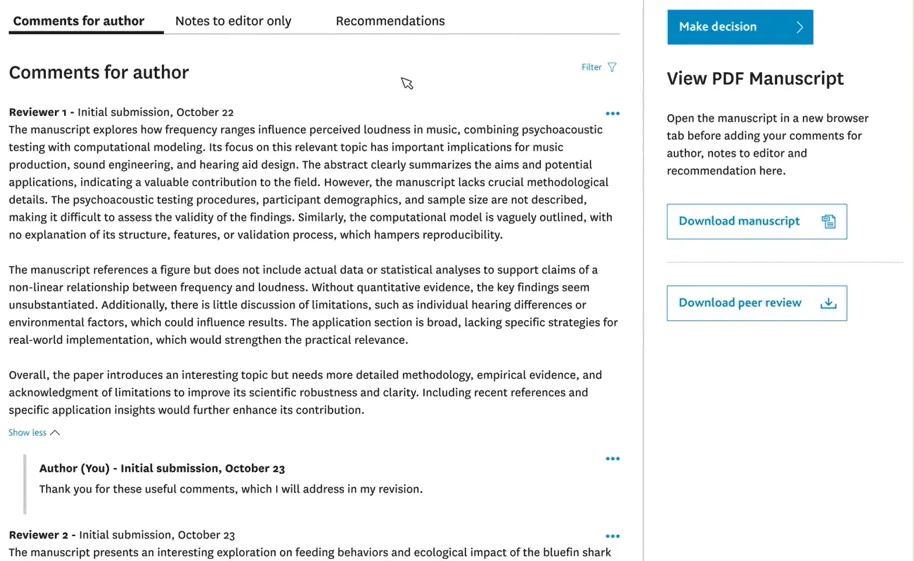
The reviewer view showing comments and author responses together in one interface
Reviewers still submit their assessments independently; what changes is where the exchange lives, now in one place instead of several. Reviewers are already seeing the benefit. Alok Singh, a senior researcher who reviewed using the new experience, described it as “a very refreshing look, cleared of all the clutter.”
The new peer review experience keeps the process online while recognizing that reviewers work in different ways. Some referees enter comments directly as they read, while others prepare notes, annotate figures or formulae, or develop detailed suggestions in a separate document.
To support feedback that is difficult to capture in plain text, reviewers can now upload files alongside their online comments. "In response to reviewer feedback, we designed the experience to accommodate how reviewers fit peer reviews into their busy schedules, rather than prescribe a specific approach," explains Sabir.
Structured Review Guidanceopens in new tab/window also provides prompts outlining key considerations for those new to peer review, while allowing experienced reviewers to continue working in the way that suits them best. Together, these options make the process clearer and more flexible without requiring every reviewer to follow precisely the same process.
Reviewers have rated the new experience on a standard measure of usability and usefulnessopens in new tab/window. Across 1,700+ journals and 56K+ responses, the score stands at 86%. That points to an encouraging early reception: the new experience is clearer to follow and gives reviewers more room to concentrate on the research. Their comments help illustrate why.
"It was easy to navigate and use, which allowed me to focus on the manuscript and complete a quality review efficiently," said Danijela Tekić, a reviewer for Food Chemistry:
For Edwin E. Ngowi, Associate Professor at Sokoine University of Agriculture in Tanzania, the experience made the task more inviting. He called it a thoughtful upgrade that, in his words, “respects my time and makes me actually want to engage with the review.”
Ken Winters, Senior Scientist at the Oregon Research Institute, said the new experience had made an already reviewer-friendly editorial system even more so.
Peer review has taken many shapes, from a letter in the post to the shared screen, and it will continue to evolve as technology does. Reviewers’ questions show growing interest in how newer tools using generative AI might support their work, for example. As Laura Schmidtopens in new tab/window, Senior Director, Publishing Experience at Elsevier notes: “We will continue to work closely with the research community to explore how AI and technology can make peer review more efficient, while ensuring reviewers and their unique expertise remain at the heart of the process.”
Whatever comes next, we will keep bringing the best of new technology to the peer review experience while ensuring the vital human element, the reviewer's expertise, insight and judgment, stays front and centre. For now, we hope the new experience gives you a clearer place to work, and, as ever, tell us what would helpopens in new tab/window as we continue the centuries-old conversation of peer review.

Laura Schmidt, Senior Director, Publishing Experience
This piece is part of our Researcher Voices program, which spotlights researchers' work, perspectives, and experiences.
