
What the new submission experience means for your journal's authors
September 17, 2026
|
5 min read
By Lipsa Panda

For many researchers, their first direct experience with a journal is the moment they submit to it. Submitting a manuscript can involve lengthy administrative work, from reformatting a paper to meet different journal’s requirements to answering the same questions more than once. That burden matters at a time when only 45% of researchers say they have sufficient time for research, according to Elsevier’s 2025 Researcher of the Future survey report.
Long before a decision arrives, the submission process signals how much a journal values authors' time. For a society journal, that first impression can shape confidence in the journal, reflect on the society behind it, and influence whether authors choose to return.
Editorial Manager's new submission experience is now live for more than 1,600 journals published by Elsevier and is reaching more every month. More than 300 of those are society-owned titles, whose authors are already describing what the change feels like in practice.
A faster, simpler submission for your authors
The new experience guides authors through submission step by step, asking only for the information that is relevant at each stage. Key details such as the title, abstract, and keywords are still drawn automatically from the manuscript file, now with greater accuracy, so authors spend less time correcting what the system reads.
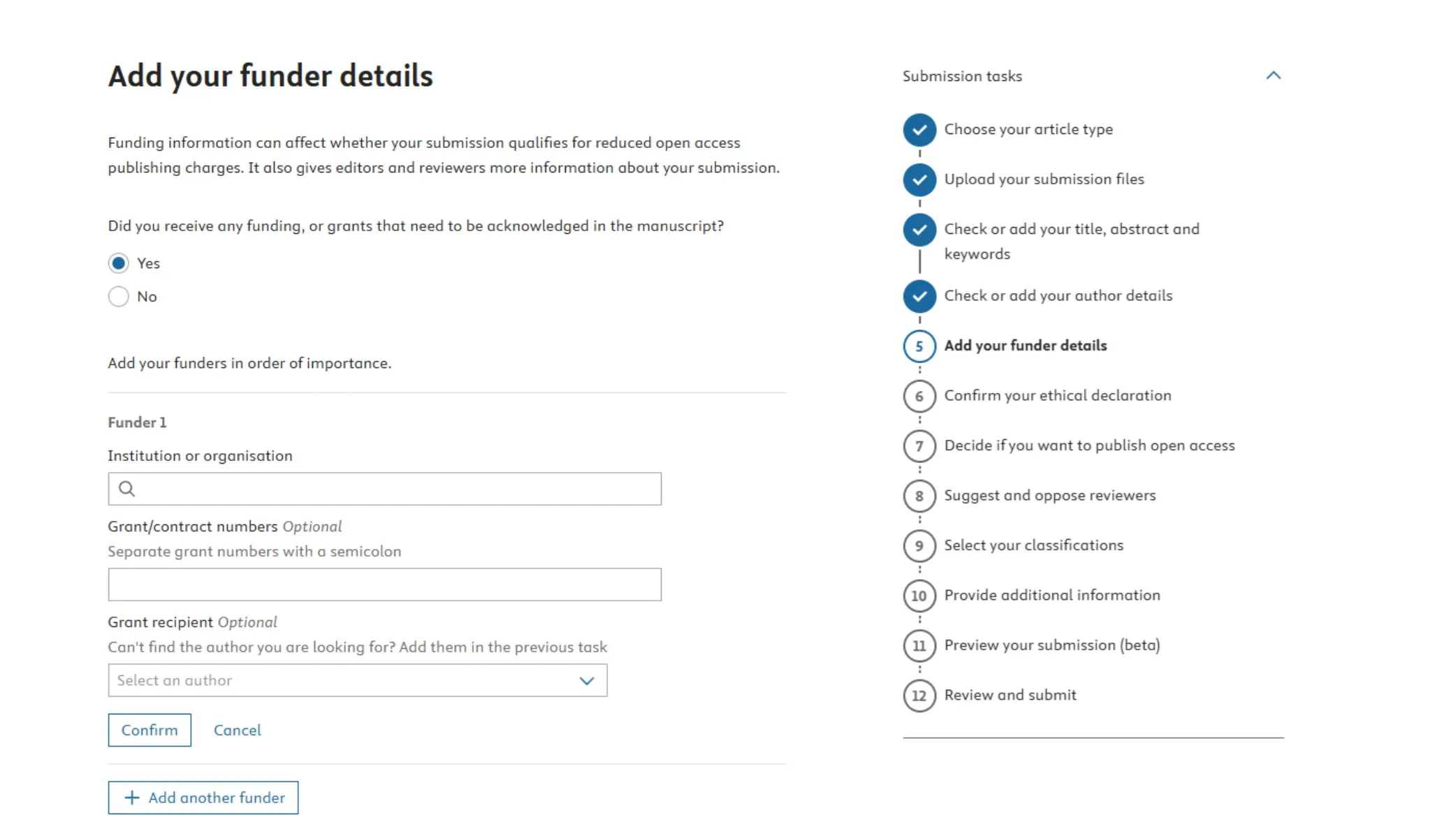
The new submission interface showing the step-by-step task list
The experience also includes a new ethics declaration tool. When a journal requires an ethical declaration, authors answer a short series of guided questions; the declaration is then generated, attached to the submission, visible in the manuscript PDF, and available for publication with the final article.
Authors are noticing the difference early . Dr V. Harinath, Associate Professor and an author in Solar Energy , the official journal of the International Solar Energy Societyopens in new tab/window, described his first impression of the interface as "well-organized, and easy to navigate through each stage of the manuscript submission process," adding that "the step-by-step guidance minimizes confusion, making the submission experience smoother."
Data show that the time saved is significant. On average, submission now takes around a third of the time it once did, falling from 88 minutes to 33 . Authors give the new interface an average score of 88.6% for usability and usefulness, indicating they find a process both easy to use and helpful.
For Arnold Frisby of the University of Pretoria, an author in the South African Journal of Botany , the official journal of the South African Association of Botanists,opens in new tab/window the gain was practical: "The new system saved time and reduced the possibility of accidentally excluding an important document for submission. It was fantastic and easy to use."
For authors, those gains are immediate. For editors, the same guided process also improves what arrives at the journal.
More complete submissions for your editors
Because the new submission experience prompts for exactly what each journal needs, submissions arrive more complete and better aligned with the journal's Guide for Authors requirements. For editors, that can mean less time spent chasing missing elements and a cleaner starting point for editorial assessment.
Professor Leonidas Kyriakides , Editor-in-Chief of Studies in Educational Evaluationopens in new tab/window, sees the longer-term value for the journal itself: "Fewer errors will occur during the submission process, facilitating a smoother editorial assessment. Over time, this could improve author satisfaction. A consistent and intuitive submission system can strengthen authors' trust in the process and may encourage future submissions to our journal."
For a society journal, where editorial quality and author confidence shape reputation, that is a meaningful gain.
What is changing, and what is not
Making submission simpler means deciding what a journal needs from authors at initial submission, and what can reasonably wait until revision. Formatting requirements that are not needed for an initial editorial decision, such as prescribed line spacing and line or page numbering, are being eased, so authors have more freedom in how they prepare a submission. This affects submission only, not how the final article appears once published.
The same thinking applies to the questions an author must answer. Questions that are no longer necessary are removed, while others are deferred until revision rather than required at first submission.
At the same time, requirements that protect the integrity of what you publish are clearer and more prominent. A dedicated declaration workflow takes authors through competing interests, ethical approvals, patient consent, and clinical trial registration, supporting more reliable checks at submission.
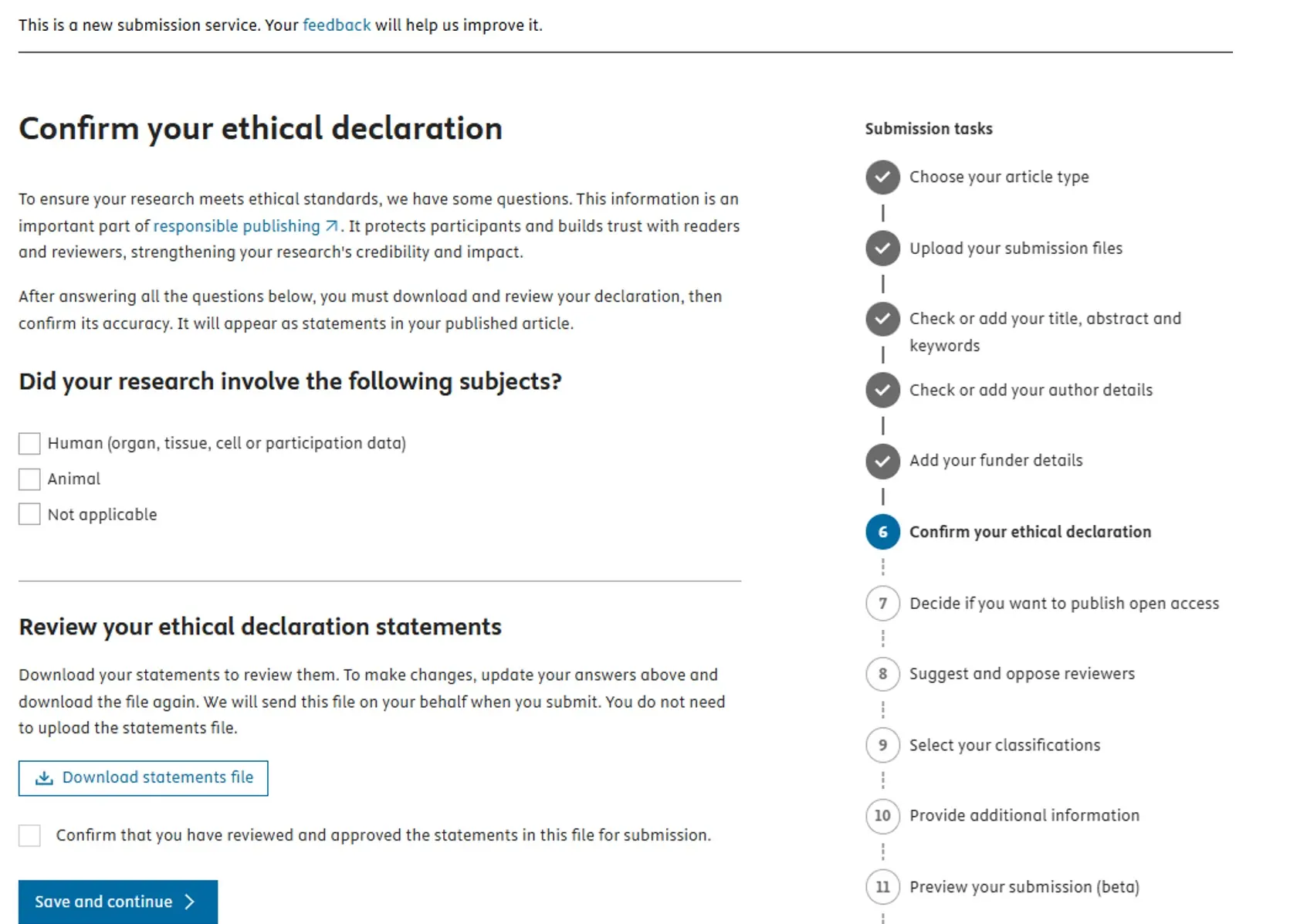
The declarations step, showing how authors are guided through ethics and compliance questions
Reaching more journals
As the rollout continues, authors will encounter a more consistent process across the titles they submit to. For societies publishing more than one journal, this may be especially practical: authors submitting across your titles experience the same process each time, which also supports smoother article transfer between journals.
If your journal has already moved to the new experience, please share your editors’ observations with your Publisher so that feedback can continue to inform future improvements. If it has not, your Publisher will be in touch with details ahead of the rollout, so you will know what your authors can expect.
You can read more about the wider set of publishing developments in Peer review just got easier to navigate. Here’s what users think and How authors are saving time and effort with our new submission experience.
You can also reach out to your Publisher for more information about what the rollout means for your journal.
Contributor
