
Are you interested in this topic? Sign up for our AI for Higher Education newsletter

Unfortunately we don't fully support your browser. If you have the option to, please upgrade to a newer version or use Mozilla Firefox, Microsoft Edge, Google Chrome, or Safari 14 or newer. If you are unable to, and need support, please send us your feedback.
Research-grade AI helps institutions evaluate AI tools for trusted outputs, responsible safeguards and human oversight in research workflows.

AI is rapidly becoming integrated into research workflows. Between 2024 and 2025, adoption among global researchers grew by more than 20%, with nearly 60% currently using AI in their research (Researcher of the Future — a Confidence in Research Report, 2025). These tools offer meaningful opportunities to accelerate research, but they also introduce risks such as misinformation, hallucinations, and overreliance.
As the number of AI tools, vendors and models continues to grow, institutions and their libraries face an urgent question: how should tools be evaluated for use in research?
The research-grade AI model provides a practical lens for institutions and libraries to assess and implement AI tools that support research quality, integrity and responsible adoption.
For the purposes of this framework, research-grade AI refers to AI systems purpose-built for research workflows, grounded in trusted content, designed with responsible functionality and built to support – not replace - human judgement. In practice, research-grade AI can be evaluated across three interdependent and overlapping pillars: trusted content, responsible functionality and human-in-the-loop.
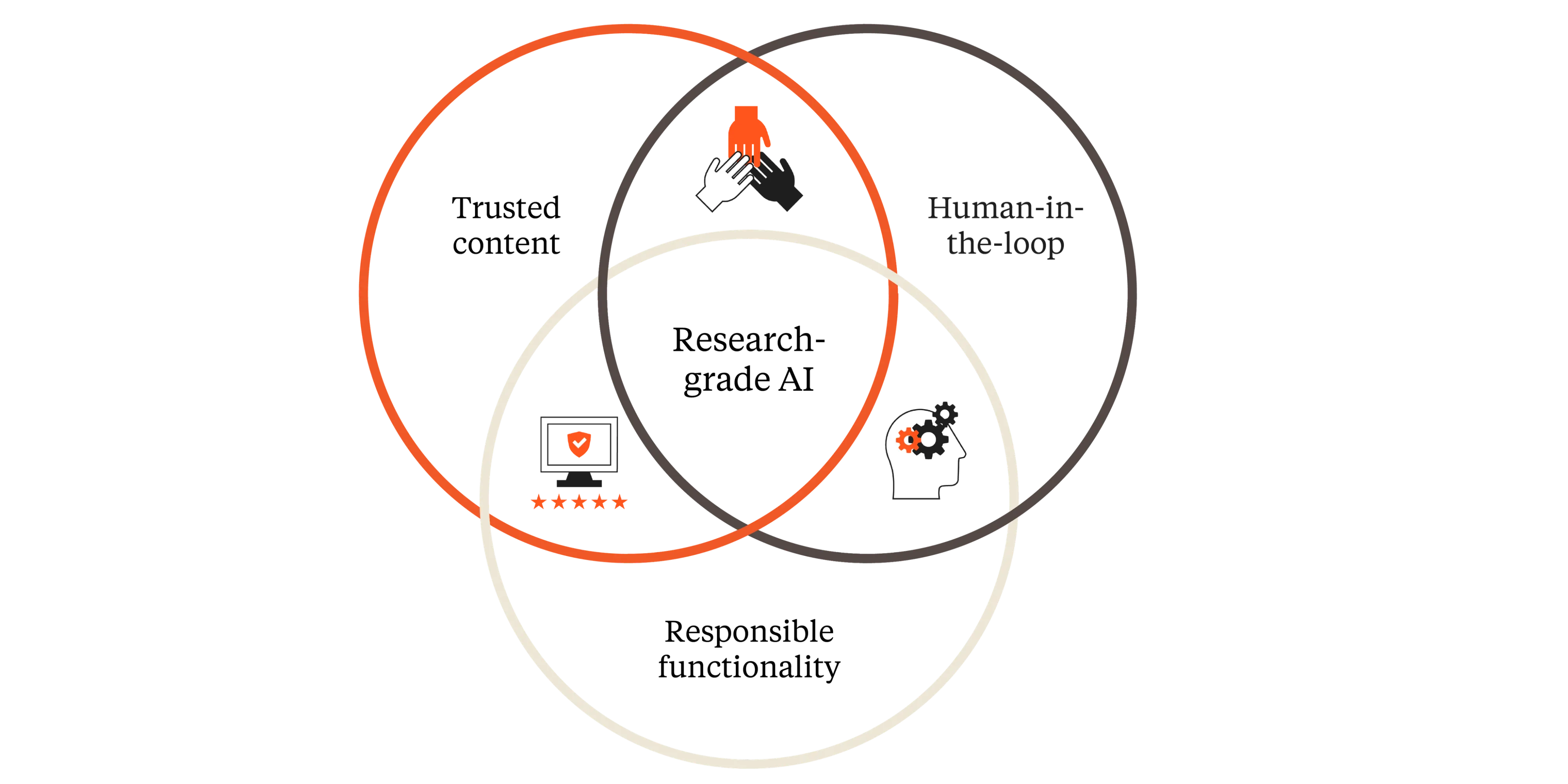
For conducting research, the content used to generate responses in an AI tool should meet research standards that depend on trusted content.
Research literature, along with the journals and publishers that support it, are trusted if they reflect three interdependent qualities of accuracy, authority, and transparency — and safeguard those qualities through integrity processes that contribute to this robustness.
In practice, trusted content features include peer-reviewed research, strong research integrity safeguards and a curated, up-to-date content base. Content should also be obtained ethically, without violating copyright, and with clear attention to provenance, rights and governance.
The functionality of an AI tool serves to put trusted content in the right context and with the right guardrails to allow researchers to critically evaluate the response.
AI systems designed with appropriate guardrails include features such as citations, transparent reasoning steps and mechanisms that help users assess the strength of claims. These features make AI responses easier to verify and use responsibly, allowing humans to control evaluation and decision-making processes.
Responsible functionality should also be assessed for its approach to privacy and security. Institutions may wish to evaluate factors such as applicable privacy compliance, whether and how data is shared with third parties, and what encryption safeguards are in place.
Continued human involvement in the development and use of AI is essential to responsible use. Humans in the loop act as a check for trusted content and responsible functionality.
Humans should remain in the loop during the creation, maintenance and use of the tool. When developing and maintaining the tool, responsible AI and design principles should be implemented. These principles are created to ensure further guardrails for developers and users that aim to mitigate risks and support responsible, informed use.
Human users are also a critical component of remaining “in the loop.” While there can be guardrails in place, users play a key role in evaluating and critically considering tool responses. User evaluation includes the use of AI literacy skills as well as topic knowledge to determine the next steps to an AI response.
Evaluating an AI tool for your institution? This checklist translates the research-grade AI framework into practical questions for procurement, governance and vendor conversations.
The current state of AI and the research ecosystem necessitate a framework that helps researchers get the benefits of AI while attempting to temper the risks. This allows institutions and their libraries to support the responsible use of AI tools.
The growing volume of information and data generated is often overwhelming and evaluating information quality adds an additional layer of complexity. Even further still, is evaluating AI-generated responses, which can contain hallucinations and bias. False citations have been one of the more common risks, appearing in courtrooms opens in new tab/windowand at Deloitteopens in new tab/window.
These factors contribute to the risk of misinformation. At a minimum, false citations and hallucinations stemming from GenAI tools waste researchers’ time and increase the likelihood of retractions in the published record. At worst, they expose researchers or their institution to reputational and financial costs, put grant funding at risk, and degrade trust in the research ecosystem and higher education.
These risks can be reduced when institutions activate the research-grade AI model to evaluate both the tool and the outputs it produces. When considering which tool to use, focus on curated sets of trusted content to reduce information overload and look for features that minimize the risk of hallucination, like citations.
While only 45% of researchers feel they have sufficient time and as few as 33% say they expect an increase in funding, 68% say the pressure to publish is greater than two to three years ago (Researcher of the Future — a Confidence in Research Report, 2025). Tools that meet research-grade AI standards can help researchers work more efficiently by reducing verification time, allowing deeper analysis and prompting critical thinking.
While responses from any AI tool need to be verified and relevance considered, research-grade AI tools use peer-reviewed research with direct links to citations. Additionally, the responsible functionality can help to evaluate the usefulness of sources to a query or its relation to other literature around the same topic.
In a recent survey, 27% of global researchers feel they have received adequate AI training (Researcher of the Future — a Confidence in Research Report, 2025). In addition, only 32% of researchers believe their institution provides adequate AI governance (Researcher of the Future — a Confidence in Research Report, 2025). With lack of training and governance, researchers can be more likely to use less secure tools, share private information in those tools or rely on responses without verification. The research-grade AI model can supplement AI literacy and training by providing researchers and institutions with a practical way to understand requirements for AI tools used in research.
The research-grade AI model also supports strategic decision-making about AI adoption.
Establish standards for AI procurement and evaluation. The model provides basic criteria - trusted content, responsible functionality, and human oversight - that can be embedded into procurement and vendor evaluation processes. This allows institutions to assess AI tools not just on performance, but on alignment with academic standards.
Position the library as a strategic AI leader. Libraries are uniquely equipped to operationalize research-grade AI, driving responsible AI adoption across the institution. With expertise in content curation, information literacy, and research workflows, librarians can:
Lead evaluation and selection of AI tools
Support integration of AI into existing research infrastructure
Deliver AI literacy training and guidance
Inform institution-wide AI governance and policy. The model provides support when developing AI policies grounded in transparency, accountability, and human oversight. Research-grade AI elements can be used to align stakeholders across the institution, ensuring a consistent approach to AI adoption.
Enable high-quality research outcomes. By prioritizing trusted content and verifiable outputs, institutions can enable researchers to work more efficiently while reinforcing the importance of rigor. Researchers can spend less time sorting and validating information and more time generating insight, while institutions strengthen research quality, confidence and return on investment.
By grounding AI in trusted content, designing it with transparency and accountability, and embedding it within institutional frameworks, organizations can move beyond experimentation toward more responsible, scalable innovation.

References
Researcher of the Future — a Confidence in Research report. (2025). Elsevier.