Researcher Voices: Learn from peers and benefit from the critical insights of key opinion leaders

Unfortunately we don't fully support your browser. If you have the option to, please upgrade to a newer version or use Mozilla Firefox, Microsoft Edge, Google Chrome, or Safari 14 or newer. If you are unable to, and need support, please send us your feedback.
March 26, 2026
|
5 min read
By Tiffany Chen
Credit: Jesse Delia
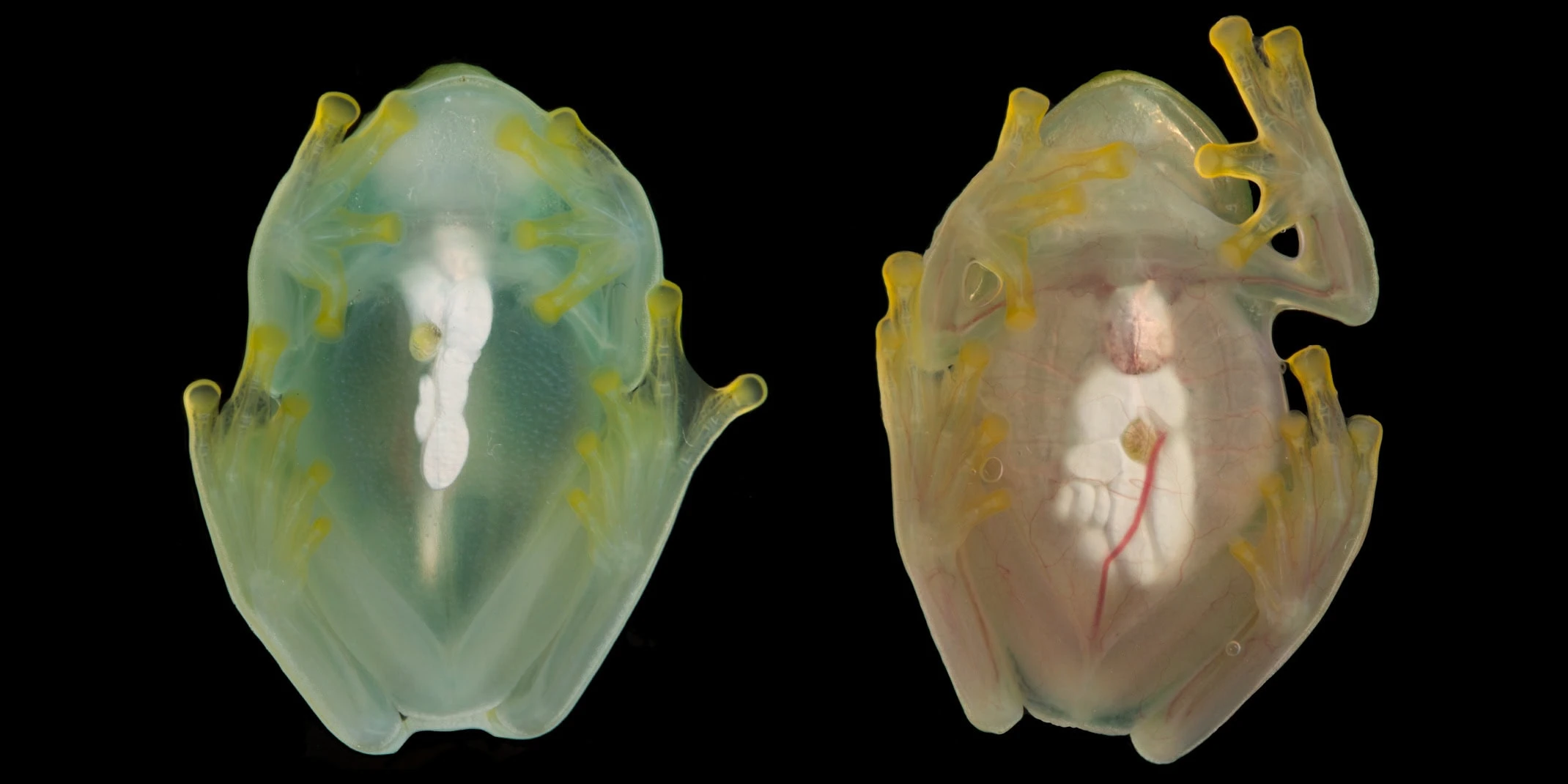
Do you not like being watched when you sleep? Neither do glass frogs. But they’ve got the perfect remedy: an invisibility cloak. Perched on the underside of leaves in the rainforest, these snoozing amphibians turn transparent, blending into the foliage to evade predators.
"It has puzzled people for more than 100 years," says biomedical engineer Junjie Yao of Duke Universityopens in new tab/window. "How do they become transparent when sleeping?"

In a new study published in the journal Photoacousticsopens in new tab/window, researchers built a powerful microscope to investigate this mystery. The results show that the technology can map multiple tissue components inside glass frogs and trace development, offering a new way to study their biology without using traditional dyes and labels.
Transparency is a rare feat in nature — especially among vertebrates. The gummy-bear-sized glass frogs are constructed much like we are, with blood, muscle, fat, and pigments, none of which are truly transparent.
Previous research in which Yao's team participatedopens in new tab/window, has shown that sleeping glass frogs can temporarily hide nearly 90% of their red blood cells in the liver. By clearing the light-absorbing blood cells from much of their body, the frogs become three to four times more transparent.
"But that's not the whole story," says Yao. "If you drained my blood, I wouldn't become transparent — I'd just be pale. They must have other tricks; other tissues must cooperate."
To uncover the frogs' disappearing act, researchers tapped into photoacoustic microscopy, which sends lasers into tissues. When molecules absorb this light, they warm up and expand slightly, emitting sound waves. These signals allow scientists to create images of tissues and organs.
"We got involved because our imaging technology can study biological tissues without dyes or labels," says Yao. "Glass frogs are super sensitive and picky about their environment. If you disturb them, they immediately lose their transparency. They must feel perfectly safe before they'll put on that transparent trick."
The team developed two microscopes. One enabled a non-invasive means of tracing red blood cells in living animals in real time. The other revealed striking details in muscle fibers, liver tissue, and fat deposits from tissue samples with different wavelengths of laser.
They also identified a pigment called biliverdin-binding serpins, which contributes to glass frogs' signature green. Following the animals from egg to adulthood, the team found that this pigment appears early in the egg stage and spreads across the body as the frogs grow.
"Another interesting discovery is that the frogs have a lot of fat," explains Yao. "Their fat seems to be more transparent than ours and is uniquely distributed across different organs. This may give them this more transparent feature."
While the research serves as proof of concept for using photoacoustic microscopy to study glass frogs, limitations remain. Yao hopes to capture more tissues, such as collagen in muscles, and optimize the technology to take detailed snapshots in living animals over extended periods.
Understanding how tissues and organs work together for transparency in real time could answer fundamental questions about the glass frog’s 200-million-year evolution. The frog’s ability to safely pack away red blood cells in a single organ without triggering clot formation, may also inspire new approaches to treating strokes and heart attacks.
"These frogs are very vulnerable," says Yao. "If we don't care about invisibility, we should care about potential medicine. Protect our environment, protect the frogs, and that may one day save us!"
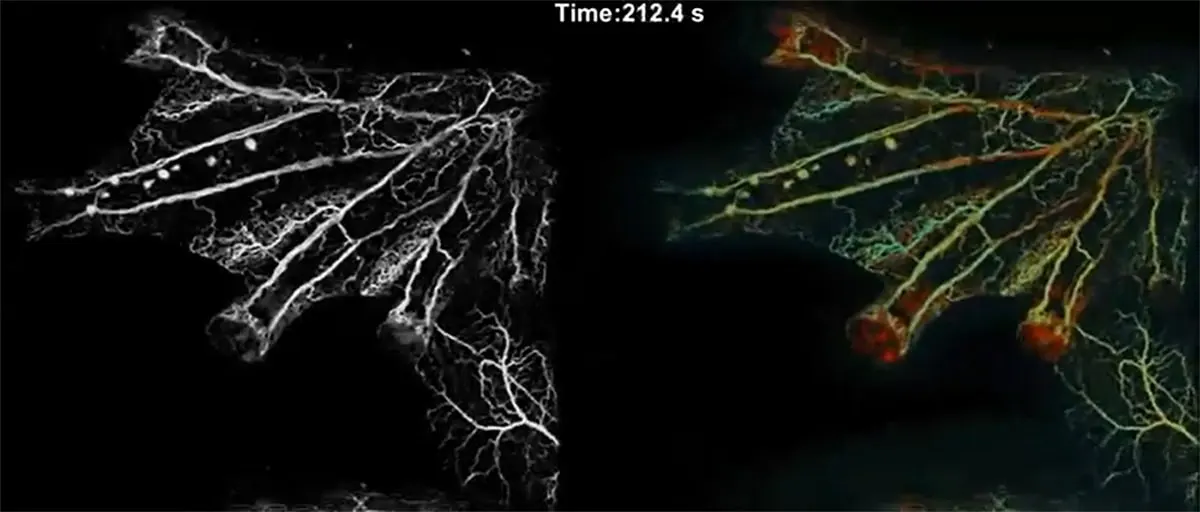
Movement of red blood cells (right) in the blood vessels (left) over time in the left leg and foot of an active glass frog under photoacoustic microscopy. | Q Rong, C Taboada, VT Nguyen, et al., Photoacoustics.
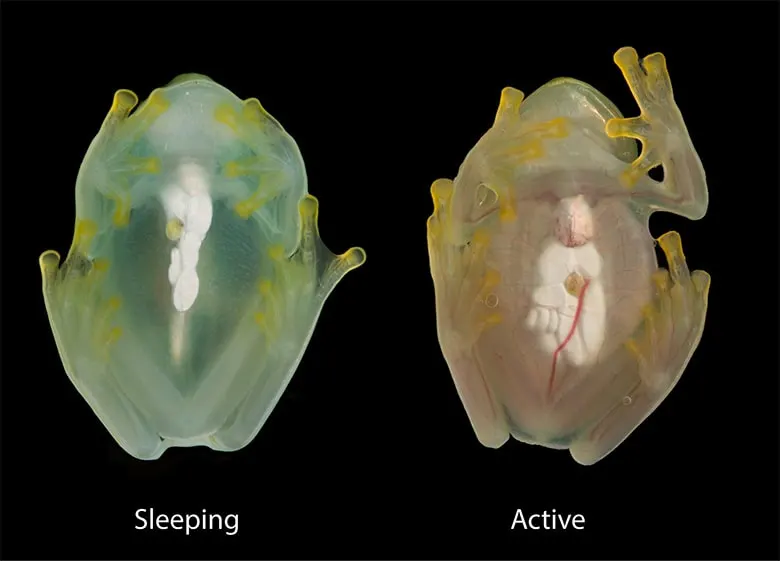
The same glass frog photographed during sleep (left) and while active (right), using a flash. Researchers measured the frog’s muscle and skin while it was asleep, finding that these tissues let over 90% of visible light pass through and are yet perfectly functional. | Credit: Jesse Delia
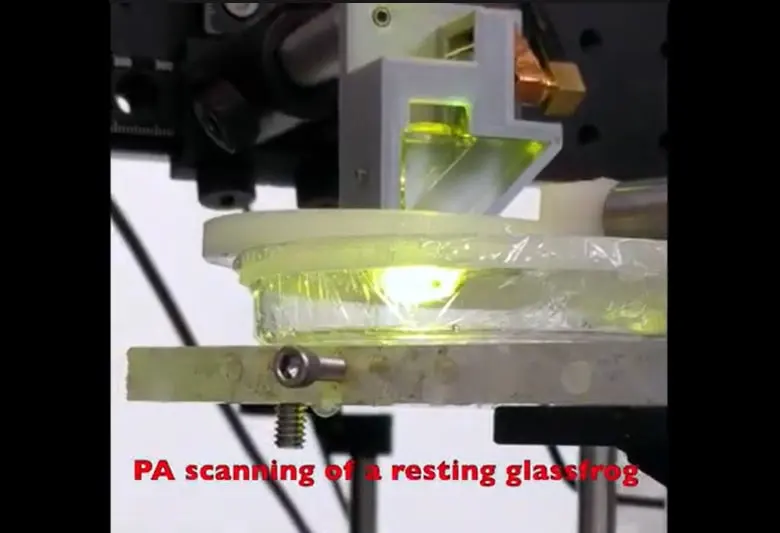
Photoacoustic scanning allows researchers to study glass frogs’ transparency while they sleep naturally upside down on a petri dish. | Credit: Jesse Delia.
This piece is part of our Researcher Voices program, which spotlights researchers' work, perspectives, and experiences.