Researcher Voices: Learn from peers and benefit from the critical insights of key opinion leaders

Unfortunately we don't fully support your browser. If you have the option to, please upgrade to a newer version or use Mozilla Firefox, Microsoft Edge, Google Chrome, or Safari 14 or newer. If you are unable to, and need support, please send us your feedback.
February 11, 2026
|
6 min read
By Tiffany Chen

Scientists have long thought that Alzheimer’s disease mainly stems from the buildup of “junk” in the brain — sticky plaques and tangles of protein that clog its circuits. More recently, researchers are discovering that the brain’s own immune system, when agitated, may also accelerate cell damage and cognitive decline.
A recent study published in Pharmacological Researchopens in new tab/window, takes aim at this frenzied immune response. Researchers at Fujian Medical University in China focused on Galectin-3 (Gal-3), a protein that activates microgliaopens in new tab/window, the brain’s resident immune cells. Under healthy conditions, these cells help clear debris and support brain health. But prolonged activation can fuel harmful inflammation instead.
Scientists have speculated that blocking Gal-3 may offer a way to disrupt inflammation. However, developing drugs for the brain is notoriously difficult. Most compounds, including potential medicines, never make it past the brain’s protective barrier. To tackle this challenge, the researchers turned to artificial intelligence.
Using AI-driven tools, the team sifted through a library of 1.6 million compounds to predict which candidates were most likely to bind to Gal-3, block its function, remain stable, and cross the brain barrier. Along with confirmation from laboratory experiments, FJMU1887 emerged as a promising small molecule, and was put to the test.
In mouse models with Alzheimer’s-like features, animals treated with FJMU1887 showed less microglial activation and lower inflammatory markers compared with untreated mice. The findings suggest that FJMU1887 toned down the brain’s agitated immune response.
The changes extended beyond the molecular and cellular levels. FJMU1887 treatment also led to behavioral shifts. The researchers compared three groups of Alzheimer’s disease mouse models: one group was given FJMU1887, another received a known cognitive-improving compound, resveratrol, and the third was left untreated.
Across cognitive and functional assessments, FJMU1887-treated mice performed on par to those that received resveratrol, while outperforming the untreated animals. For instance, FJMU1887-treated mice were better at recognizing new objects and navigating mazes, indicating memory improvements. They were also better at building nests, a measure of everyday functioning, often impaired in neurodegenerative conditions. These findings suggest that FJMU1887’s anti-inflammatory effects may translate into enhanced brain function.
While promising, the results are early and limited to animals. Safety, dosing, long-term effects, and true clinical benefits remain to be tested. Gal-3 biology is complex and broadly blocking it may impact other similar processes in the body.
Nonetheless, interest in Gal-3 as a therapeutic target is growingopens in new tab/window. An injectable anti-Gal-3 antibody therapy, which works similarly to FJMU1887, has received FDA support for limited clinical use, highlighting the strategy’s potential. Small molecules like FJMU1887 may hold additional advantages. They can be taken orally, reach the brain more effectively, and are generally easier and more cost-effective to produce at scale. These features showcase FJMU1887’s real-world accessibility if it reaches patients one day.
Worldwide, an estimated 78 million people are expected to be living with dementia by 2030opens in new tab/window, with about 50-60% affected by Alzheimer’s diseaseopens in new tab/window, which remains without a cure. While current treatments may slow the decline, they do not stop or reverse the disease. Future therapies may not focus solely on clearing harmful debris from the brain, but also on calming the brain’s immune storm, adding a new tool in the fight against Alzheimer’s.
Image:
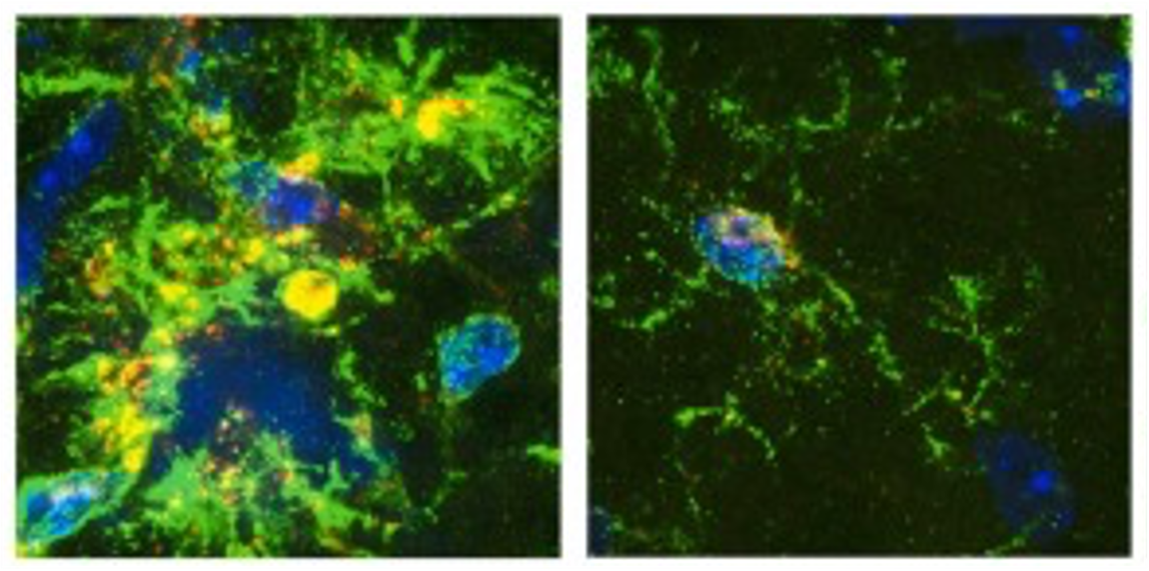
Brain immune cells, microglia (blue) in the brain of mice with Alzheimer’s-like disease. Compared to untreated mice (left), FJMU1887-treated mice (right) appear to have less microglial activation and fewer inflammation markers (green, red, and yellow).