
Uncovering hidden impact: A guide to maximizing collection data
Libraries face increasing pressure to maximize the value and impact of their collections amid tight budgets. Expanding collection assessment to include impact data more effectively demonstrates value and prioritizes suitability over volume, ensuring optimal collection makeup for each institution.

Recognizing collection value
Evaluating a collection from an impact lens allows the library to go beyond usage strategies and consider the broader impact on research, the institution and global initiatives. For example, the library can highlight the collection’s support of growing fields or alignment with institutional strategic plans. From a global perspective, this can mean demonstrating the collection’s support for advancing international research collaborations, health initiatives, environmental sustainability goals or other initiatives that advance human progress.
The impact approach ensures the collection is seen not just as a resource, but as a catalyst for innovation, collaboration, and positive change, strengthening the library’s role within the academic community and beyond.
The library’s collection may already be making an impact in these ways, but you may not have the right metrics to fully articulate it. Evaluating impact introduces new metrics and perspectives, making the library’s value clearer in the evaluation process.
Demonstrating the value of library collections isn’t new, but it shouldn’t be limited to return on investment (ROI) alone. Relying solely on ROI risks reducing collections to cost centers instead of strategic assets. Professor David Baker and Dr. Lucy Ellis highlight the need to shift from ROI to return on value in the webinar, “What is a collection and what does it do?” (2024). Baker emphasizes that there are many ways to ascertain value. This could be value to society, value to the environment or the value of inclusion (2024). In other words, is the collection providing the right value and can this be demonstrated to the right stakeholders?
The guide below provides an outline of considerations when evaluating collections for impact. As you work through the evaluation, carefully consider if this means updating your collection development policy.
The strategic advantage of impact
Clear evidence of the library’s impact and relevance is more important than ever given that only 51% of library directors believe senior leaders see the library as aligned with institutional priorities (Hulbert, 2023).
Elements of an impactful collection serve to support the continued value of the library and its collections. These elements include quality, alignment, interdisciplinarity, usability and accessibility, and sustainability. Aligning to these elements can provide better insight into collection value.
An impactful collection assessment also brings clarity to collection decisions by identifying where to grow the collection for maximum benefit and resource efficiency.
Changes in technology and learning environments also necessitate a collection that can demonstrate meeting the needs of users and the institution. AI is the latest example of such changes. The ways users search, interact with and conduct research may adapt with the presence of AI, and the collection should reflect this. Expanding the dimensions of value illustrates how the library adapts to and supports changes in its community.

Elements of an impactful collection
Quality
It’s essential for the collection to be composed of trusted, quality materials that provide accurate, credible and up-to-date information. Quality materials contribute to rigorous scholarship and elevate the institution’s competitiveness and reputation. Without trusted, foundational content, flawed understandings of scientific material could compromise research quality. Focusing on quality materials also ensures the library budget is maximized in value instead of quantity. Quality can usually be assessed by looking at citations or associated metrics like Field-Weighted Citation Impactopens in new tab/window (FWCI). These metrics compare books and journals relative to other material written in the field. Assessing quality can also be supplemented by reviewing the prestige or distinction of authors as well as the makeup of journals by tier.
Interdisciplinarity
Collections that support interdisciplinary research are key to supporting institutional research goals. Interdisciplinary research solves real-world problems by bringing together different disciplines to drive innovation, discover new methodologies and diversify solutions. As an added benefit, interdisciplinary research provides greater visibility via media and policy documents (D’Este and Robinson-Garcia, 2023). When assessing the interdisciplinary aspect of the collection, assess the foundational content, usually found in books. Foundational content can be used by researchers from other fields looking to get oriented with new areas that support or expand their existing research. You may also factor in the ease of moving between content types and subjects.
Alignment
Impactful collections have alignment to both the library’s and institution’s strategic goals. When the library’s resources fully support the broader institutional mission, it not only increases the library’s measurable results and impact but also demonstrates its strengths. From a research perspective, without access to collections that are aligned to their needs, researchers may look elsewhere, wasting valuable time and potentially relying on information that is not trusted or credible. To evaluate alignment, explore a process used by Liz Bober, a library assessment officer, for aligning to the university’s strategic plans. Using this process, she measures the library’s progress towards university goals. Keep in mind, there are likely parts of the collection that may remain out of this purview but still follow the collection development guidelines.
A fine balance has to be struck between what matters to the university, what the students need and what the researchers and faculty are asking for.Lee & Tillack, 2022
Usage and accessibility
A collection wouldn’t be impactful without being well-used and accessible by all. Understanding users' needs and the materials that best support research and learning is critical. This includes ensuring the collection is accessible and inclusive. Consider different modes of access—are screen reader users able to access the collection? Are there alternative ways to find or use materials that improve accessibility? Collaboration and consultation play key roles in these decisions.
Sustainability
Sustainability, in this context, not only refers to the environment, but also financial and institutional sustainability (Baker, Ellis, Evans, 2024).
From a financial perspective, decisions should be made to optimize the value of the collection for the duration instead of short-term benefits (Baker, Ellis, Evans, 2024). Doing so helps to sustain a continuous collection that maintains its integrity and provides a steady core of material for users to access.
Aside from the core collection, there may also be room to update and innovate with the changing needs of the institution, supporting institutional sustainability. The collection should be able to adapt to different institutional initiatives or priorities. It should also support new technologies and different ways of learning.
Finally, there can be an environmental component to the collection, which addresses global impact and the collection’s role in supporting energy reduction. It can also examine the best way to acquire material to provide sustainable methods of access.
Data points to measure impact
Collecting insights
When evaluating the collection, quantitative methods provide a benchmark to understand alignment with user and institutional goals, resource use, budget allocation, and gaps. These insights support the advancement of collection policy and goals.
Collecting and using data also helps update or develop new initiatives. As technology evolves, data reveals how users interact with the collection, guiding strategy updates. Generative AI (GenAI) is the latest example (Blanco-Domingo, 2025).
When using quantitative data for collection assessment, consider the following:
Not all data is created equal. While there are many different data types to utilize, all data must be of a high quality. Examine data sources and have an understanding of their accuracy, reliability and rigor. Pay attention to any gaps or shortcomings.
Remember to enhance quantitative data with qualitative perspectives and feedback. It’s important to have a holistic approach when assessing the collection. A single data point will not provide an accurate representation.
Ensure a wide breadth of collection data by seeking out different sources for compiling data. Doing so empowers you to make fully informed collection decisions. Aggregate data resources are excellent for examining collection use but consider other locations that may hold more specific data. Publishers, for example, can usually provide more in-depth information relating to your collection.
Metrics that illuminate collection impact
Consider the following data points when evaluating for impact. While this focus is on books data, some data points can apply for the entire collection. Remember that data points can be used for different modes of analysis depending on the goals. The subsequent section discusses how to utilize this data to evaluate impact.
Co-usage is a measure of cross-use between journal and books content. It helps to understand how many users who use journals also use books in their research process, and vice versa. A university, for example, may have a 53% co-usage rate, meaning that of total research sessions in a given period, 53% of sessions used both books and journals.
Co-reference measures how often books and journals are cited together in an institution’s research output. This is expressed as a percentage of the total research output.
Usage by subject provides a view into the use of books by subject.
Book type looks at the breakdown of different types of books within the collection, including major reference works, textbooks, serials and more.
Turnaway data reveals which books users attempted to access but were unable to access because they are not included in the current collection. This common data point is another type of gap analysis to understand user needs.
AI-driven usage looks at the use of books by the AI tools available when responding to a query.
Market demand is broader data that looks at the demand for books at a variety of levels. For example, the most popular books, related to a particular subject, in your region.
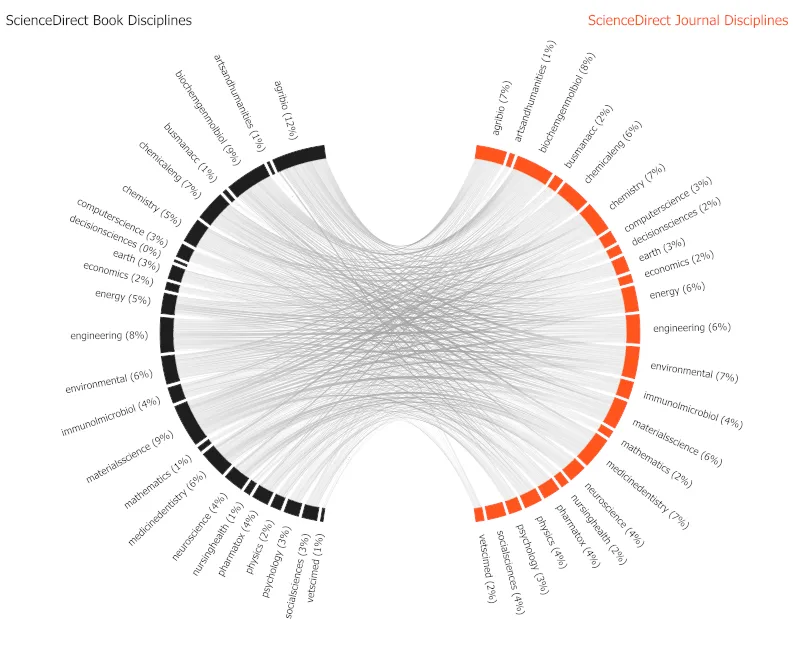
Books and journals co-usage on ScienceDirect in 2024
Amplifying collection value
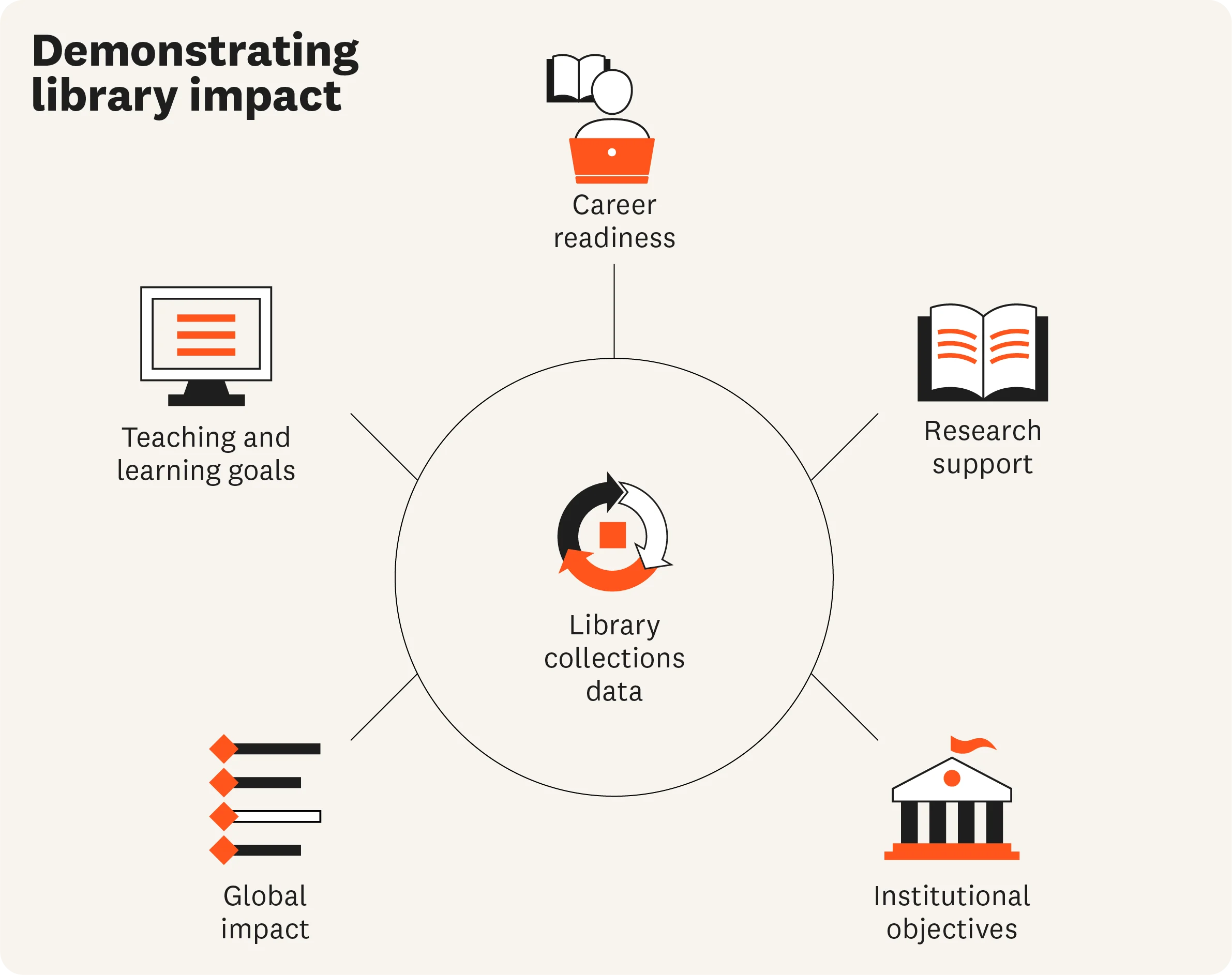
Evaluating collections for impact involves assessing components individually and then reviewing these results as a whole. The result will help prioritize where to advance the collection with the most benefit and resource efficiency. Remember that this is a holistic process and a single data point will not provide a full picture.
Evaluating teaching and learning objectives
Co-usage: In the context of analyzing the collection for teaching and learning objectives, co-usage can be used to understand how foundational knowledge (books) and original research (journals) are working together. Get a better understanding, at a high level, of how the collection supports the full learning process.
Turnaway data: This can be used to show that the collection meets teaching and learning objectives. If turnaways are relatively high for an area, the collection makeup might need to be reassessed. It might be beneficial to connect with faculty or researchers to learn more about their goals and ensure curriculum alignment. Even with low turnaway levels, supporting faculty awareness of available resources can increase usage of existing material.
AI-driven usage: If the library has an AI tool that uses collection material, understanding the role of the books collection is a great way to demonstrate that quality, trusted content provided by the library is being utilized to its fullest potential with the latest technologies.
Evaluating for career readiness
Career readiness is another facet of teaching and learning; providing students with the skills they need to be successful in the workplace. Exposure to a wide range of topics and viewpoints is important to preparing for the workforce (AACU, 2023 as quoted in Elsevier, 2024). With this in mind, consider these data points to showcase career readiness support.
Book type: Because each book type provides a different set of purposes, having the right mix of major reference works, textbooks, serials and others provides the necessary content to facilitate learning. By providing this breakdown and highlighting the specific applications of each resource type, the library demonstrates support for each stage of the learning process.
Co-usage: Similar to book type, co-usage can be used in this case to amplify the support for all stages of the journey. Reading diverse materials encourages analytical thinking, enabling students to approach complex problems and make informed decisions—key skills in any profession.
Market demand: Preparing students for the workforce not only includes setting them up with the right skills, but also the right material. Demonstrating that the collection offers up-to-date topics and supports new ideas strengthens career readiness evidence.
Evaluating for research support
Co-reference: To demonstrate the collection’s support of researcher needs, use this metric to show the combination of foundational content and original research referenced in research outputs from the institution. On a global scale, articles that reference at least one book have a 15% higher FWCI, demonstrating a rise in research quality (ScienceDirect global usage 2022/SciVal).
Book type: Highlighting the variety of book types and their use cases can clarify which resources best support discovery. This is particularly true when demonstrating the interdisciplinarity of a collection, as books provide foundational content. Because foundational content helps researchers get up to speed in a new field quickly, having a mix of major reference works, textbooks, serials and others best supports research growth.
Turnaway data: Turnaway data can give the library an understanding of its alignment to research goals. Evaluating the data against objectives provides insight into collection alignment or gaps.
Usage by subject: Similar to turnaway data, compare the usage to areas of greater research output at the institution. Use alignment to research goals as another facet of support to the institution.
Evaluating for alignment to institutional objectives
Before assessing the collection for its impact on institutional success, have a good understanding of the institutional priorities. This may also be a good time to ensure the collection development policy is aligned. For a more holistic view of institutional objective alignment, review the data points below in combination with teaching and learning and research support data.
Turnaway data: With the institutional priorities at hand, review turnaway data in relation to those subjects or areas. Assess whether the cohesive collection supports these priorities. Are there many requests for books related to areas specifically outlined in the institutional priorities?
Usage by subject: Similar to turnaway data, understanding the mix of usage and comparing it to institutional initiatives can point to areas of strong alignment or show gaps for growth. Examples of institutional initiatives can include energy reduction, mental health support or community engagement. With this data, assess usage of existing materials or areas you might consider expanding or reducing.
Evaluating for global impact
Academic institutions strive to improve the world through their research, community initiatives and preparing the next generation, among others. In this way, supporting global initiatives may also be supporting institutional initiatives.
Usage by subject: Assess the subject collection distribution with the same process as institutional goals. Compare the global initiatives to the collection makeup and look for any gaps or areas of strength. Use the areas of strength to share with stakeholders.
Turnaway data: Many institutional initiatives can also have a global component aimed at advancing human progress in certain areas such as poverty alleviation or improving quality of drinking water. Assess content needs related to a specific subject or initiative that is frequently requested.
If the library doesn’t have specific global initiatives in mind, Sustainable Development Goals (SDGs) are an excellent starting place. Mapping the collection to different focus areas with the SDGs can also provide fuel for departments to align their research to these topics using the collection resources.
Take into account the other community initiatives taking place in the institution. For example, if citizen science is taking place at the university, think about how the collection material can support these initiatives. This interaction can also support further interdepartmental collaboration.
With this data in hand and the qualitative analysis, use the stakeholder mapping exercise to determine who to share this information with and how to further use the results to show the benefits of the collection.
Enriching data evaluation
Using qualitative and quantitative methods to evaluate the collection provides a full picture of impact and ensures the evaluation considers data and the contextual factors that shape collection effectiveness.
Qualitative methods are particularly strong in providing context and further detail about collected data. “While numbers are useful, they will not tell the whole story and should be complemented by other methods, such as focus groups and interviews, to clarify, contextualize, and interrogate the significance of analytics” (ACRL, 2010 as cited in Thorpe, 2025).
Furthermore, qualitative measurements help distinguish the library’s values and its role within the institution. These measurements can look at the library mission against the collection, view the collection against the institutional research goals, or compare the quality of content (Fulkerson, 2021).
Engaging in an active qualitative feedback process can also support engagement with senior researchers and faculty. Holding informal feedback sessions, running surveys, or having informational conversations can be effective ways to collect responses.
Publishers as Data Partners
Publishers play an important role in providing data that supports collection decisions. The data received should be trustworthy and enhance the library’s existing set of data. Additionally, it’s beneficial for publishers to enable SUSHI to enhance access to COUNTER data and reports, which provide usage information over the full collection.
Deeper data analytics beyond COUNTER may be available from individual publishers. Contacting the publisher for additional data allows the library to view a fuller picture of the collection. Incorporating data from publishers and holistic usage dashboards ensures you’re fully empowered to make collection decisions and can utilize all resources available to demonstrate impact. Without a full view of available data, the library risks missed insights to better support users and an opportunity to showcase the value of the collection.
It’s important that publishers also use data to make their own strategy decisions. Providing a holistic approach with accurate breadth and depth requires proper use of the variety of book types available in combination with comprehensive qualitative feedback from researchers and customers (Fulkerson, 2021).
Additionally, it’s important for publishers to leverage data to further understand the research landscape, ensuring the right content is published for the markets they serve (Fulkerson, 2021). Some data markers may include use case and intended level, funding, FWCI and usage. This research also helps to understand portfolio gaps in subject areas or fast-growing fields.
Collaboration and partnership between publishers and libraries are essential to building a collection that provides the most impact for the library. By fostering open dialogue, listening to feedback, and adapting offerings, these collaborations can ensure that libraries deliver the highest impact to their users.
While numbers are useful, they will not tell the whole story and should be complemented by other methods...ACRL, 2010 as cited in Thorpe, 2025
Making every resource count
In today’s climate of tight budgets and high expectations, libraries must continually find ways to maximize the value and impact of their collections. By expanding assessment practices to include impact alignment, libraries can more effectively demonstrate both the relevance and strategic value of their collections. Prioritizing suitability over volume ensures that each institution maintains an efficient, purposeful collection—one that amplifies research, teaching, and learning while supporting broader institutional and global goals.
References
Baker, D., Ellis, L. & Evans, G. (2024). What is a collection and what does it do? [Webinar]. Elsevier. https://www.elsevier.com/promotions/what-is-a-collection-and-what-does-it-do
Blanco-Domingo, L. M. (2024). Collections: Acquisitions, Development and Evaluation Procedures (pp. 432–438). Academic Press. https://doi.org/10.1016/B978-0-323-95689-5.00133-4opens in new tab/window
D’Este, P., & Robinson-García, N. (2023). Interdisciplinary research and the societal visibility of science: The advantages of spanning multiple and distant scientific fields. Research Policy, 52(2), 104609. https://doi.org/10.1016/j.respol.2022.104609opens in new tab/window
Elsevier. (2024). Beyond knowledge: The crucial role of books in higher education excellence and employability. Elsevier. https://assets.ctfassets.net/o78em1y1w4i4/1YrmmtIYTpStArjDbhPCQ6/c89822db21d9f8b8251aae54af9081db/Value_of_Books_in_Higher_Ed_EN_DIG.pdfopens in new tab/window
Fulkerson, M. (2021). The use of data in publishing and library acquisition strategies. In D. Baker & L. Ellis (Eds.), Libraries, Digital Information, and COVID (pp. 161-168). Chandos Publishing. https://doi.org/10.1016/B978-0-323-88493-8.00004-5opens in new tab/window
Lee, M., & Tillack, T. (2022). ANZ Ebook Forum 2022. What are your metrics costing you? https://web.archive.org/web/20221020133429/https://www.elsevier.com/en-au/solutions/sciencedirect/anz-ebook-forum/what-are-your-metrics-costing-youopens in new tab/window
Hulbert, I. G. (2023, March 30). US Library Survey 2022. Ithaka S+R. https://sr.ithaka.org/publications/opens in new tab/windowus-library-survey-2022/
Thorpe, C. (2024). Library Assessment and Impact (pp. 565–572). Academic Press. https://doi.org/10.1016/B978-0-323-95689-5.00124-3opens in new tab/window