
Boolean searches in Scopus: understanding operator precedence and best practices
Knowing how to structure a Boolean query for a Scopus literature search can help you control both the number and the relevance of the results retrieved.
When you search in Scopus, you’re using a comprehensive, curated and trusted academic database. You can find authoritative research, identify top experts and gain strategic insights. Combing through content from more than 7,000 global publishers to find relevant content for your project may seem daunting, but Scopus tools quickly refine your search. Among them is Scopus Advanced search, which fine-tunes the scope of your search using field codes, proximity operators and Boolean operators.
Knowing how to structure a Boolean query for a Scopus literature search can help you control both the number and the relevance of the results retrieved. Since the search logic was designed with librarians in mind, many non-librarian users may not be familiar with Boolean operator precedence and best practices for using parentheses. Learning about them can help you understand how search terms are processed and in what order.
In this article, we’ll explain how Boolean logic is applied in Scopus and share best practices for constructing queries..
Many thanks to Rosie Dunne, Research Services Librarian at Ollscoil na Gaillimhe – University of Galway, for her expert insights and examples that contributed to this blog. (0000-0003-2256-5590) – ORCID
Understanding Boolean operator precedence in Scopus
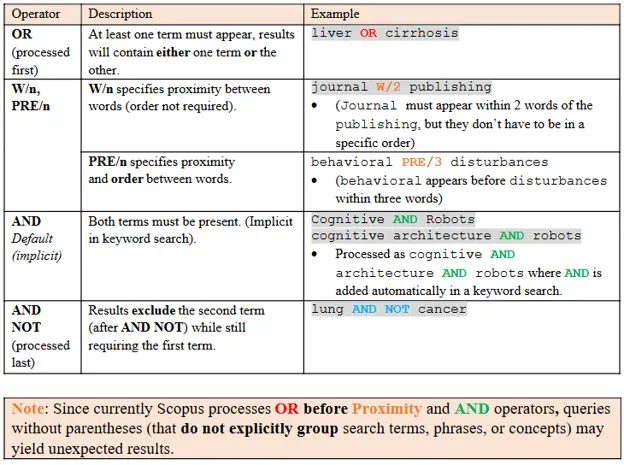
Boolean operators define how search terms interact, and the order in which they are applied can significantly impact search results, especially if parentheses are not used to group key concepts.
In basic or advanced lexical searches with multiple operators, Scopus processes queries in the following order:
Best practices for constructing Boolean queries with proximity searching
Proximity searching narrows searches by finding words that are next to or within a specified distance from each other. This is useful when you are looking for concepts that might be expressed by multiple different phrases.
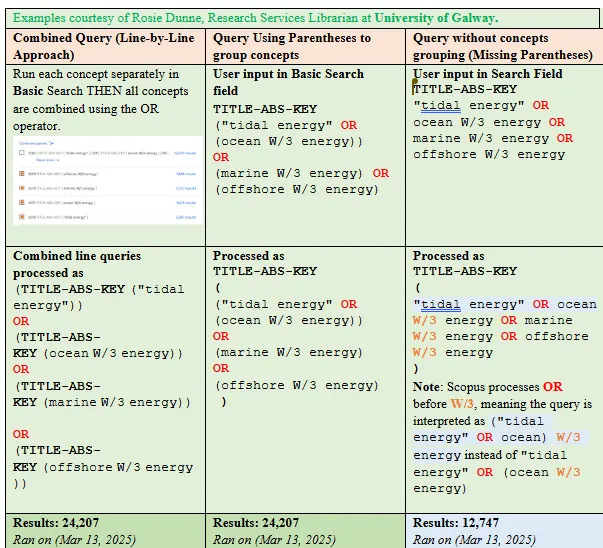
Example 1: Searching for tidal energy research
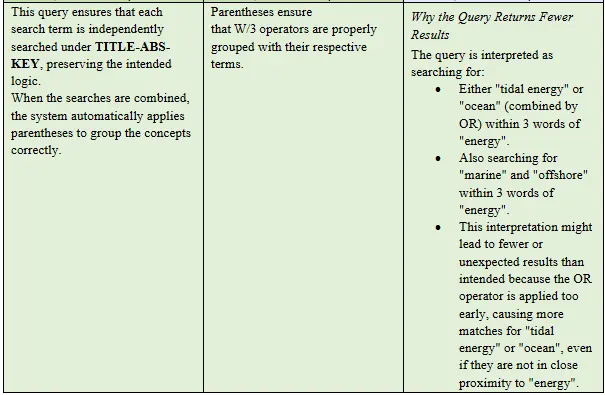
Consider these three queries, all with the same user intent. However, one of them produced unexpected results:
Example 2: Enhancing complex queries
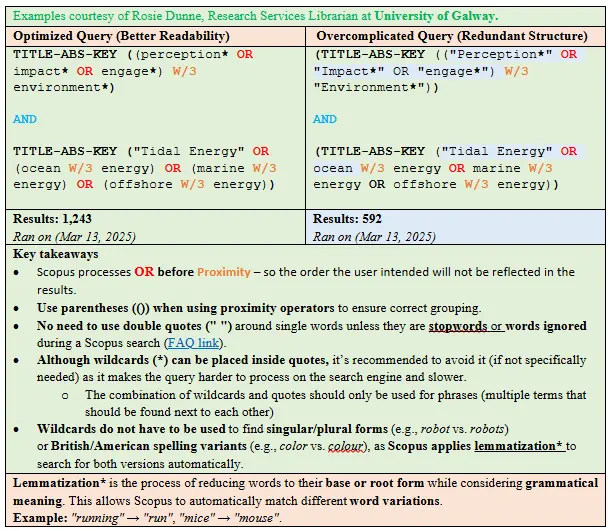
Many users assume complex searches require lengthy queries, but grouping enhances clarity and efficiency. Using parentheses to structure searches ensures logical relationships between keywords, improving precision and yielding better results.
Consider these two queries:
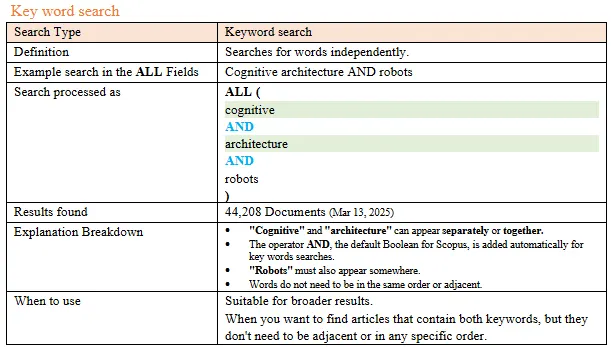
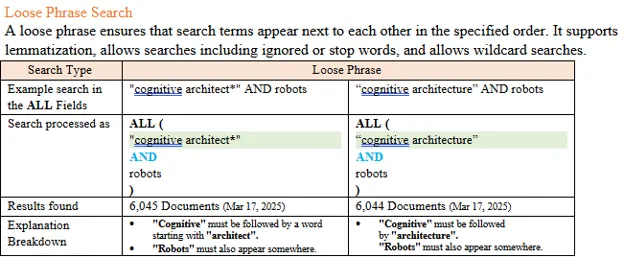
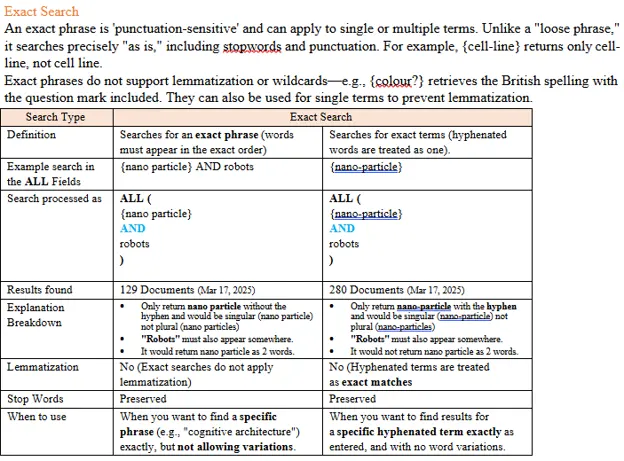
Example 3: Comparison of Scopus search types
Final Thoughts
Understanding Boolean operator precedence and search types in Scopus is crucial for retrieving the desired accurate and comprehensive search results.
By applying these best practices, you can maximize the effectiveness of your Boolean searches in Scopus.
Use parentheses ( )to control precedence and avoid unexpected results.
Keep queries concise and structured to improve readability and efficiency.
Be aware of the different search types and what they are suitable for, based on your need.