
Impact from Elsevier: trusted data, advisory expertise and workflow solutions for better-informed institutional decisions.

Unfortunately we don't fully support your browser. If you have the option to, please upgrade to a newer version or use Mozilla Firefox, Microsoft Edge, Google Chrome, or Safari 14 or newer. If you are unable to, and need support, please send us your feedback.
Scopus analyzes an immense pool of information to deliver reliable source-neutral data and metrics you can use to derive actionable insights about institutions, authors and research areas.
Scopus data is a trusted source for informing research planning and decision-making for institutions, ranking organizations, funding agencies and governments around the world.

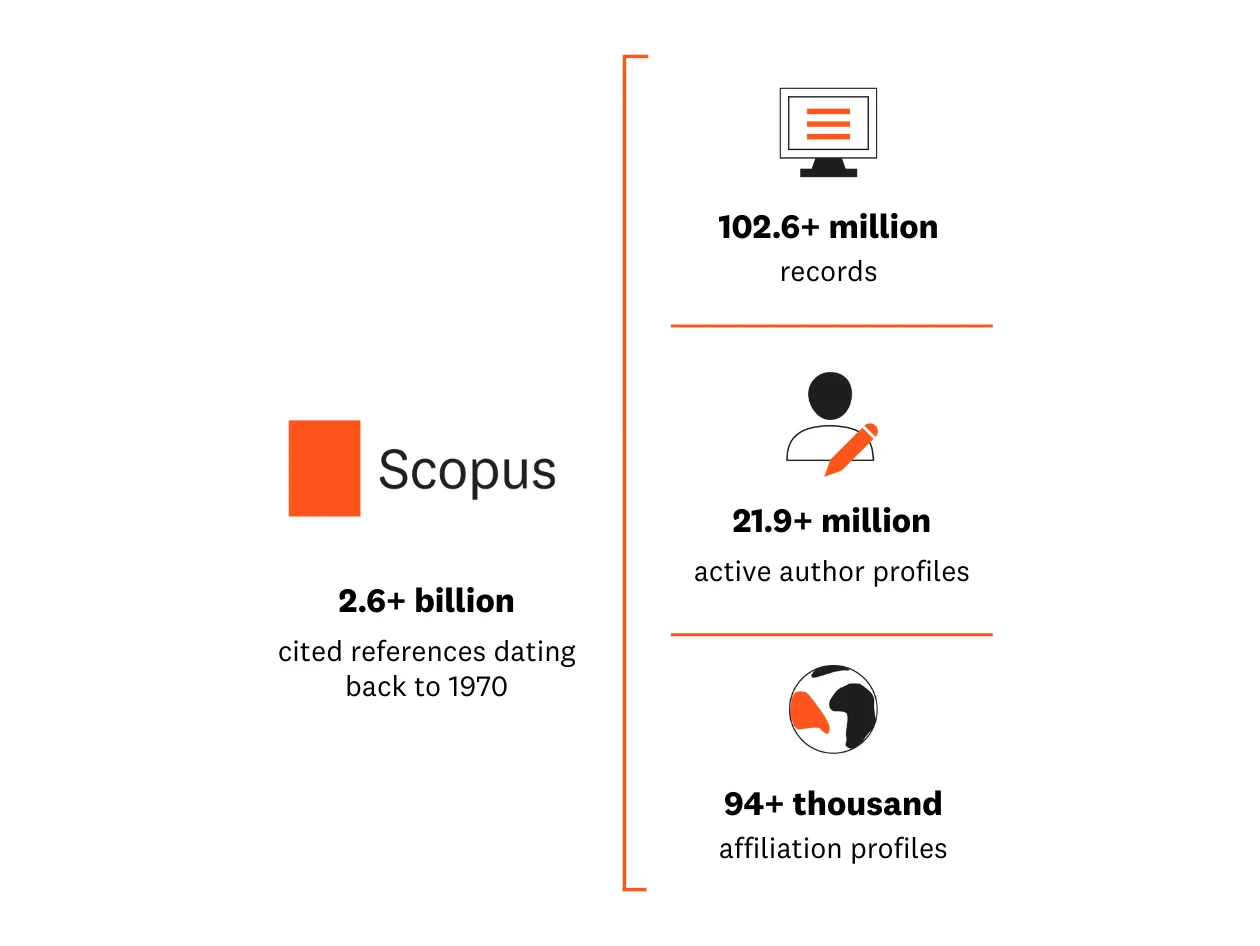
When researchers publish their findings, they also publish a wealth of information beyond the science or subject matter — details such as how the research was funded, who contributed, and how it has been used, cited and applied. Scopus collects this information from thousands of platforms, institutions and publishers, including details such as:
Citations of published works
Names and institutions of contributing authors
Funding sources
Awarded grants
Policy citations
Scopus collects, processes and organizes this data to create a comprehensive information source for scientific research.
With Scopus data, you can analyze and evaluate:
Your organization’s total research output based on citations of published literature to assess productivity and to identify emerging trends
Output of researchers within your organization to identify potential multi- or interdisciplinary projects or for tenure and promotion considerations
Output of researchers from other institutions for potential collaborations, team science projects or recruiting and hiring decisions
Your organization’s research in SDG areas to assess progress and align sustainability strategies
You can’t compare other products to Scopus — no other output metrics offer the same kind of depth and coverage. ...it is the kind of information that administrators and the Office of Research seek all the time.
Hector R. Perez-Gilbe
Research Librarian at Health Sciences, University of California, Irvine (USA)

Scopus features a rich variety of metrics, including SNIP, SJR, PlumX, h-index and CiteScore®.
Generate custom reports and deep-dive into the data with Scopus APIs. Available to Scopus-subscribing academic institutions only, our APIs provide access to rich citation data, metadata and abstracts from scholarly journals as indexed by Scopus.
Scopus APIs allow you to display relevant information pulled from Scopus on institutional domains, including researchers’ websites. You can also embed Scopus data in other applications such as:
Research Information Management (RIM) systems such as Pure
Institutional Repository (IR) systems like Digital Commons
Publicly accessible research portals, such as Pure Portals
Use Scopus APIs to:
Benchmark the output and performance of researchers at your institution
Identify other institutions and researchers for collaboration or team science projects
Detect emerging research trends through text mining
Scopus also has a federated search API so librarians can implement a single search across all their subscribed digital scholarly resources.
