
Demonstrating real-world impact
Learn how a closer look at research data can encourage improved alignment between research funding and the UN's Sustainable Development Goals.
Driving research impact
The United Nations Sustainable Development Goals (UN SDGs) span 17 objectives that, collectively, lead to a healthier, more secure and more equitable world. These are the types of problems that draw researchers into their field in the first place, representing a chance to use science to improve life on Earth.
Pursuing the UN's SDGs requires many types of effort and inputs. Scientific research can bring substantial contributions in identifying challenges or gaps, and in proposing technical solutions that might be implemented via the enactment of public policies. This makes it essential for research funders to know how the results of the projects they support have linkages to each SDG.
The UN acknowledges that both governmental and private-sector research funding organizations (RFOs) play their own rolesopens in new tab/window in supporting and fostering SDG-focused research. Many times the linkages between research results and SDGs are subtle, and it is very common to find cases where a publication contributes to the achievement of SDGs without ever mentioning the SDG. Your activities may already be advancing the SDGs, and drawing a transparent, data-driven correlation between the research your organization supports and these goals helps you build better visibility and legitimation with the taxpayer.
Amid calls for research fundingopens in new tab/window that addresses the SDGs from organizations like the International Science Council as well as the UN's own hopes for greater networking and collaborationopens in new tab/window, it's clear that there's plenty to discover in the intersections between RFOs and SDGs.
Getting to know the United Nations Sustainable Development Goals
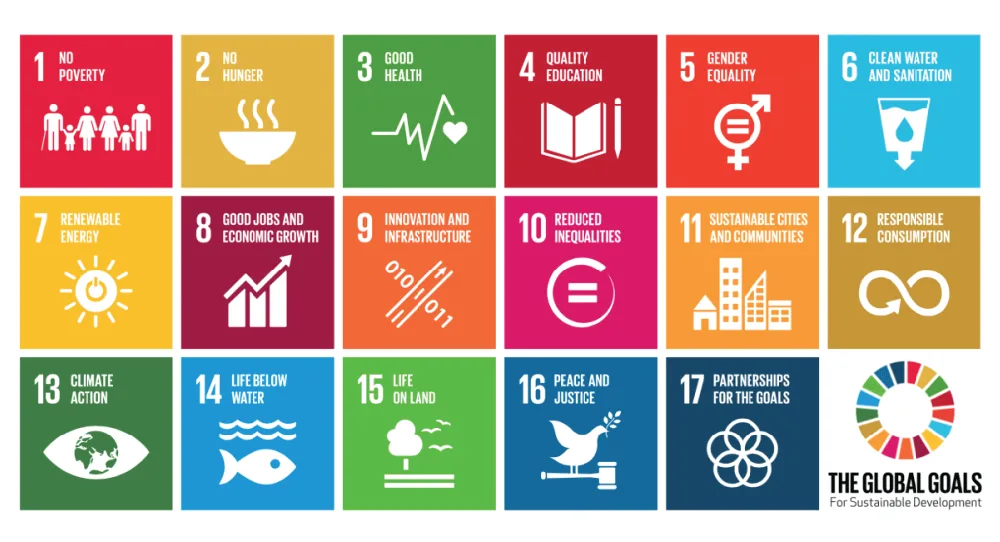
The 17 UN SDGsopens in new tab/window have, since 2015, given global governments and organizations a guiding set of principles to funnel their efforts on targets such as the availability of affordable, clean energy, the elimination of hunger, and the promotion of a sustainable environment on land and under the water.
Considering how varied these goals are, it's impossible to track them using a single set of criteria. Progress toward the SDGsopens in new tab/window could mean anything from a reduced CO2 emission rate to the amount of women in leadership roles.
The sheer variety of these goals reveals opportunities for RFOs to address them through the research they support, as further demonstrated in case studies of transformative impact from organizations like the São Paulo Research Foundation (FAPESP)opens in new tab/window in Brazil or the European Research Council (ERC)opens in new tab/window. While progress on some SDGs, such as the need for strong democratic frameworks, stems from long-established norms and practices, others, such as those focused on the climate and energy, have much to gain from RFOs' efforts.
RFOs' sponsored research and the innovations that emerge from their efforts can have a notable outcome on the sustainability of the world, as codified in the SDGs. Efforts from bodies like U.K. Research and Innovation (UKRI) International, the Wellcome Trustopens in new tab/window, FAESPopens in new tab/window, the ERCopens in new tab/window, and the National Science Foundation (NSF)opens in new tab/window demonstrate the close link between project funding and SDG progress. RFOs can also drive impact by collaborating, as with a housing program devised by UKRI and FAESPopens in new tab/window.
Better research impact through performance analysis
Linking your organization’s work to SDG outcomes is a compelling way to demonstrate its impact and relevance. This may not even mean changing your focus drastically, but rather highlighting the percentage of your funding that already addresses one or more SDGs.
It's important to remember that the SDGs didn't appear out of nowhere in 2015. The goals are based on age-old needs and concepts tied to the overall quality of human life and the environment. RFOs that are active in research that focuses on health, social welfare or the natural world may be advancing SDGs, whether they're actively measuring it or not.
How much is your RFO contributing toward the achievement of various SDGs? Data can help a lot with this challenge, when paired with more holistic observation. One simple but compelling way to connect an organization with progress toward SDGs is to measure specific RFOs' acknowledgement in research publications targeting SDGs. By using acknowledgements metrics, it's possible to determine how much knowledge created with support from an RFO can contribute to the understanding of challenges related to each SDG and clarify the path to actions to achieve the target.
Sophisticated modern analysis of data can make the analysis more granular, with research in the Harvard Data Science Review citing the need for advanced analytics and high-quality data to more accurately determine SDG progress and performanceopens in new tab/window.
Data analysis provides an overview of progress, while citing cases and outcomes helps you provide anecdotal examples of research in action.
Analyzing contributions to knowledge and innovation
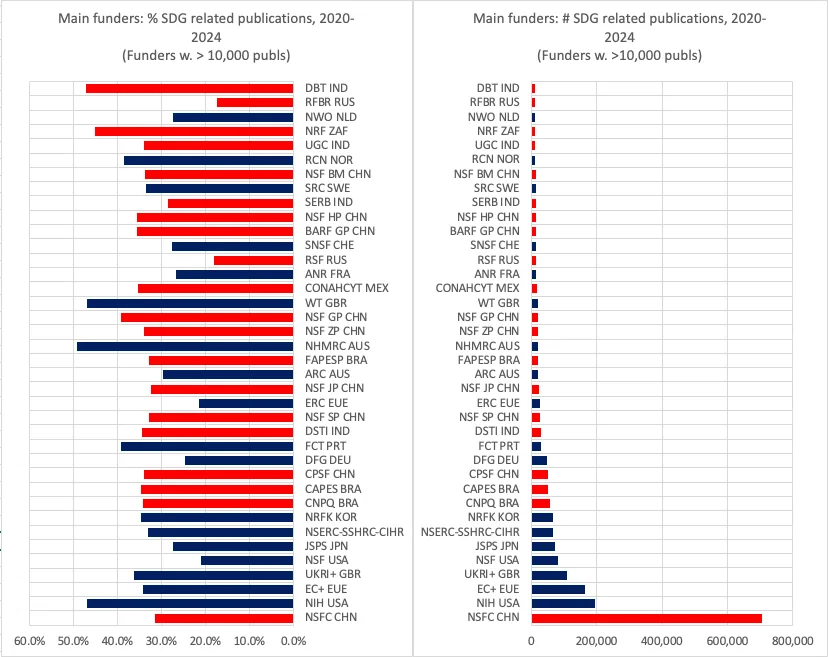
What does it look like when you map out RFOs' commitment to SDGs in terms of focused publication citations?
Among the 38 RFOs acknowledged in 10,000 or more SDG-focused research publications between 2020 and 2024, it becomes clear which organizations are contributing the most to the SDG space. The results show that RFOs in low- and middle-income countries (LMICs) are playing a major role in RFO progress following years of capability-building.
Linking your RFO's spending to contributions to SDG progress helps you demonstrate the value of your efforts. You can make it visible to governmental bodies and taxpayers that the research you fund aims at a meaningful impact. This is a vital consideration for your long-term efforts because policymakers need a clear understanding of the relationship between the research results and societal challenges.
Elsevier's Scival uses third-party data to inform the demonstration of how research results exert influence. Compared to academic metrics, policymakers often care more about social media visibility and other signs of mainstream popularity.
Advanced analytics methods are a useful new tool available to RFOs when it's time to measure and evaluate how RFOs' work advances SDGs. For instance, bibliometric analysis can delve into the text of research to discover which SDGs are drawing the most attentionopens in new tab/window from researchers, or which SDGs need emphasis in funders' strategies to best contribute to public policy objectives and social benefit.
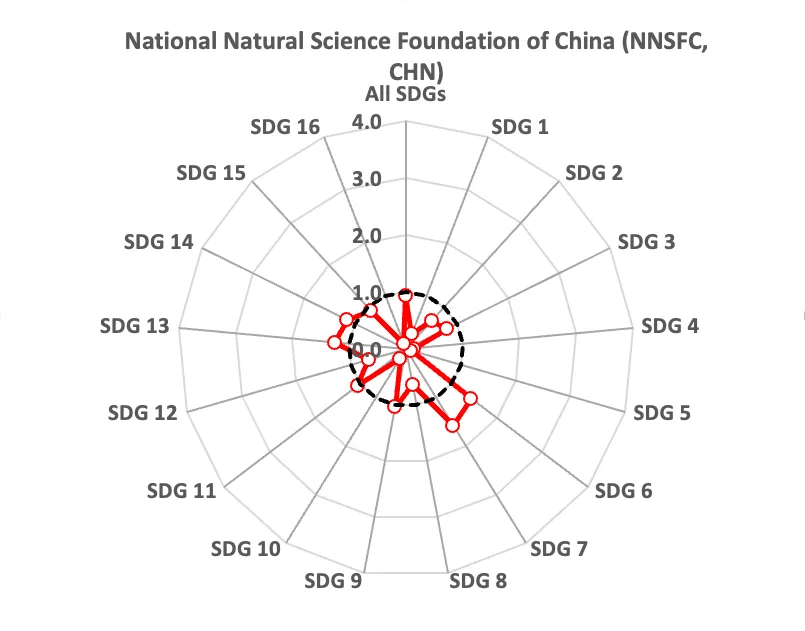
Relative Activity Index for each SDG and for any SDG, considering the publications that acknowledge support by the National Natural Science Foundation of China (NSFC, China). The black dashed circle shows the World average publication activity for each SDG.
As an example, the chart above shows that the NSFC in China supports research related to SDG 7 (Clean and affordable energy) at an intensity that is 50% above the World average.
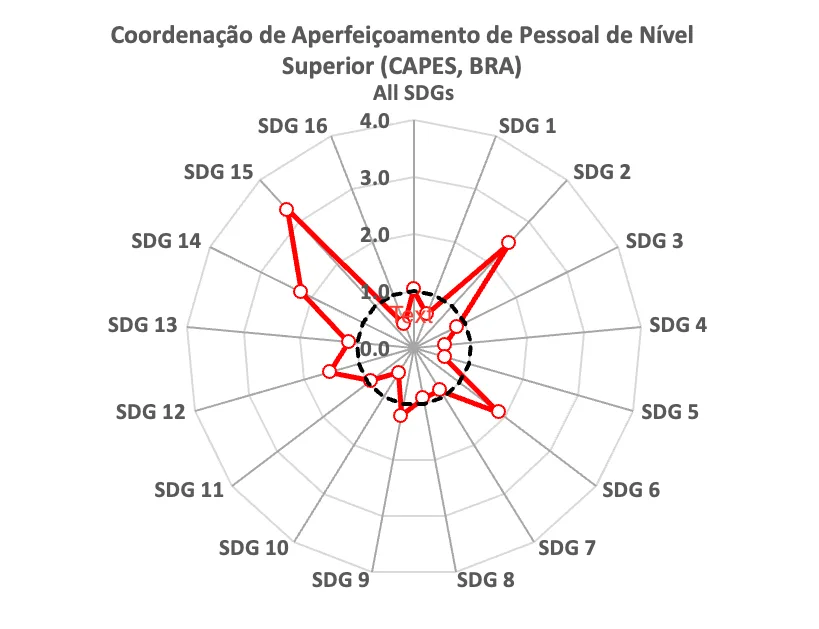
Relative Activity Index for each SDG and for any SDG, considering the publications that acknowledge support by the Coordination for Training Higher Education Personnel (CAPES, Brazil). The black dashed circle shows the World average publication activity for each SDG.
Here, the chart shows that CAPES in Brazil focuses strongly on themes related to SDG 15 (Life on Land), resulting in an intensity that is more than three times the World average.
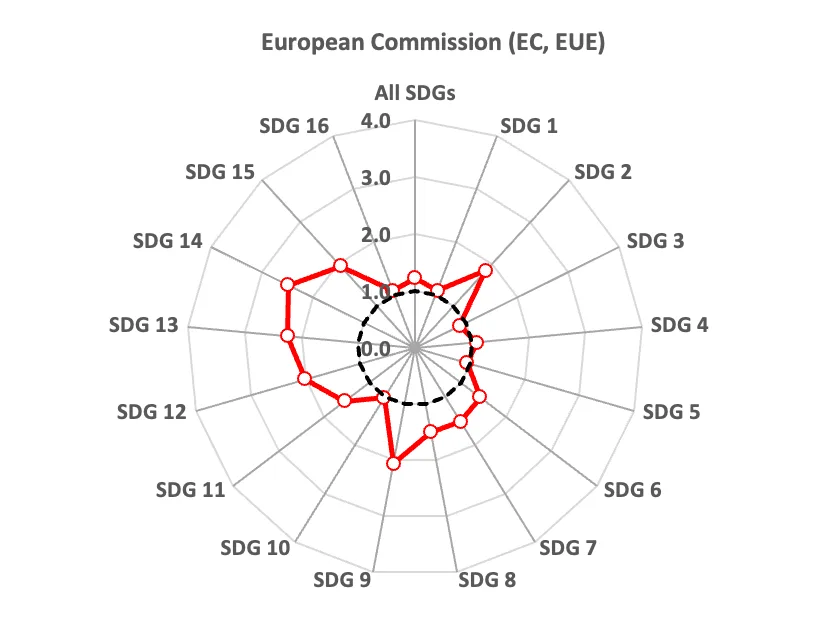
Relative Activity Index for each SDG and for any SDG, considering the publications that acknowledge support by the European Commission (EC, Europe). The black dashed circle shows the World average publication activity for each SDG.
The European Commission shows a Relative Activity Intensity curve that is twice above the World average for SDG 15 (Life on Land) and 2.5 times the World average for SDG 14 (Life below Water).
Presenting the results of SDG-focused research can thrive in a hybrid model that combines practical observations with data analysis. This is how the British Council quantified the outcomes of some of its early opens in new tab/windowSDGopens in new tab/window effortsopens in new tab/window, linking outcomes to specific goals while also giving more holistic progress reports, as well as how the U.N. 10-Member Group has been tracking research inputs that contribute to SDG achievementopens in new tab/window.
Strategies to present impactful research data
Communicating performance externally — to a governmental body or agency — requires a different approach than looking up information for internal use. The key is in presentation style. RFOs that can make their data easily understandable in terms of their potential impact when addressing their target audience are more likely to win policymakers' interest and support.
In practice, this means:
Producing graphically compelling charts and visualizations that put research outcomes related to local priorities in terms that government audiences understand.
Outlining research focus on areas that match government and taxpayer priorities, whether that means laying groundwork for future development, promoting the nation's competitiveness in the scientific field or driving immediate quality-of-life improvements.
Balancing generalized data for a whole program with specific cases that show the actual impact of the research being turned into tangible outcomes.
Many funders find that what they're presenting is not progress toward a specific SDG, but rather alignment between their areas of research and that goal. By indicating this alignment in a way that's supported by data and represented by clear visualizations, they can demonstrate how they play into overall societal priorities.

Successful RFO initiatives
The results of SDG-focused funding can demonstrate research's potential to have a concrete positive effect on society and the environment. Demonstrating these outcomes wherever possible is a way to show where your organization fits into national and international development objectives.
Studying examples of other governments' and RFOs' successful efforts, both in achieving results and presenting their outcomes to the public, can inspire your own programs. Programs around the world demonstrate the ways in which funders in different circumstances and with their own remits can approach SDGs.
These examples include:
Canada's SDG Funding Program: The Canadian government offers a web resourceopens in new tab/window that allows users to view funded research tied to any of the 17 SDGs, further broken down by province, year and more. This is an encyclopedic way to show Canada's federal priorities regarding sustainability.
The São Paulo Research Foundation (FAPESP): The FAPESP maintains a searchable websiteopens in new tab/window that demonstrates linkages between awarded grants and SDGs. Not only is the Brazilian organization leading its own programs, it also maintains a special set of grantsopens in new tab/window for collaboration with researchers from the National Natural Science Foundation of China (NSFC).
While the balance of research themes may differ between high-income and low- and middle-income countries, there are many examples from around the world of companies funding SDG-based research and drawing explicit connections between the work and its sustainability outcomes.
Challenges and opportunities
Achieving suitable alignment between research funding and SDGs can be fraught with challenges, as can communicating the performance of the resulting studies and their impact. Acknowledging and overcoming these difficulties, however, can set RFOs, government agencies, and individual research groups up for success.

Challenges and barriers: Issues hampering progress on SDGs can include a general misalignment at high levels. For example, Nature cited the relative lack of SDG-based research in high-income countriesopens in new tab/window. While low- and middle-income countries have less to spend on research per capita, their alignment with the UN's goals is much stronger.
Some research funders may also encounter procedural difficulties. These include relatively short funding cycles, as well as the risk that political change and volatility within governments may lead to quick changes in priorities. Funding can be conditional and rapidly reapportioned, upsetting funders' efforts to pursue specific SDGs or related objectives.
In some cases, the problem comes not with funding the research but with finding ways to demonstrate the linkages between spending and outcomes. RFOs that don't use data-driven analysis methods may fail to adequately show where they fit into the SDG ecosystem.

Opportunities for improvement: Organizations that become more adept at tracking their research outcomes can simultaneously overcome multiple problems with research funding alignment. With access to bibliometric databases and ML-powered data analytics tools, it's possible to draw connections between present research and SDGs, clarify the social value of efforts and arrange for closer alignment in the future.
Adding analytical capacity may represent a change for today's RFOs, many of which can struggle to express their outcomes and results in data. Implementing greater data analysis capacity can mean collaborating with onboarding and product experts from the software provider.
Rather than establishing new data resources, organizations are tapping into databases that have existed for years. The key scientific publication database tapped by today's RFOs and research teams dates back to 1788 and contains over 100 million publications. Searching and analyzing research and turning the results into visualizations can make it easier to explore and visualize existing research data.
Alignment between RFOs and the achievement of SDGs is already strong, but with adjustments to the way organizations quantify and measure their funding activities, there is room to deepen the linkage.
Exploring new ways to demonstrate SDG performance
By investing in effective bibliometric databases and access tools that implement search technology based on ML, you can gain new levels of insight into your organization's contributions to the SDGs. This will empower you to convincingly demonstrate the societal and environmental value of your organization's support, connect with organizations inland and overseas, and engage more closely with the taxpayer and your own government's goals.
Deploying this evidence is a way to continue pursuing the society-shaping research that inspires researchers to pursue scientific careers. It's an ability to put the world's welfare in focus, putting numerical proof to governments' and individuals' highest aspirations.