
Individual subscriptions now available. Experience ClinicalKey AI free for 14 days

非常抱歉,我们不完全支持您的浏览器。如果您可以选择,请升级到较新版本或使用 Mozilla Firefox、Microsoft Edge、Google Chrome 或 Safari 14 或更高版本。如果您无法进行此操作且需要支持,请将您的反馈发送给我们。

2026年8月4日
|
United States
I’m an internist by training. I also have a board certification in clinical informatics. My day’s sort of all over the place. I work on the resident service so we have inpatient rounds, outpatient service to serve the follow-up clinic to span both of them in our small little residency world. I’m on the teaching service as well so I spend a fair bit of time mentoring residents for quality improvement projects and process improvement.
I think that the best thing about this is it gives me the answer that I need when I need it … I think it’s really nice that I can put in sort of natural language that I’m looking for [specific queries], like the last query I had was for polyarthritis and fevers and we had done the non-infectious work up and what other inflammatory markers were we looking to do. And it gave a really nice sort of overview in terms of what the time course would be that we’re looking at, make sure that we had assessed all the non-infectious work up before moving on to what laboratory tests should do from there. So just was really nice overview and to a point where we could, I don’t want to say we can use that as our rounds, but that definitely helped the residents sort of frame to me and to the patient what the next steps would be from there. So, which is really helpful.
You know, we have phones and tablets on rounds, unfortunately, which can be distracting. So a lot of residents do use [general AI tools] to sort of look up questions or answers. And I’m a little weary in terms of the veracity of some of the claims that are on there. With [ClinicalKey AI], I have a really nice knowledge that I know where it’s coming from number one. Number two, you know, I have the references that I can look up or point to right from there. The biggest fear is always sort of is how true is what you’re looking at, and is this hallucinations or is it false information you’re getting. With [ClinicalKey AI], I do have, you know, with the residents, especially for this last case for polyarthritis, it was nice to have the journal articles that we’re referencing in terms of what to do for a second, third [option] sort of right there. So if the residents had any questions, I had any questions, I could easily refer to it from there. Whereas unfortunately, looking at it [with other large language models] it’s sometimes hard to see where that information is coming from. It’s not as transparent. And, and that worries me a little bit is how can I tell the patient or tell the resident this is sort of the next steps to take without having something to back that up from there.
The big benefit for me for using ClinicalKey AI is that I asked it a very specific thing I’m looking for. Is Eliquis good enough for cryodissection or do I need to use the gold standard that were taught before, you know, Coumadin or Heparin or what’s the validity of having, you know, CT coronary angiograms to for moderate risk chest pain? It’s just, it’s a test. It’s an add on test. It’s more delay or time in there. It was really nice to sort of give me a quick, concise answer.
But I really do like the fact that if I ask a specific question and again, all the queries I’ve put on there, I’ve been getting very nicely curated responses back based on the query I put in. It’s not something generic that “hey, I have a patient with a fever. What do I do?” I’m not asking it that. I’m asking very specific questions for, you know, polyarthritis serology questions, modality, so it’s been really helpful with that.
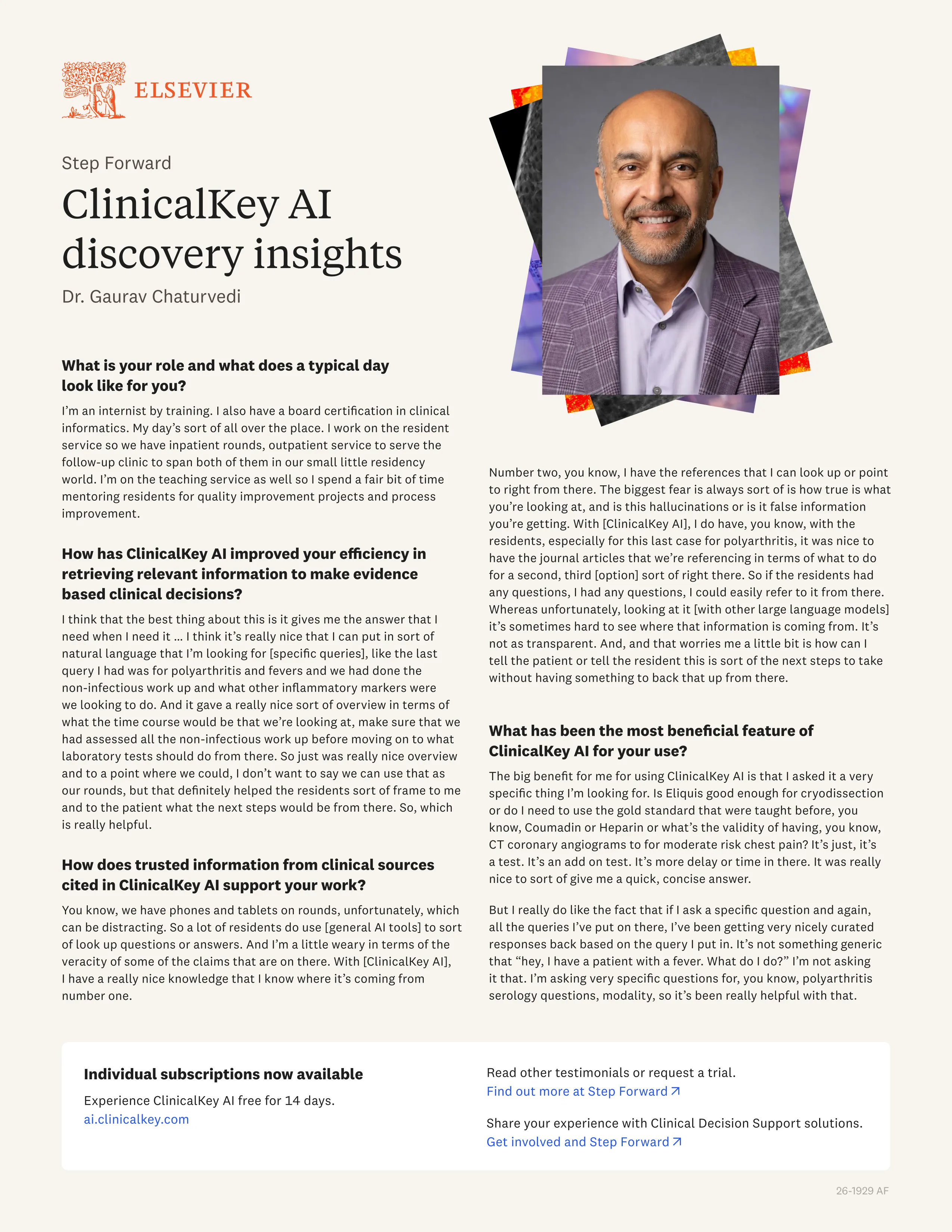
ClinicalKey AI Discovery Insights: Dr. Gaurav Chaturvedi
Download here 在新的选项卡/窗口中打开