
Harnessing AI for innovative research
Building the conditions for responsible, AI-enabled discovery

About this guide
Artificial intelligence is changing research across higher education. Created for research leaders, this guide explores the potential of AI in research, including its implications for responsible use, research quality, integrity and impact. It offers perspectives to help you shape an effective AI strategy for research.
This guide explores questions such as:
How is AI changing research and scientific discovery?
What opportunities and challenges does AI create for research institutions?
How can research leaders enable responsible and effective AI adoption?
Why AI is a defining development for research leadership
In October 2024, the Nobel Committee awarded the Prize in Chemistry to Demis Hassabis, John Jumper and David Bakeropens in new tab/window for using artificial intelligence to solve protein structure prediction — a problem that had defeated generations of researchers for five decades. It was not the beginning of AI in research, but it signaled what becomes possible when AI is applied to scientific challenges with the right data, talent and institutional conditions.
That moment carries both inspiration and weight for those leading research at their institutions. Academic research leaders want to ensure their universities are prepared to meet intensifying expectations to deliver results faster and with greater impact. At the same time, there are growing questions about what AI offers — and the risks that come with it. Leaders are working in challenging circumstances: the opportunity to accelerate innovation must be carefully balanced against the need for responsible, ethical and safe practice.
Adding to the pressure are region-specific challenges that look markedly different around the world. In the US, public confidence in higher education ticked up in 2025 for the first time in a decade, but at 42% it remains well below the 57% Gallup recorded in 2015 — and only modestly above the 36% historic low of 2023 and 2024 (Gallup, 2025opens in new tab/window). The research enterprise is not isolated from these broader trends. In a world where AI can produce expert-sounding content on demand, the trustworthiness of research itself is increasingly in question. Research leaders who lead effectively on AI will not only accelerate their institution’s research outputs; they will help restore the credibility of scholarship at a moment when that public trust urgently needs strengthening.
Elsewhere, those pressures take different shapes:
In Japan, which ranks among the world’s fastest-aging societies, with its population projected to fall by nearly 40 million over the next 40 years (Gigante & Gest, 2025opens in new tab/window), AI is framed less as a way to cut costs than as a way to augment a shrinking research workforce. The country’s 2025 AI Promotion Act deliberately favors light-touch, guidance-based regulation to keep innovation moving (World Economic Forum, 2026opens in new tab/window). That policy stance is now backed by substantial investment and international reach: Japan’s draft fiscal 2026 budget allocates ¥502.7 billion (~ US$3.2 billion) to AI, with nearly 90% devoted to strengthening the country’s AI development capabilities (White & Case, 2026). The country's global AI ambitions are also evident in its research partnerships: in June 2026, Japan became the first international partner in the US Genesis Mission — a $1 billion AI-for-science partnership, funded equally by both governments over five years, to accelerate AI-driven scientific discovery (US Department of Energy, 2026).
In China, AI is viewed as a strategic technology central to national importance and competitiveness, prompting institutions to rapidly expand AI education and research. By 2026 more than 600 universities had launched AI degree programs (Ministry of Education, 2026opens in new tab/window), part of a broader national effort to address a projected shortfall of up to four million AI professionals by 2030. For China, the story is one of rapid capacity building rather than declining public trust (McKinsey, 2023opens in new tab/window).
In Singapore, more than S$1 billion (~ US$750 million) has been committed to AI research and talent through 2030, yet research leaders there must navigate intense global competition for the very people they train, as well-funded technology firms aggressively recruit talent from their campuses (MDDI, 2026opens in new tab/window).
In Europe, the pressure is largely regulatory: under the EU AI Act, the world’s first comprehensive AI law, university systems used for tasks such as admissions or grading can be classified as “high-risk,” carrying obligations for risk management, documentation and transparency. For research leaders, this is a challenge to navigate rather than a barrier — part of a push toward responsible, trustworthy AI — even as Horizon Europe and the AI Continent initiative channel funding into compliant research (European Commission, 2024opens in new tab/window).
In Latin America, ambition is outpacing capacity: Brazil’s 2024–2028 national AI plan commits roughly R$23 billion (~ US$4.3 billion) and a flagship supercomputer, yet the region attracts only about 1% of global AI investment despite accounting for 6.6% of global GDP, leaving leaders to close persistent gaps in computing, funding and advanced talent (ILIA, 2025opens in new tab/window).
Each country faces its own version of this pressure — demographic, competitive, regulatory, infrastructural or reputational — but all share the same defining moment: a narrow window in which research leaders must define how AI is used and shape the opportunities it opens for their researchers.
This piece is for those leaders. It is not a primer on AI technology but a framework for thinking through as you weigh the opportunities and challenges that define this moment.

What AI makes possible in academic research
AI breakthroughs accelerating research today
Across disciplines, AI is compressing the time between question and discovery in ways that would have seemed implausible only a decade ago. There are already numerous examples of AI accelerating discovery, such as:
Researchers at Stanford used an AI “co-scientist” to identify existing drugs that could be repurposed to treat liver fibrosis — one candidate, Vorinostat, blocked 91% of the chromatin changes that drive scarring (Guan et al., 2025opens in new tab/window).
In Japan, Tokyo-based Sakana AI built an autonomous “AI Scientist” that generates hypotheses, runs experiments and drafts full manuscripts end-to-end. One of the system’s AI-generated papers cleared the first round of peer review at a 2025 ICLR workshop, placing it roughly in the top 45% of submissions (Lu et al., 2026opens in new tab/window).
A machine-learning model trained on 19,000+ battery cathode experiments across 14 metal-containing species is now helping researchers rapidly identify candidate materials for next-generation batteries (Zhong et al., 2024opens in new tab/window).
AI models are helping researchers uncover causes of Alzheimer’s disease that were only visible because AI could predict three-dimensional protein structures with the necessary precision — in one 2025 UC San Diego study, modern AI revealed a previously unknown function of the PHGDH protein that points to a new therapeutic target (Chen et al., 2025opens in new tab/window).
Climate scientists are now able to forecast weather with a level of precision that was previously out of reach. Google DeepMind’s GraphCast produces 10-day global weather forecasts in under a minute and beats the ECMWF’s industry-standard model on roughly 90% of metrics (Lam et al., 2023opens in new tab/window).
How researchers are using AI day-to-day
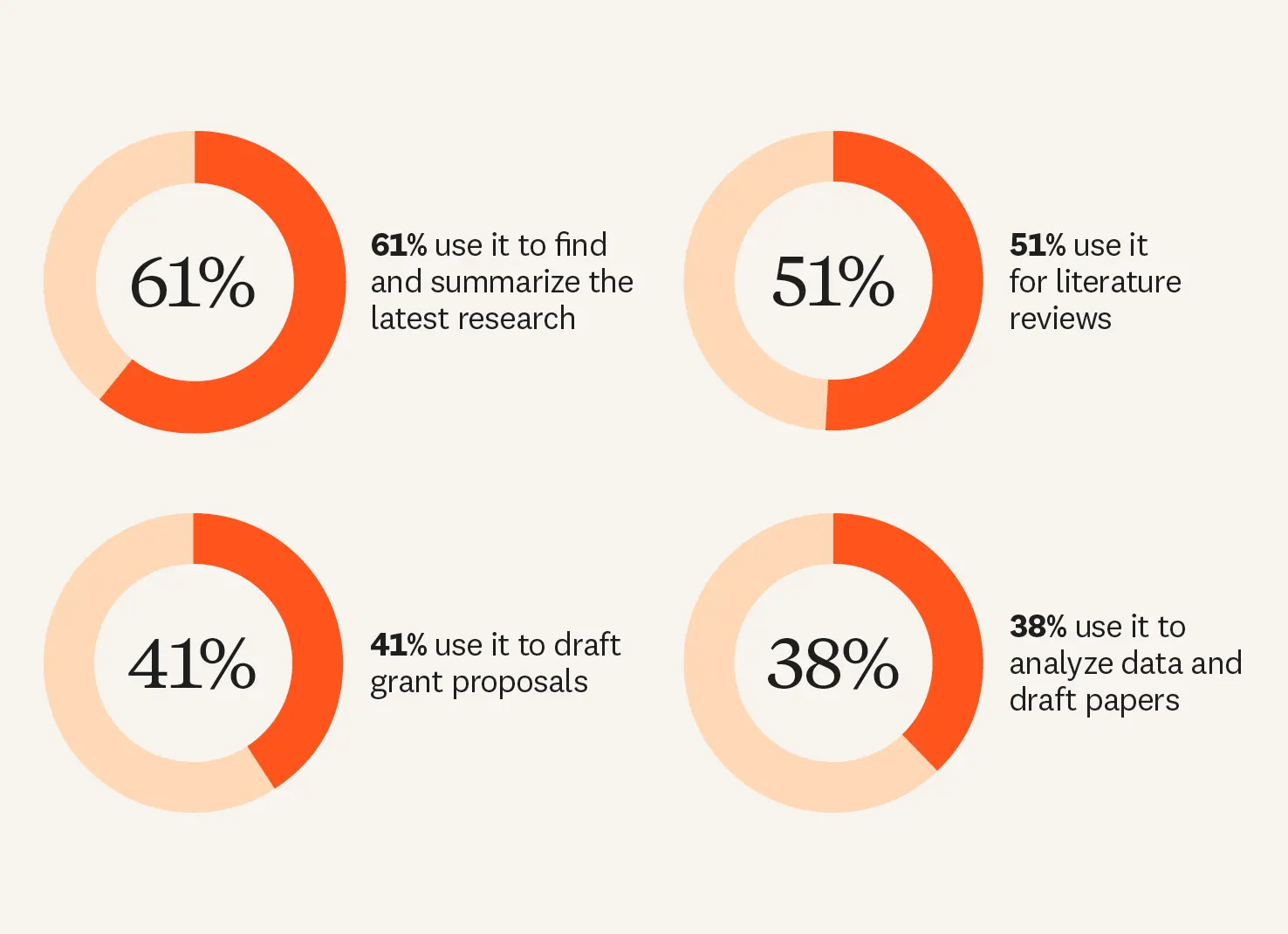
Examples like these are easy to point to, but they are only the visible tip of a much broader shift. Elsevier’s 2025 Researcher of the Future report, based on responses from 3,200+ researchers across 113 countries, found that AI use among researchers jumped from 37% to 58% in a single year. How researchers are using AI is just as revealing:
61% report using it to find and summarize the latest research.
51% use it for literature reviews.
41% use it to draft grant proposals.
38% use it to analyze data and draft papers.
AI has moved past the experimental stage — it is now embedded in the workflow of many researchers, often invisibly.
How AI is expanding access to research
AI is also making research more accessible in a deeper sense. Translation capabilities are opening non-English research to researchers globally, addressing the long-standing dominance of English in scholarly publishing. For example, a researcher in São Paulo whose native language is Portuguese can now engage substantively with a Japanese-language methods paper — and, more importantly, identify relevant insights from research published in virtually any language at scale, far faster than traditional translation workflows ever allowed. Researchers at less-resourced institutions are gaining access to analytical capabilities previously available only to well-funded labs. And AI’s ability to surface unexpected connections across fields broadens the scope of what interdisciplinary research can achieve.
We have large-scale data and pre-identified massive research questions ready to be solved and transformed using AI-based approaches for the benefit of people and the planet.Source: Elsevier, AI for science (2025)Professor Sharon Pickering
Vice-Chancellor and President at Monash University (Australia)
What does this mean for research leaders?
For research leaders, the question is no longer whether these capabilities matter for their institution — they already do, in labs and at desks across campus. The question is whether the institutional conditions are in place to turn that a grassroots experimentation into competitive advantage: the data infrastructure researchers can use, the training they need to use it well and the governance that lets people move quickly while managing risks.
These experimental platforms will democratize access and participation across a broad and inclusive population, enhance interdisciplinary and nimble collaboration around the world and speed up translation from scientific discovery into practice.
Theresa Mayer, PhD
Vice President for Research at Carnegie Mellon University
The AI adoption-enablement gap in higher education
Despite rapid adoption, researchers reported feeling unsupported. That gap may signal a pressing focus area for research leadership.
27% of researchers say they have adequate training to use AI effectively in their work. Elsevier, Researcher of the Future, 2025
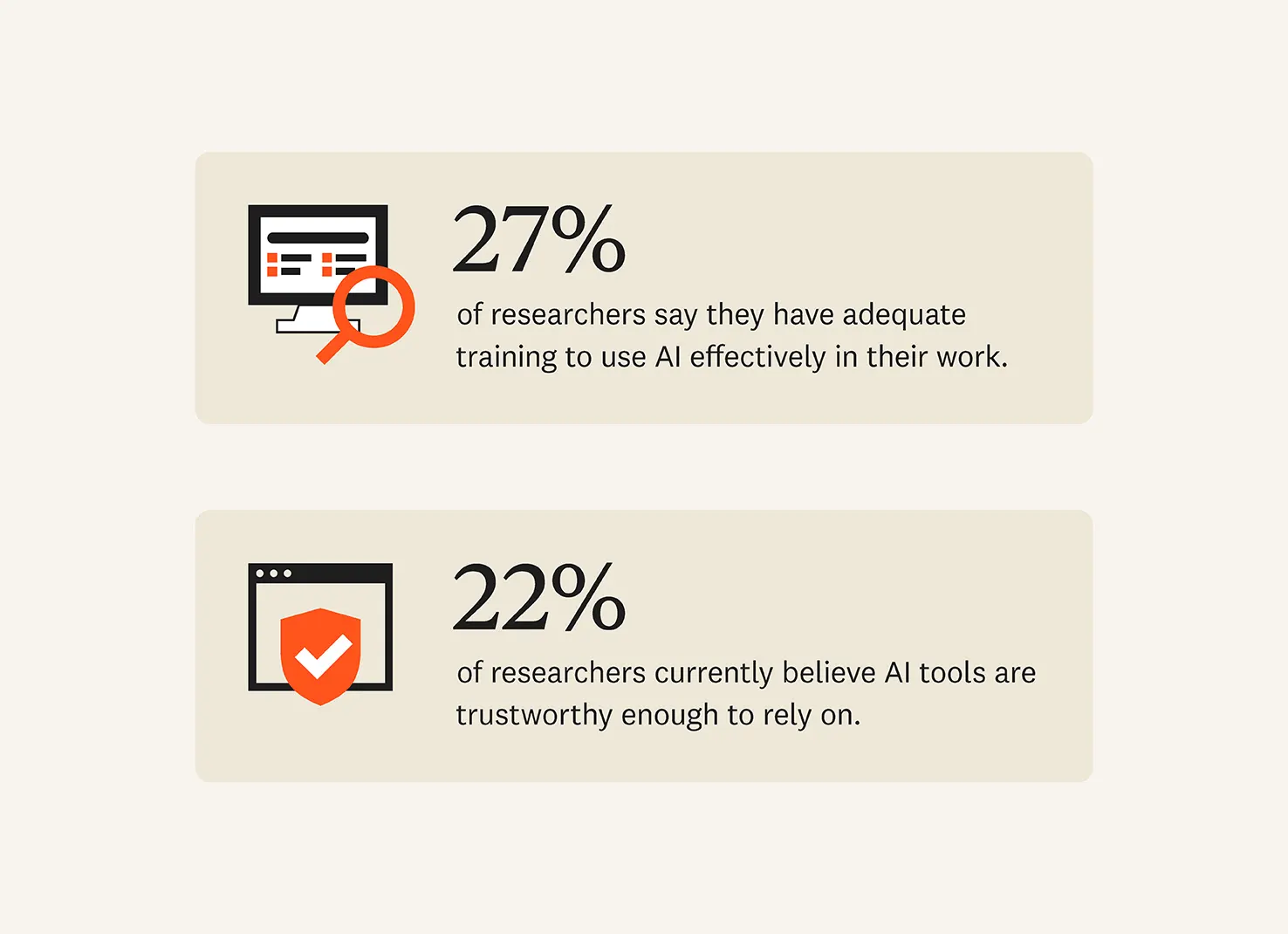
22% of researchers currently believe AI tools are trustworthy enough to rely on. Elsevier, Researcher of the Future, 2025
Researchers are not waiting for permission — they are already using AI tools. The question is whether they are doing so with adequate guidance, appropriate tools and institutional support. EDUCAUSE’s 2025 AI Landscape Studyopens in new tab/window suggests the majority are not: The survey found that 80% of faculty and staff use AI tools, yet fewer than one in four are aware of a formal institutional policy. More than half of higher education institutions report having no institution-wide AI strategy. When researchers were asked directly what would increase their confidence in AI tools, the answer was striking in its clarity (Elsevier, Researcher of the Future, 2025):
Transparency and clear citations (59%)
Recency of data and up-to-date literature (55%)
Training on high-quality, peer-reviewed content (55%)
Regular human validation of AI outputs (49%)
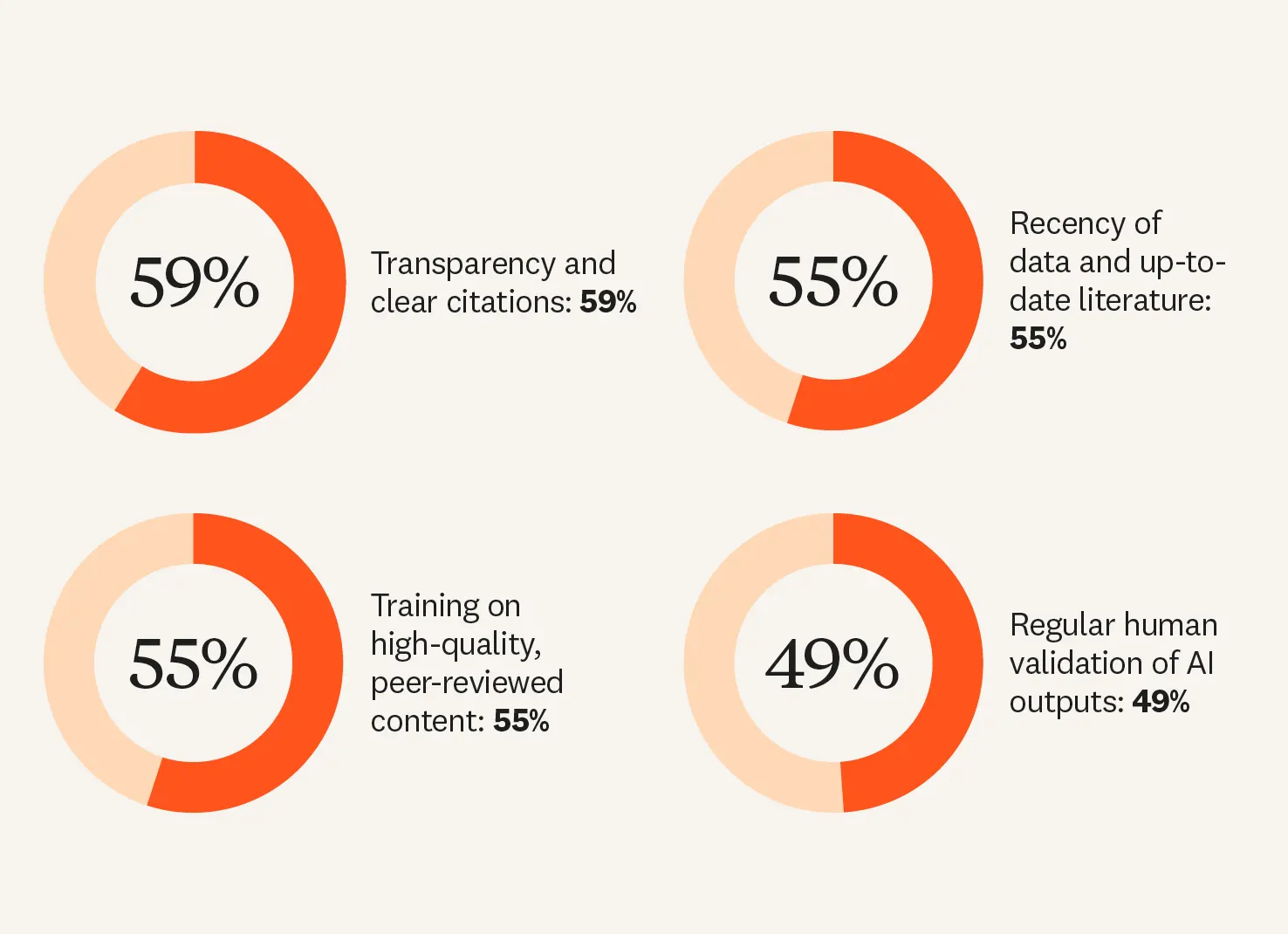
None of these can be achieved by researchers alone. Academic and research leadership can directly influence each of them through procurement decisions, policy frameworks and the culture they cultivate.
Focus on early career researchers
The gap is sharpest at the start of the research career. Younger researchers are consistently the heaviest AI users — a survey of over 6,000 researchers at two major German research organizations found familiarity and use of AI decline with age (Chugunova et al., 2026opens in new tab/window) — and in a recent European University Association survey, more than two-thirds of universities reported that their doctoral candidates use AI in their research (Times Higher Education, 2026opens in new tab/window). Policy has been slower to follow with fewer than 40% of institutions having any AI acceptable use policy (EDUCAUSE, 2025opens in new tab/window). Yet guidance rarely reaches the questions that land hardest on doctoral students and early career researchers — what counts as acceptable AI use in a thesis, how disclosure works between student and supervisor and how AI-assisted work is evaluated in hiring and promotion. Because habits formed in doctoral training persist across a career, supervision and graduate training may be where investments in AI enablement deliver the greatest long-term return.
Six AI challenges shaping research leadership
Here are six challenges likely to shape your AI leadership agenda over the next three years.
1. AI hallucinations and research integrity
As is well-known, AI tools can generate plausible-looking but entirely fabricated citations, data and analyses. In late 2025, an analysis by the AI detection company GPTZero of papers accepted at NeurIPS, an AI research conference, identified at least 100 AI-fabricated citations across 53 published papers, roughly 1% of all papers accepted that year (Ansari, 2026opens in new tab/window). A companion analysis found similar contamination in ICLR 2026 submissions. The problem extends well beyond AI conferences: a Lancet audit of 2.5 million biomedical papers found fabricated references rose roughly 12-fold between 2023 and early 2026, with the steepest increase following the wider use of AI writing tools in mid-2024 (Topaz et al., 2026opens in new tab/window).
As Elsevier has examined in its own work on AI tooling, hallucinations take more than one form — from outputs ungrounded in the underlying sources to outputs that are well-grounded but factually incorrect — and the practical response is to ground AI in trusted, peer-reviewed content and keep human verification in the loop at every stage ( see both Preventing AI hallucinations in our research and health tools and EAI in Higher Education — A Question of Trust ).
The risk is not theoretical, and it is not confined to fringe cases. Research leadership can work with research integrity offices, journal editors and faculty to establish disclosure standards, verification requirements and meaningful consequences for misuse. Underpinning all of this is a more foundational choice: which AI tools the institution sanctions for research, and whether those tools are built on trusted, peer-reviewed sources in the first place. Policies on disclosure and verification cannot do their work if the underlying content is unreliable.
2. AI, public trust and the value of expertise
Beyond the internal integrity challenge lies a broader public trust problem. As we saw earlier, public confidence in higher education remains well below where it sat a decade ago — and the trust problem is no longer just about how universities are perceived; it is also about whether the public still believes in the value of human expertise. The 2026 Yale Committee on Trust in Higher Educationopens in new tab/window found that “the rapid technological changes of our moment are contributing to declining public trust in the very idea of human expertise.” When AI can produce expert-sounding outputs on demand, the public increasingly asks: what is the value of a human expert? In academic publishing and research more broadly, trust is the currency of progressopens in new tab/window — what allows ideas to travel, funders to commit and scholarship to accumulate. For research leadership, responsible and transparent AI governance in research is not just an operational question; it is a question of whether the public, funders and the scientific community will continue to trust the research your institution produces.
3. Research funding pressure and AI infrastructure
The funding context differs sharply by region (see table below), but the direction is strikingly similar: established research economies face acute pressure while China and India are scaling AI investment as a central policy priority. Research leaders are being asked to lead on AI strategy at the same moment they are managing real uncertainty about whether their labs will be funded next year — in nearly every major research economy. Explore examples of how research leaders around the world are navigating AI.
Although institutions are contending with these external pressures, some of the sharpest challenges are internal — starting with making the case for AI investment when core budgets are under pressure. That case rarely rests on the promise of transformation alone. With 58% of researchers already using AI in their work, the practical choice facing most institutions is between supported, governed adoption and ungoverned use. A phased approach, starting with trusted tools and training before larger infrastructure commitments, can help keep the investment conversation grounded in demonstrated demand rather than speculation. Framed well, the case is as much about reallocation as it is about new money: according to BCG in their report, How AI Can Help Higher Education Capture a Once-in-a-Generation Opportunityopens in new tab/window, a well-prioritized AI roadmap can shift millions toward mission-critical priorities, research and innovation among them (BCG, 2026opens in new tab/window).
4. Faculty resistance to AI in research
Not all researchers are enthusiastic AI adopters — and some have principled, well-founded concerns worth taking seriously. Adoption is uneven across disciplines, seniority levels and levels of resource access. Mandates without culture rarely work in research settings. Research leaders can help by building an environment that respects legitimate skepticism while still enabling the institution to move forward purposefully.
Some of that resistance is better understood as a capability gap: only 27% of researchers say they have adequate AI training (Elsevier, Researcher of the Future, 2025), and skepticism often softens when structured training, protected time to experiment and peer examples are available (Times Higher Education, Boosting AI Literacy Across Your Institution, 2026opens in new tab/window). Research leaders need not build that capability alone — academic libraries are emerging as institutional anchors for AI literacy education, drawing on strategic thinking, technical experimentation and principles of knowledge integrity to build capacity across the institution ( see Elsevier, Rising to the Challenge: Library Leaders on AI Literacy Education).
5. AI governance in higher education
Movement is happening, but slowly. Institutions with AI acceptable use policies rose from 23% in 2024 to 39% in 2025 (EDUCAUSE, 2025 AI Landscape Studyopens in new tab/window). Yet Inside Higher Education reports that only 14% of US provosts say their institution has adopted a comprehensive AI strategy or governance framework; one in five report an intentionally hands-off approach, and the largest share are still developing policy (Inside Higher Ed, 2025 Survey of Chief Academic Officers, n=478opens in new tab/window). The challenge is that governance frameworks risk being obsolete by the time they are ratified. Adaptability and continuous review are requirements, not aspirations.
6. AI and the equity gap in higher education
AI models trained on historical data can perpetuate existing biases — in the research questions that are surfaced, which datasets are privileged and which languages and geographies are represented. In “Can colleges be run using AIopens in new tab/window?,” The Chronicle of Higher Education has called the resulting institutional gap “Digital Divide 2.0:” well-resourced institutions with the infrastructure and talent to leverage AI accelerate further, while those without fall further behind (Chronicle of Higher Education, 2025). The sector recognizes the risk — in EDUCAUSE’s 2025 AI Landscape Study (subtitled Into the Digital AI Divideopens in new tab/window), 83% of respondents said they were concerned about a widening digital equity divide.
This is not only a US concern. Across the Pacific Rim, the Association of Pacific Rim Universities (APRU)opens in new tab/window has brought member institutions from very different economies together, cautioning that “access remains a critical equity issue — without deliberate intervention, AI risks widening existing digital divides,” and arguing that governance should move beyond restriction to enablement, giving researchers clear guidance while actively encouraging experimentation (APRU, 2025opens in new tab/window).
Its conclusion is that “individual institutional responses are insufficient for the scale of change required:” APRU points instead to collaborative clusters — universities moving “beyond competition to cooperation in key areas including joint development of generative AI applications and pedagogical approaches, shared frameworks for assessment redesign, coordinated advocacy for equitable access, combined faculty development initiatives and unified governance frameworks that respect local contexts.”
A question for research leaders to consider is whether their AI strategy narrows or widens the equity gap within and beyond their institution.

Five AI leadership actions you can take now
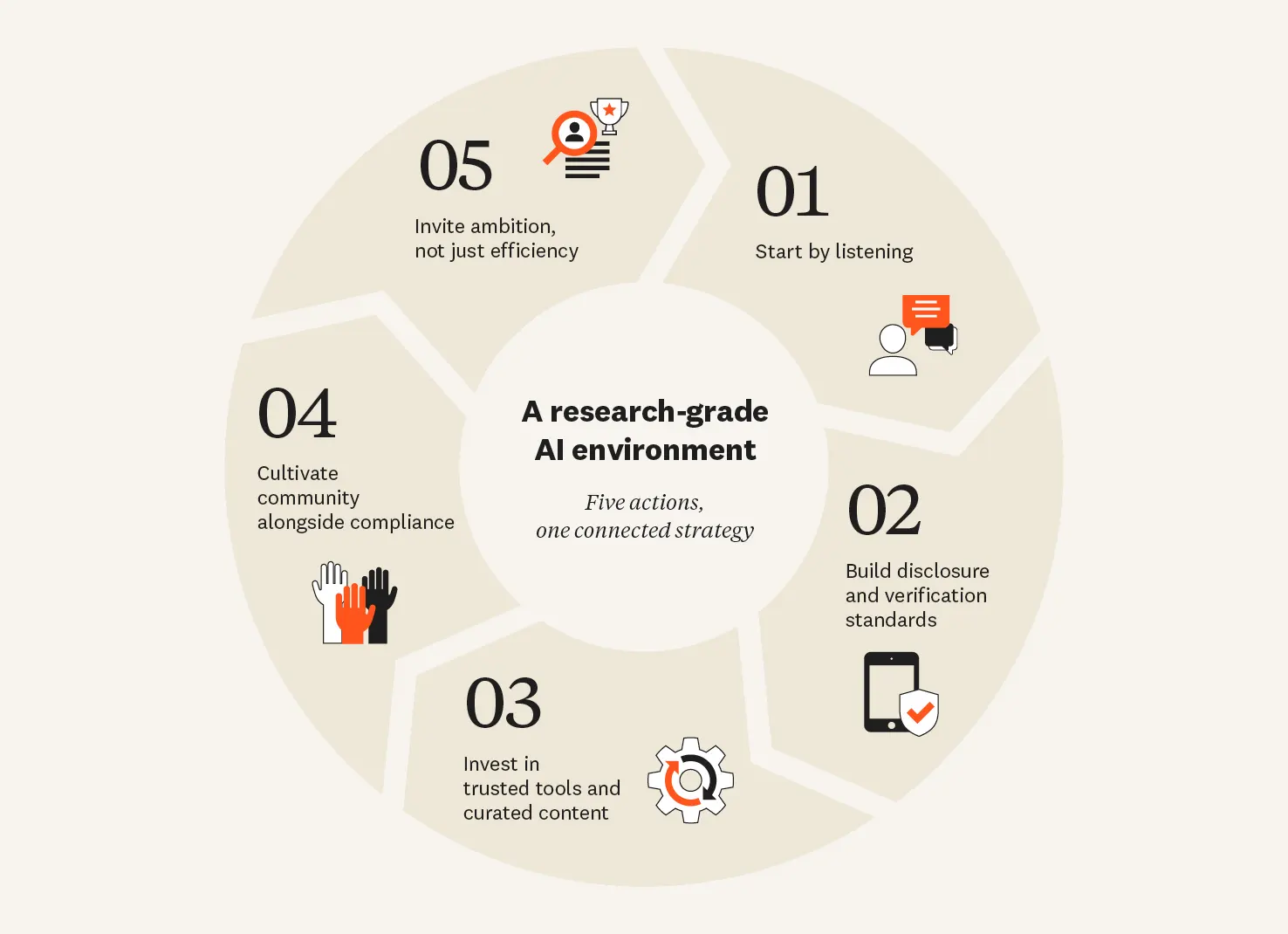
The good news is that the most important moves are ones research leaders are already positioned to make. These five actions are accessible to every institution, whatever its size, funding picture or technical starting point and the leaders making them now are shaping where their institutions will sit five years from today. For most institutions, the question is no longer whether to adopt AI, or even whether researchers are using it. Enterprise-wide rollouts of tools like ChatGPT and Gemini are already underway, often ahead of any research-specific strategy or governance. The leadership task has shifted accordingly: from granting permission to giving fast-moving, scattered adoption a coherent, research-grade shape. In “How AI can help universities capture opportunityopens in new tab/window,” the Boston Consulting Group (BCG) makes the same point for higher education broadly: value comes not from isolated pilots but from end-to-end transformation of core functions, with research and innovation being one of five domains where AI is already delivering gains (BCG, 2026opens in new tab/window). The five actions below work best when read as one connected strategy, not a menu.
1. Start by listening. Some of the most useful AI insights at any institution are already in faculty and researcher hands. A quick survey of which tools researchers are using, for what and what they want from you turns that into shared knowledge. Governance built on that baseline tends to land better because it reflects the work people are actually doing. It also tells researchers what most of them want to hear: that policy is being shaped with them.
Idea: Start with a five-question pulse survey — which tools are you using, for what, what do you want the institution to provide, what holds you back and what would earn your trust — and publish the results back to researchers.
2. Build disclosure and verification standards that fit research. The norms researchers need for AI in their work may be different from those that fit teaching and learning, and they may vary across disciplines — which means the strongest frameworks might come from collaboration, not a single institutional template. Research integrity offices, discipline leaders, chief technology officers, publishers and funders are all useful partners; many are already building pieces of this. The goal is not to restrict AI use but to make it verifiable and properly attributed without limiting legitimate innovation, which is also what most researchers are looking for.
Idea: Convene a small group; research integrity, a few discipline leads, a librarian and IT. Then agree on a one-page baseline: what to disclose when AI is used, what human verification is expected and where disciplines differ; distribute version one in weeks and revise it openly.
3. Invest in trusted tools and curated content. One of the most consequential AI procurement decisions a research leader can make is which underlying data to trust. Researchers themselves are clear about what they want: AI tools trained on high-quality, peer-reviewed content, with transparent citations and up-to-date literature. Treating data provenance and quality as a primary criterion in procurement is one of the strongest investments in long-term research quality. For why source quality is the decisive factor when evaluating AI for research, see Elsevier's “Why trusted content matters in AI research.”
Idea: Ask four questions of every AI procurement: Is it built on peer-reviewed, licensed content? Does it return citations and provenance? Is the literature current? Does it meet privacy and IP requirements? Then, score data provenance rather than treat it as an afterthought.
4. Cultivate community alongside compliance. The strongest AI adoption in research tends to grow from shared norms, peer learning and iterative refinement — the same things that make any research environment work. Champion your early adopters. Create visible, low-stakes forums for researchers to share what is and is not working. Bring in external expertise. Connect with peer institutions. Policy will always matter, but the culture you build around it is what determines whether the policy is used.
Idea: Name three or four early adopters as AI champions, give them a small budget and a monthly forum to show what is and is not working, and make sure skeptics are in the room. 5. Invite ambition, not just efficiency. AI’s most powerful use in research is not just a faster literature review, it is the question that was previously out of reach. The Nobel-winning protein structure work, the AI co-scientist surfacing drug candidates, the climate model that finishes with better-quality data; i.e. these are research questions that AI made tractable, not just tasks AI made faster. Research leaders who explicitly invite their researchers to attempt those questions — and back them with data, compute and protected time — unlock the upside that efficiency alone can’t deliver.
Idea: Put out a small internal call — even a few seed grants or blocks of protected time — for research questions that were previously out of reach, and pair the teams that answer with data, compute and methods support. Where to start with these actions depends on the institution: if there is no AI policy yet, idea 1 (listening) builds the foundation; if there is a policy but tooling is uneven, idea 3 (trusted tools) tends to deliver the fastest visible improvement; if both are in place, idea 4 (culture) is where the next gains live; and idea 5 (ambition) should run alongside all the others, whatever the starting point.
What a well-supported AI research environment looks like
When these five actions land well, a research environment starts to feel different. A doctoral student running a literature review for a grant deadline finishes a first pass in two days instead of two weeks and uses the time saved to design a stronger study. A faculty member working at the intersection of two fields surfaces a cross-disciplinary connection that would not have been visible at human reading speed. A research office processes proposal due diligence in a fraction of the time, freeing capacity for strategy. And a research team takes on a question that was previously out of reach — a protein structure no one had cracked, a drug candidate hidden in decades of literature, a weather forecast at a resolution no human could compute — because the institution has made room for that ambition. The ideal state is researchers who move faster, with more confidence in their sources and with the institutional support to attempt the work that matters most. That is what harnessing AI for research looks like: not a technology layer, but a research environment that has changed shape.

We worked across all research councils and consulted widely with the community to define a shared vision for AI — one that supports development and deployment across the research landscape and beyond.Kathryn Magnay
Director of Research Infrastructure at UK Research and Innovation (UKRI)
Why the next move on AI belongs to research leaders
The 2026 Yale Committee on Trust in Higher Education concluded its report with a charge that applies directly to this moment: “trust is built through action, not messaging.”
That action is now within reach: listen to what researchers are already doing with AI, build standards that protect integrity while making room for innovation, invest in tools grounded in trustworthy content and cultivate a culture where responsible adoption feels natural rather than imposed. The opportunity is bigger than speed: it is a chance to strengthen the credibility of scholarship at the very moment that trust matters most. The institutions investing now in rigorous, transparent, human-overseen AI use will be the ones the public, funders and the scientific community continue to trust — and continue to support and look to for answers. And research leaders are well placed to lead the way.
How to evaluate an AI tool or data source
Before adopting or scaling an AI tool across the institution, the same qualities researchers say would earn their trust double as a practical checklist. Five questions to ask of any tool and of the data behind it:
Provenance: Where does the underlying content come from: high-quality, peer-reviewed sources, or open web data of unknown quality? This is the most consequential choice, because disclosure and verification policies cannot compensate for unreliable source content.
Transparency: Does the tool show its sources, with citations and provenance for every output, so researchers can trace and verify each claim?
Recency: Is the literature it draws on current and kept up to date?
Human oversight: Does the workflow keep human validation in the loop rather than presenting outputs as final?
Fit and security: Does it meet the institution's privacy, IP and compliance obligations, and is access equitable across disciplines rather than widening the gap?
For why the data behind AI is the decisive factor in research, see Elsevier's “Why trusted content matters in AI research”.

How Elsevier supports the research mission
Elsevier has been a partner to the research community for more than 140 years. The same commitment to peer review, research integrity and trusted scholarly content that has shaped that history is what we are building our AI tools on — and what we bring to the partnership with research leaders to shape what comes next.
In practice, that means these tools are built on trusted, curated scholarly content, including Scopus, the world’s largest collection of research abstracts. Researchers get AI-assisted insights they can trace back to the source.
LeapSpace — research-grade AI workspace enabling your teams to work faster, smarter and with greater confidence in their sources. Built with the global research community, LeapSpace grounds every response in more than 20 million peer-reviewed full-text articles and books from Elsevier and over 1,000 publishing partners, plus over 100 million Scopus records, and every insight carries a Trust Card showing how the claim aligns with its cited source. New agentic tools such as Writing Coach and Claim Radar extend that support from literature review through to writing — all in a secure environment where researcher data is never used to train public AI models.
Scopus — AI-assisted literature discovery and citation analysis, grounded in peer-reviewed content. With more than 100 million records curated by an independent review board, Scopus with AI surfaces relevant insights with every response grounded in trusted, clearly cited content, and its metrics and author profiles help leaders identify experts, track emerging trends and evaluate research output at individual or institutional level.
SciVal — Research performance analytics to inform strategic decisions about where AI investments will have the most impact. Built on trusted Scopus data, SciVal helps institutions benchmark against peers, map collaboration networks and spot emerging research areas, while Smart Summaries transform complex analyses into plain-language insights for faster, more confident decision-making.
Frequently asked questions
The most significant challenge is not adoption — researchers are already using AI widely — but enablement. Elsevier’s 2025 Researcher of the Future report found that while 58% of researchers now use AI in their work, only 27% say they have adequate training and only 22% believe current tools are trustworthy enough to rely on. This adoption-enablement gap puts research leaders in a critical position: AI is already in use across campuses, but the governance, training and infrastructure needed to use it responsibly are lagging. Closing that gap — not restricting AI use — is the defining leadership task.
Effective AI governance in research requires more than a single institution-wide acceptable use policy. Research use cases differ from teaching and learning and vary across disciplines — which means the strongest frameworks come from collaboration between research integrity offices, discipline leads, librarians, technology teams and funders. Key elements include clear disclosure requirements when AI is used in research outputs, human verification standards for AI-generated content, transparent citation and provenance requirements for AI tools and regular review cycles. Governance built with researchers, not imposed on them, tends to be used. Fewer than 40% of institutions currently have an AI acceptable use policy (EDUCAUSE, 2025opens in new tab/window) — early movers have room to shape practice.
Five priorities stand out regardless of institution size or starting point. First, listen before governing — a faculty survey of current AI use builds a baseline and earns trust. Second, build disclosure and verification standards specific to research, not borrowed from teaching policy. Third, invest in AI tools grounded in peer-reviewed content — source quality is the most consequential procurement decision. Fourth, build culture alongside compliance by championing early adopters and creating low-stakes forums for peer learning. Fifth, invite ambition: the most powerful AI applications in research open questions that were previously out of reach, not just speed up existing workflows.
AI is compressing the time between research question and discovery across disciplines. Researchers are already reporting practical gains: 61% use AI to find and summarize research, 51% use it for literature reviews and 41% use it for grant proposal drafting (Elsevier, Researcher of the Future, 2025). At the frontier, AI is enabling discoveries that were not previously possible — Stanford researchers used an AI co-scientist to identify drug candidates for liver fibrosis; Google DeepMind’s GraphCast produces 10-day global weather forecasts in under a minute; and AI-predicted protein structures are revealing therapeutic targets for Alzheimer’s disease. The distinction that matters for research leaders is between AI as an efficiency tool and AI to attempt questions that were previously out of reach.
AI introduces integrity risks that operate at scale and with the plausibility that earlier forms of misconduct did not. AI tools can generate fabricated citations, data summaries and analyses that are difficult to detect — a 2026 Lancet audit of 2.5 million biomedical papers found fabricated references rose roughly 12-fold between 2023 and early 2026. The practical response involves two parallel tracks: institutional policies requiring disclosure and human verification of AI-assisted research outputs, and procurement decisions that favor tools built on trusted, peer-reviewed content with transparent citations. Disclosure and verification policies cannot fully compensate for tools drawing on unreliable source material in the first place.
The AI digital divide in higher education refers to the growing gap between well-resourced institutions that can afford the infrastructure, talent and compute capacity to leverage AI, and those that cannot. EDUCAUSE’s 2025 AI Landscape Study — subtitled “Into the Digital AI Divide” — found 83% of respondents concerned about a widening digital equity divide. The risk operates at multiple levels: between institutions within a country, between research-intensive and teaching-focused universities, and between nations. The Association of Pacific Rim Universities argues that “individual institutional responses are insufficient for the scale of change required” and points to collaborative clusters — shared frameworks, joint tool development and coordinated advocacy — as the appropriate response.
When procuring AI tools for research, the most important criterion is the quality and provenance of the underlying content, not the interface or feature set. Researchers are clear about what would earn their trust: tools trained on high-quality, peer-reviewed content (55%), with transparent citations (59%), current literature (55%) and human validation in the workflow (49%) (Elsevier, Researcher of the Future, 2025). Five questions to ask before adopting any tool: Where does the underlying content come from — peer-reviewed sources or open web data? Does it return citations and provenance for every output? Is the literature current? Does it keep human oversight in the loop? And does it meet your institution’s privacy, IP and compliance requirements?
Most cases start from what is already happening rather than what might: with 58% of researchers using AI in their work, the choice facing institutions is between supported, governed adoption and ungoverned use, which carries its own integrity and security costs. Framing the investment in phases — trusted tools and training first, larger infrastructure investments as demand is demonstrated — keeps the request proportionate and lets each stage make the case for the next. Framed well, the case is as much about reallocation as it is about new money: BCG estimates that a well-prioritized AI roadmap can shift millions of dollars toward mission-critical priorities, research and innovation among them (BCG, 2026opens in new tab/window).
Training gaps, not attitudes, explain much of the unevenness in AI adoption: while 58% of researchers use AI, only 27% say they have adequate training. The institutions closing that gap treat AI literacy as professional development rather than compliance — structured training, protected time to experiment, visible champions and low-stakes forums where researchers share what works. Institutions need not build that capability alone: academic libraries are emerging as institutional anchors for AI literacy education, giving training efforts reach across disciplines (see Elsevier’s Rising to the Challenge: Library Leaders on AI Literacy Education).
Early career researchers and doctoral students are among the heaviest AI users on campus: AI use declines with researcher age (Chugunova et al., 2026opens in new tab/window) and more than two-thirds of European universities report that their doctoral candidates use AI in their research (Times Higher Education, 2026opens in new tab/window). Policy has been slower to follow and is usually written with established faculty in mind. Support starts with clarity: explicit guidance on acceptable AI use in theses and publications, disclosure expectations agreed between supervisors and students and training that treats AI literacy as part of research methods rather than an optional extra. Habits formed in doctoral training persist across careers, so graduate supervision is where investment in responsible AI practice compounds most.
Start by taking it seriously — some skepticism is principled and well founded, and mandates without culture rarely work in research settings. Much resistance is better understood as a capability gap: only 27% of researchers say they have adequate AI training, and skepticism often softens when structured training, protected time to experiment and peer examples are available. Practical responses include championing early adopters rather than compelling holdouts, creating low-stakes forums where researchers compare notes and partnering with academic libraries, which are emerging as institutional anchors for AI literacy education. The goal is an environment that respects legitimate concerns while still moving forward purposefully.
AI cuts both ways for trust. When AI can produce expert-sounding content on demand, the public increasingly questions the value of human expertise — the 2026 Yale Committee on Trust in Higher Education found that rapid technological change is contributing to declining public trust in the very idea of human expertise. Integrity failures amplify the problem: fabricated citations and undisclosed AI use erode the credibility on which funding and scholarship depend. Institutions that adopt AI transparently — clear disclosure standards, human verification and tools built on trusted, peer-reviewed content — can make responsible AI governance a trust asset rather than a liability. For research leaders, the stakes are whether the public, funders and the scientific community continue to trust the research their institution produces.
The global context: examples of how research leaders around the world are navigating AI
Region | Funding climate | Top challenge for research leaders | National AI stance | Distinctive opportunity |
|---|---|---|---|---|
Australia | Moderate and partnership-led. Ranked alongside the US and UK as a top global influence in AI in higher education research. Active joint programs with India. | Maintaining global research competitiveness at smaller national scale without a coordinated national AI research mandate. | Institution-led. No single national framework; individual universities (Macquarie, QUT, Melbourne, Sydney) developing strong governance models. | Agile, ethics-led governance frameworks well-positioned for global export and strategic partnership. |
Brazil | Significant & state-led. Brazilian AI Plan (PBIA) 2024–2028 — 'AI for the Good of All:' R$23 billion (~US$4.3B) over four years across R&D, sovereign infrastructure, workforce training and governance. First investment step: a fourfold upgrade of the LNCC Santos Dumont supercomputer, which the government aims to make one of the world's five most powerful. Additional R&D support via the development bank BNDES. | Translating an ambitious federal plan into sustained delivery across multiple ministries (MCTI, MGI, MDIC) and budget cycles. Building sovereign computing and Portuguese-language model capacity while competing globally for talent. Securing energy and data-center infrastructure to match rising AI demand. | Sovereignty-focused, socially-oriented. PBIA (launched July 2024, approved Nov 2024) is coordinated by the Ministry of Science, Technology and Innovation (MCTI) around five strategic axes and 54 actions, emphasizing digital sovereignty, social inclusion and sustainability. Anchored by a national high-performance supercomputer, a sovereign government cloud and the Brazilian AI Observatory (OBIA). | Santos Dumont as a regional research-computing anchor for Latin America. A renewable-heavy energy matrix (largely hydroelectric) gives Brazil a sustainability advantage for AI infrastructure. Investment in Brazilian Portuguese language models reduces dependence on foreign systems and builds a research base relevant across Lusophone and Latin American contexts. Open Horizon Europe collaboration channels with Latin America. |
Canada | Established & institute-led. Pan-Canadian AI Strategy — the world’s first national AI strategy (2017), administered by CIFAR; Phase 2 (2022) committed more than C$443M (~US$325M) to three national institutes (Amii, Mila, Vector). Budget 2024 added a C$2.4B (~US$1.8B) package, including C$2B (~US$1.5B) for the Canadian Sovereign AI Compute Strategy (public supercomputing + an AI Compute Access Fund); Budget 2025 added a further ~C$926M (~US$680M). | Talent retention against intense US recruitment and salaries — described federally as a ‘crisis moment’ — and converting world-leading research depth into domestic computing capacity and commercial scale. A comprehensive federal AI law is still absent after AIDA (Bill C-27) was shelved in 2025, leaving a governance gap. | Research-first, now scaling toward computing sovereignty. World’s first national AI strategy (2017); a second national strategy (“AI for All”) launched in 2026. Governance rests on the Voluntary Code of Conduct on generative AI (2023) and the Canadian AI Safety Institute (2024); binding federal legislation is pending after AIDA lapsed. | Deep foundational-research pedigree — Turing laureates Geoffrey Hinton and Yoshua Bengio — and the Amii–Mila–Vector network anchor world-class talent. New sovereign-computing funding can convert research strength into capacity, and a long-standing convening role in international AI governance (a GPAI co-founder) positions Canada as a trusted-AI standard-setter. |
China | State-directed acceleration. National AI+ Education plan active across 17 provinces. Top universities expanding AI enrollment. Chinese-developed models, including DeepSeek, advancing rapidly on global benchmarks. | Aligning institutional research programs with national priorities at speed and scale; navigating an evolving international collaboration landscape. | Centrally coordinated and high priority. AI is core to national strategy, with funding, talent and deployment directed through national programs. | Speed and scale. Tsinghua, SJTU and Peking University are among the fastest-growing AI research outputs globally. |
European Union | €2B+ (~US$2.3B) in Horizon Europe AI budget 2026–27. RAISE pilot (€107M, ~US$125M). Goal to double AI investment to €3B+ (~US$3.5B). Only one European company at the AI frontier; projects may not begin until 2028–29. | Navigating EU AI Act compliance while maintaining research agility. Grant systems are overwhelmed by AI-assisted applications; success rates falling. | Ethics-forward and regulatory. EU AI Act and European AI in Science Strategy (Oct 2025) provide direction; implementation is still in early stages. | Ethics-led research AI leadership as a global differentiator, if institutions can operationalize it. |
Gulf States (UAE & Saudi Arabia) | Sovereign-wealth-fueled and vast. The UAE and Saudi Arabia have each committed on the order of US$100B to AI, backed by combined sovereign wealth exceeding US$3T. The UAE’s Stargate UAE (G42 with OpenAI, Oracle, Nvidia, SoftBank) anchors a planned 5GW Abu Dhabi campus (first 200MW due 2026); Saudi Arabia’s PIF-owned HUMAIN targets 1.9GW by 2030. US clearance for advanced Nvidia chips (Nov 2025) unlocked the build-out. | A binding talent constraint: computing capacity can be procured, but PhD-level researchers cannot — SDAIA targets 20,000 specialists and the UAE 30,000 against intense global competition. Converting imported infrastructure and models into home-grown research depth, Arabic-language capability and durable university research is the harder task. | State-led, infrastructure-first. The UAE appointed the world’s first Minister of State for AI (2017) and runs the National AI Strategy 2031; Saudi Arabia’s data-and-AI strategy is led by SDAIA. National champions G42 (UAE) and HUMAIN (Saudi) concentrate capital, energy and computing capacity; governance is strategy- and partnership-led rather than statutory. | Dedicated research universities — MBZUAI (UAE) and KAUST (Saudi) — plus sovereign open models (Falcon, Jais, ALLaM) and structurally low-cost energy make the Gulf a rising non-US, non-China computing pole. Abundant computing capacity and Arabic-language model infrastructure open collaboration and data-partnership opportunities at rare scale. |
Hong Kong SAR | Targeted and infrastructure-led. The 2025–26 Budget earmarked HK$1B (~US$128M) for a new Hong Kong AI R&D Institute (AIRDI, 2026); Cyberport’s AI Supercomputing Centre (live Dec 2024) is scaling to ~3,000 petaFLOPS, backed by a HK$3B (~US$385M) AI Subsidy Scheme (up to 70% of computing costs) and a HK$3B (~US$385M) Frontier Technology Research Support Scheme to recruit international researchers. | Building scale against high land, power and recruitment costs and a thin local AI-talent pool while computing capacity catches up with neighboring cities. Balancing world-class university research and international openness with deeper integration into the national ‘AI+’ agenda and Greater Bay Area cross-boundary data frameworks. | Strategy-led, application-focused. The Innovation & Technology Development Blueprint (2022) sets the course — ‘strengthening infrastructure and promoting the application-oriented approach’ — aligned with the national ‘AI+’ initiative. The locally built HKGAI V1 model is already used by 20,000+ civil servants; GBA data flow is a policy priority. | Five universities in or near the global top 100 and a dense research base (HKUST hosted APRU’s 2024 generative-AI workshop) position Hong Kong as a bridge between the Chinese mainland and the global AI ecosystem. Public supercomputing, an international data-port role and GBA integration make a distinctive platform for cross-border, application-driven research. |
India | Building rapidly. 2025 declared ‘Year of AI’ by AICTE across 14,000+ colleges and 40M students. IIT system leading research AI. IndiaAI mission active with major tech partners. | Infrastructure gaps and resource access limits. Challenge: scaling beyond teaching applications to genuine research-grade AI capability. | Government-led momentum. Strong political will; IndiaAI partnerships with Meta and global universities. | Potential to leapfrog legacy constraints with AI-native research models. |
Japan | Significant & scaling. 7th STI Basic Plan (FY2026–2030): record ¥60 trillion (~US$390B) government R&D investment target — double the 6th Plan — plus ¥180 trillion (~US$1.2T) combined public-private spending. AI & semiconductor package: JPY 10 trillion (~US$65B) committed to 2030. US-Japan Genesis Mission (2026): $1B over 5 years, $500M each (subject to appropriations). | Reversing a two-decade decline in global research ranking (currently 13th in top-tier papers; target: 3rd within a decade). Building AI research capacity at universities while absorbing record investment. Attracting international talent against language and structural barriers. | Innovation-first, state-coordinated. AI Promotion Act (May 2025, full effect Sept 2025): Japan's first AI-specific legislation — promotional not restrictive. AI Basic Plan (Cabinet, Dec 2025) as the overarching national AI masterplan. AI Strategic HQ sits under Prime Minister's Office. 7th STI Basic Plan (Apr 2026) frames science revival as a national survival imperative. | 7th STI Basic Plan's ambition to move Japan from 13th to 3rd globally in top-tier research papers creates a multi-year institutional reform opportunity. Fugaku + DOE HPC access via Genesis Mission provides unique bilateral computing infrastructure. RIKEN AIP and AIST AIRC as established AI research anchors. Innovation-first AI Promotion Act (no penalties) offers the most permissive regulatory environment of any G7 nation — a potential draw for international research partnerships. |
Kenya | Investment-led, partnership-driven. No large central AI research budget; momentum comes from the US$1 billion Microsoft-G42 green data center and East Africa Cloud Region announced in May 2024 — the largest private digital investment in Kenya's history — powered by Olkaria geothermal energy. Kenya's data center market (~US$184M in 2023) is growing at roughly 12% a year. | Infrastructure and power constraints: the flagship Microsoft-G42 data center stalled in 2026 over whether the grid can supply it at full scale. No binding AI legislation yet — governance remains strategy-led. Thin advanced-research and computing base relative to ambitions; reliance on international partners and private capital. | Strategy-led, regionally ambitious. Kenya National AI Strategy 2025–2030 (launched March 2025, led by the Ministry of Information, Communications and the Digital Economy) aims to make Kenya a leading hub for AI development in Africa, built on five priority actions spanning digital infrastructure, national datasets and foundation models, sector applications, agile governance and skills. Aligned with the African Union Continental AI Strategy (2024). | Positioned as sub-Saharan Africa's leading AI-solutions hub, with strength in applied AI for health, agriculture and finance. Geothermal-powered renewable computing capacity offers a sustainable infrastructure edge. A young, fast-growing digital workforce and Nairobi's 'Silicon Savannah' startup ecosystem provide a research-and-innovation base, and the national strategy positions Kenya as a governance reference point for the wider region. |
Malaysia | Government-backed, building deliberately. AI-RMap: RM600M (~US$128M) for AI R&D + RM1B (~US$210M) Strategic Investment Fund (AI, robotics, IoT). RM64.2B (~US$13.7B) total education budget (2025), AI integrated across university and TVET systems. RM50M (~US$11M) NAIO operational budget. RM10M (~US$2M) AI education allocation. New Malaysian Higher Education Plan (RPTM) 2026–2035 sets AI-integrated research as a strategic pillar. | No comprehensive national AI legislation yet (governance remains voluntary and fragmented across MOSTI, MDEC and the new Ministry of Digital). AI-RMap 2021–2025 expiring; successor strategy under development — creating a policy gap. Infrastructure and computing limitations constrain research-grade AI beyond teaching applications. | Multi-stakeholder, ecosystem-building. AI-RMap 2021–2025 as foundational strategy; National AI Office (NAIO, 2024) under Ministry of Digital as the new coordination body; AI Governance & Ethics Guidelines (AIGE, 2024) as voluntary framework. Quadruple Helix (government-academia-industry-civil society) as the operating model. Regional ambition: become a leading ASEAN AI hub. | Strategic bridge position between ASEAN emerging economies and Singapore/global AI governance norms. Demographic scale (34M population, 40M+ students in AICTE-adjacent programs) with a growing university research base. UTM AI Faculty and Malaysian AI Consortium as platforms for regional research convening. Microsoft and Google partnerships (200,000+ teachers trained) accelerating AI literacy on an institutional scale. First-mover advantage if Malaysia enacts a comprehensive AI law — it would become only the second APAC jurisdiction after Korea. |
Singapore | Well-resourced & targeted. NAIS 2.0: S$500M (~US$375M) committed via RIE (Research, Innovation & Enterprise) Fund (2023). S$70M (~US$52M) dedicated multi-modal LLM R&D initiative (National Supercomputing Centre). Digital economy: 18.6% of GDP (up 4% since 2019). NAIC updated priorities announced May 2026. | Small domestic talent pool relative to strategic ambitions. Translating world-class governance frameworks into applied research output at scale. Avoiding over-dependence on multinational R&D presence (Google, Microsoft, Nvidia all have Singapore AI labs) without building sovereign research capability. | Governance-first, globally positioned. NAIS 2.0 (Dec 2023) as the strategic framework; updated May 2026 with 10 refreshed priorities under the National AI Council (NAIC) chaired by PM Lawrence Wong (est. Feb 2026). Singapore positions itself as ASEAN's AI governance standard-setter and international convening hub. | The world's most exportable AI governance framework — model adopted by multiple ASEAN and Gulf states. NUS and NTU compete globally with Stanford and MIT in AI research rankings; strong industry-university pipeline. Natural convening role for pan-ASEAN AI research standards, data-sharing norms and multilateral governance. NAIC's elevation to PM level signals durable political commitment. MERaLiON sovereign LLM creates a Southeast Asian-language research infrastructure with no peer in the region. |
South Korea | Aggressive & front-loaded. National Growth Fund: ₩150T (~US$102B) over 5 years, 2026–2030 — the '20-year growth engine' investment. AI budget: tripled from ₩3.3T (2025) (~US$2.4B) to ₩9.9T (2026) (~US$7.2B). ₩6T (~US$4.4B) AI-specific in 2026. ₩1.4T (~US$1B) AI talent development in 2026. 260,000 GPUs secured (public-private). National AI Computing Centre: 15,000 GPUs approved. | Absorption capacity: doubling AI R&D in a single year strains institutional deployment capacity. Balancing AI Framework Act compliance with research agility. Maintaining academic independence under a strongly centralized, presidential-led growth agenda. Execution risk: translating record investment into world-class research output. | Presidential-led, legally anchored, globally competitive. National Strategy for AI (2019) established the original framework; AI Framework Act (2025) provides the overarching legal basis; National AI Strategy Committee (Sept 2025), chaired by President Lee, is the highest cross-ministerial decision-making body. Target: Top 3 global AI power alongside US and China. | KAIST, POSTECH and Seoul National University are among Asia's fastest-growing AI research outputs. Semiconductor + AI convergence (Samsung, SK Hynix, TSMC-adjacent supply chain) creates rare industry-academia research pipeline. AI Framework Act positions Korea as the governance model for ASEAN neighbors seeking comprehensive AI law. Presidential-level commitment = sustained multi-year policy stability. |
Thailand | Modest but structured. No single published national AI budget. Target economic impact: ≥ 48B Baht (~US$1.3B) business/social impact from AI R&D by 2027; ≥ 60B Baht (~US$1.7B) from AI applications. Funding is distributed across NSTDA, NECTEC, DEPA and sectoral ministries (health, agriculture, education). Phase 2 (2024–2027) scaling HPC infrastructure (LANTA supercomputer). | Limited centralized funding relative to regional peers. Fragmented implementation across ministries with no single budget line. Ambitious 30,000 AI talent target by 2027 faces a thin advanced-research pipeline. Infrastructure concentration in Bangkok limits regional university access to AI resources. | Cabinet-directed, infrastructure-first, phased. National AI Strategy (NAIS) 2022–2027: cabinet-approved in July 2022; PM-chaired National AI Committee. NSTDA/NECTEC as technical secretariat. Two-phase structure: Phase 1 (2022–2023) pilots; Phase 2 (2024–2027) scaling research, HPC and sector adoption. AI ethics at cabinet level since Feb 2021. | LANTA supercomputer (one of Southeast Asia's most powerful HPC assets) as shared national research infrastructure — access for smaller universities is a key differentiator. Medical AI and precision agriculture as high-impact R&D sectors with direct policy and funding support. Thailand's ASEAN convening role and bilateral university partnerships (US, EU, Japan) provide pathways for international research collaboration above its absolute funding level. Phase 2's infrastructure build-out creates a 3-year window of opportunity for partnerships before capacity tightens. |
United Kingdom | Investment boom. UKRI committed £1.6B (~US$2.1B) to AI 2026–2030 — its biggest single investment area ever. Budget scaling from £143M (~US$190M) to £397M (~US$525M) annually. | Absorbing record investment responsibly. Governance, talent pipelines and ethical frameworks must scale with funding velocity. | Coordinated and ambitious. UK AI for Science Strategy (Nov 2025) frames AI as central to science and public services. | Well-resourced acceleration in healthcare AI, drug discovery and environmental research. |
United States | Decline in the number of NIH and NSF awards in 2025 compared to 2024. The funding outlook remains uncertain. | Sustaining research capacity and capability under acute funding uncertainty, while simultaneously trying to lead on AI strategy and governance. | The White House's America's AI Action Plan (2025) sets a national AI strategy centered on innovation, infrastructure and global competitiveness. Major initiatives — for example, National AI Research Institutes and the Genesis Mission — run across agencies. | AI as force multiplier with constrained resources. Private philanthropy and industry partnerships playing a growing role alongside federal funding. |
Sources for the global context table
Australia — Australian Framework for AI in Higher Educationopens in new tab/window (ACSES, 2025) and the Australian Universities Accord (2024); institution-led governance at USYD, UNSW and Melbourne.
Brazil — Brazilian AI Plan (PBIA) 2024–2028opens in new tab/window, Ministry of Science, Technology and Innovation (MCTI); Santos Dumont / LNCC supercomputer upgrade (2025).
Canada — Pan-Canadian AI Strategy (CIFAR / ISED, 2017; Phase 2, 2022, C$443M); Canadian Sovereign AI Compute Strategy, Budget 2024 (C$2B); Canadian AI Safety Institute (2024); AIDA / Bill C-27 status (2025).
China — McKinsey (2023) on the AI talent gap; Ministry of Education / China Daily (2026)opens in new tab/window on the growth of AI degree programs.
European Union — European Commission: European Strategy for AI in Scienceopens in new tab/window and RAISE (2025), and the Horizon Europe Work Programme 2026–2027 (€2B+ for AI).
Gulf States (UAE & Saudi Arabia) — UAE National AI Strategy 2031opens in new tab/window and MBZUAI; Stargate UAE / G42 (2025); Saudi Arabia SDAIA and PIF’s HUMAIN (2025); US Commerce Department advanced-chip export authorizations (Nov 2025).
Hong Kong SAR — Innovation & Technology Development Blueprint (2022)opens in new tab/window; 2025–26 Budget (HK$1B AI R&D Institute); Cyberport AI Supercomputing Centre and HK$3B AI Subsidy Scheme; HKGAI V1, Innovation, Technology and Industry Bureau (2025).
India — IndiaAI Missionopens in new tab/window, Ministry of Electronics and IT (MeitY), 2024 (₹10,372 crore, ~US$1.2B); AICTE 2025 initiatives across 14,000+ institutions.
Japan — Cabinet Office: 7th STI Basic Planopens in new tab/window and AI Basic Plan; AI Promotion Act (2025); US-Japan Genesis Mission (2026).
Kenya — Kenya National AI Strategy 2025–2030opens in new tab/window (Ministry of ICT and Digital Economy); Microsoft-G42 Olkaria data center announcement (2024).
Malaysia — National AI Roadmap 2021–2025opens in new tab/window (MOSTI/MDEC); National AI Office and AI Governance & Ethics Guidelines (2024); Higher Education Plan (RPTM) 2026–2035.
Singapore — National AI Strategy 2.0 (Smart Nation, 2023); MDDI National AI R&D Planopens in new tab/window, over S$1bn for 2025–2030.
South Korea — AI Framework Actopens in new tab/window (2025) and the National Strategy for AI, Ministry of Science and ICT (MSIT); National AI Strategy Committee (2025).
Thailand — National AI Strategy & Action Plan 2022–2027opens in new tab/window (NECTEC/NSTDA); AI Ethics Guidelines (2021).
United Kingdom — UKRI AI Strategyopens in new tab/window (£1.6B for 2026–2030); DSIT AI for Science Strategy (2025) and AI Opportunities Action Plan.
United States — The White House, Winning the AI Race: America's AI Action Planopens in new tab/window (2025); NSF National AI Research Institutes; reported NSF/NIH funding reductions (2025).
While the policy and funding environment differs significantly by region, the core leadership challenge does not: build an environment where researchers can engage with AI responsibly, rigorously and with national and institutional support.
References
Ansari. (2026). Compound Deception in Elite Peer Review: A Failure Mode Taxonomy of 100 Fabricated Citations at NeurIPS 2025. arXiv:2602.05930. https://arxiv.org/abs/2602.05930opens in new tab/window
Association of Pacific Rim Universities (APRU). (2025). Generative AI in Higher Education: Current Practices and Ways Forward. https://www.apru.org/wp-content/uploads/2025/01/APRU-Generative-AI-in-Higher-Education-Whitepaper_Jan-2025.pdfopens in new tab/window
Boston Consulting Group. (2026). How AI can help higher education capture a once-in-a-generation opportunityopens in new tab/window.
Chen, J., Hadi, F., Wen, X., et al. (2025). Transcriptional regulation by PHGDH drives amyloid pathology in Alzheimer’s disease. Cell. https://doi.org/10.1016/j.cell.2025.03.045opens in new tab/window
Chronicle of Higher Education. (2025). Can Colleges Be Run Using AI? The Chronicle of Higher Education. https://www.chronicle.com/article/can-colleges-be-run-using-aiopens in new tab/window
Chugunova, M., Harhoff, D., Hölzle, K., et al. (2026). Who uses AI in research, and for what? Large-scale survey evidence from Germany. Research Policy, 55(2), 105381. https://www.sciencedirect.com/science/article/pii/S0048733325002100opens in new tab/window
EDUCAUSE. (2025). 2025 AI Landscape Study: Into the Digital AI Divide. https://library.educause.edu/resources/2025/2/2025-educause-ai-landscape-studyopens in new tab/window
Elsevier. (2025). AI for science: a paradigm shift for scientific discovery and translation. https://www.elsevier.com/en-in/connect/ai-for-science-a-paradigm-shift-for-scientific-discovery-and-translation
Elsevier. (2025). AI in Higher Education — A Question of Trust. https://www.elsevier.com/academic-and-government/ai-in-research-and-higher-education/ai-trust-in-higher-education
Elsevier. (2025). Preventing AI hallucinations in our research and health tools. https://www.elsevier.com/connect/preventing-ai-hallucinations-in-our-research-and-health-tools
Elsevier. (2025). Researcher of the Future [report; based on 3,200+ researchers across 113 countries]. https://www.elsevier.com/insights/confidence-in-research/researcher-of-the-future
Elsevier. (2025). Rising to the challenge: Library leaders share their top strategies for AI literacy education. https://www.elsevier.com/academic-and-government/ai-in-research-and-higher-education/library-leaders-ai-literacy-education
ETH Zurich. (2026). ETH Zurich, EPFL, and Stanford HAI forge a strategic collaboration on human-centered AI. https://ai.ethz.ch/news-and-events/ai-center-news/2026/01/eth-zurich-epfl-and-stanford-hai-forge-a-strategic-collaboration-on-human-centered-ai.htmlopens in new tab/window
European Commission. (2024). Artificial intelligence — policy overview, regulatory framework (the EU AI Act), Horizon Europe funding program and the AI Continent Action Plan. https://digital-strategy.ec.europa.eu/en/library/ai-continent-action-planopens in new tab/window, https://digital-strategy.ec.europa.eu/en/policies/artificial-intelligenceopens in new tab/window, https://digital-strategy.ec.europa.eu/en/policies/regulatory-framework-aiopens in new tab/window and https://research-and-innovation.ec.europa.eu/funding/funding-opportunities/funding-programmes-and-open-calls/horizon-europe_enopens in new tab/window
Future Forward. (2026). The currency of progress: trust and transparency in higher education. Elsevier Research Intelligence [LinkedIn], May 2026. https://www.linkedin.com/newsletters/future-forward-7308106945784086528/opens in new tab/window
Gallup. (2025). US Public Trust in Higher Ed Rises From Recent Lowopens in new tab/window. Gallup. https://news.gallup.com/poll/692519/public-trust-higher-rises-recent-low.aspxopens in new tab/window
George Mason University. (2024). George Mason University’s Amarda Shehu appointed inaugural Chief Artificial Intelligence Officer. George Mason University. https://www.gmu.edu/news/2024-09/george-mason-universitys-amarda-shehu-appointed-inaugural-chief-artificialopens in new tab/window
Gigante, M. J., & Gest, J. (2025). Gray Area: Population Aging and Immigration Attitudes in Japan. PS: Political Science & Politics, 1–8. https://doi.org/10.1017/S1049096525101431opens in new tab/window
Guan, Y., Cui, L., Inchai, J., et al. (2025). AI-assisted drug re-purposing for human liver fibrosis. Advanced Science, 12, e08751. https://doi.org/10.1002/advs.202508751
ILIA. (2025). Latin American Artificial Intelligence Index (ILIA) 2025 — Key Findings: Applied Artificial Intelligence and Human Talent. https://indicelatam.cl/wp-content/uploads/2026/03/ILIA-2025.-Key-Findings-Applied-Artificial-Intelligence-and-Human-Talent-compressed.pdfopens in new tab/window
Inside Higher Ed. (2025). Survey of Chief Academic Officers (n = 478). Inside Higher Ed. https://www.insidehighered.com/reports/2025/09/12/2025-survey-college-and-university-chief-academic-officersopens in new tab/window and https://www.insidehighered.com/news/governance/executive-leadership/2025/12/17/top-12-findings-inside-higher-eds-surveys-2025opens in new tab/window
Lam, R., Sanchez-Gonzalez, A., Willson, M., et al. (2023). Learning skillful medium-range global weather forecasting. Science, 382(6677), 1416–1421. https://doi.org/10.1126/science.adi2336
Lu et al. (2026). Towards end-to-end automation of AI research. Nature. https://www.nature.com/articles/s41586-026-10265-5opens in new tab/window
McKinsey & Company. (2023). How businesses can close China’s AI talent gap. McKinsey QuantumBlack. https://www.mckinsey.com/capabilities/quantumblack/our-insights/how-businesses-can-close-chinas-ai-talent-gapopens in new tab/window
Ministry of Digital Development and Information (MDDI). (2026). Singapore invests over S$1 billion in National AI Research and Development Plan to strengthen AI research capabilities and our position as global AI hub. https://www.mddi.gov.sg/newsroom/singapore-invests-over-s-1-billion-in-national-ai-research-and-development-plan-to-strengthen-ai-research-capabilities-and-our-position-as-global-ai-hub/opens in new tab/window
Ministry of Education of the People’s Republic of China. (2026). Data on artificial intelligence undergraduate programs [Reported in China Daily, June 22, 2026]. https://www.chinadaily.com.cn/a/202606/22/WS6a388f95a310986e2b461132.htmlopens in new tab/window
Times Higher Education. (2026). Boosting AI literacy across your institution [Campus spotlight]. Times Higher Education. https://www.timeshighereducation.com/campus/boosting-ai-literacy-across-your-institutionopens in new tab/window
Times Higher Education. (2026). Two-thirds of universities report AI use among doctoral students. Times Higher Education. https://www.timeshighereducation.com/news/two-thirds-universities-report-ai-use-among-doctoral-studentsopens in new tab/window
Topaz et al. (2026). Fabricated citations: an audit across 2·5 million biomedical papers. The Lancet, 407, 1779–1781. https://www.thelancet.com/journals/lancet/article/PIIS0140-6736(26)00603-3/fulltextopens in new tab/window
US Department of Energy. (2026). United States and Japan announce historic $1 billion partnership under President Trump’s Genesis Mission. US Department of Energy. https://www.energy.gov/articles/united-states-and-japan-announce-historic-1-billion-partnership-under-president-trumpsopens in new tab/window
White & Case. (2026). Japan’s first AI legislation becomes law — Focus is on promoting research and development; no monetary penalties. White & Case LLP. https://www.whitecase.com/insight-alert/japans-first-ai-legislation-becomes-law-focus-promoting-research-and-development-noopens in new tab/window
World Economic Forum. (2026). What Japan’s path to responsible AI can teach usse. World Economic Forum. https://www.weforum.org/stories/2026/01/japan-path-to-responsible-ai-and-what-it-can-teach-us/opens in new tab/window
Yale Committee on Trust in Higher Education. (2026). Report of the Committee on Trust in Higher Education. Yale University. https://president.yale.edu/sites/default/files/2026-04/Report-of-the-Committee-on-Trust-in-Higher-Education.pdfopens in new tab/window
Zhong, P., Deng, B., He, T., Lun, Z., & Ceder, G. (2024). Deep learning of experimental electrochemistry for battery cathodes across diverse compositions. Joule. https://doi.org/10.1016/j.joule.2024.03.010opens in new tab/window