
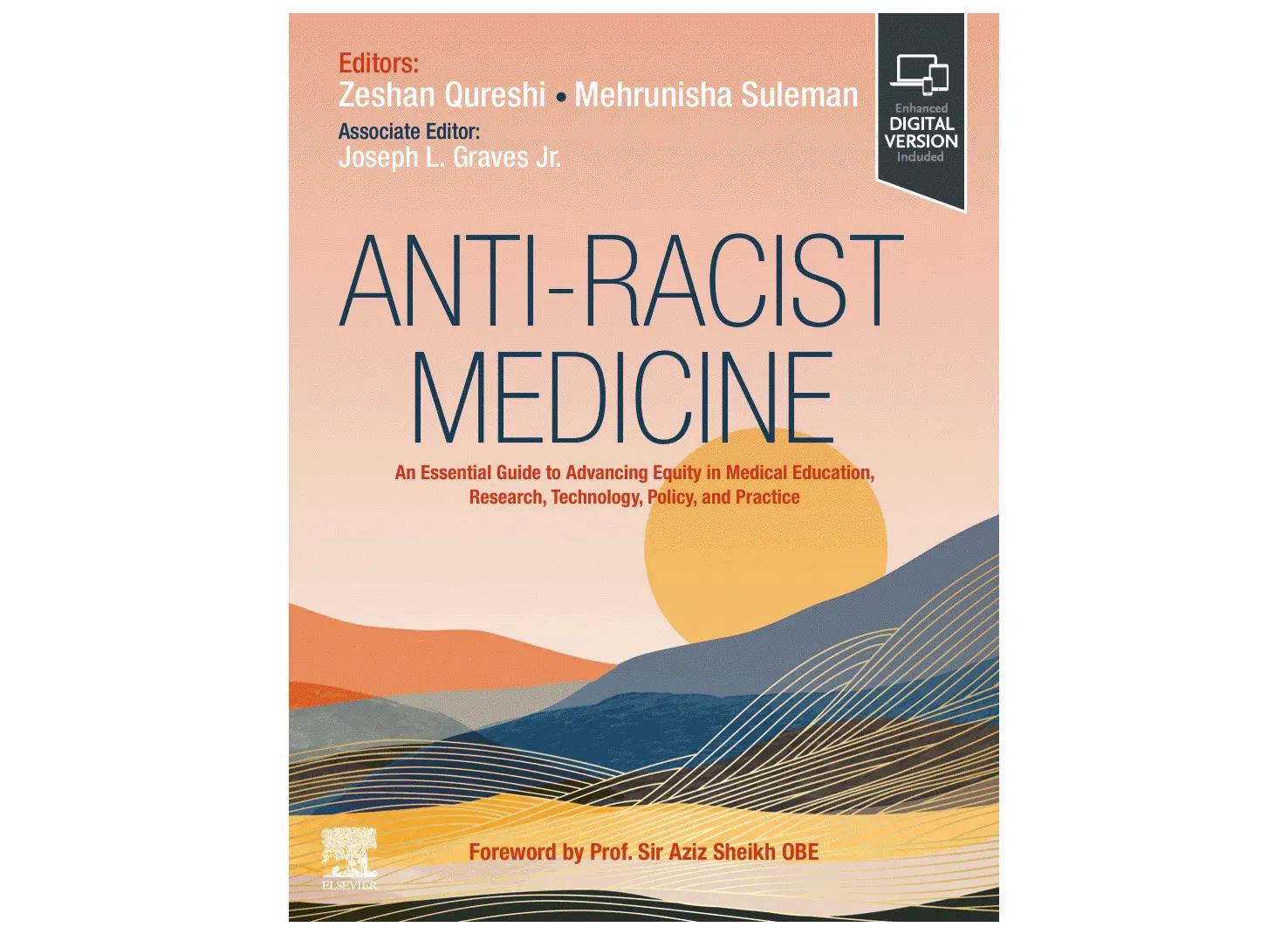
Author Q&A: Anti-Racist Medicine
2026年6月1日
Zeshan Qureshi, BM, BSc (Hons), MSc, MPhil, MRCPCH, Joseph L. Graves Jr, PhD, Mehrunisha Suleman, MA, MSc, BMBCh, DPhil, MFPH, FHEA, ‘Alimiyya
Introduction and professional background
Zeshan Qureshi: My name is Dr. Zeshan Qureshi. I am a UK-based doctor whose work sits at the intersection of clinical medicine, ethics, and technology. Alongside my clinical practice in the NHS, I have developed a portfolio career focused on improving healthcare systems through education, innovation, and advocacy.
I am currently pursuing a PhD in Philosophy at the University of Cambridge, where my research explores how racism operates within healthcare systems and how it can be meaningfully addressed. I have edited and co-edited several previous textbooks, including the Oxford Textbook of Global Health of Women, Newborns, Children, and Adolescents. I am widely published on issues relating to ethnicity, race, and health, including zero-tolerance policies, medical education, and paediatric clinical services. I have also contributed to anti-racist policy development through collaborations with the BMA, GMC, UK government, and Royal College of Paediatrics and Child Health, and I have spoken publicly on wider health-related issues, including as a TEDx speaker and media commentator.
Mehrunisha Suleman: My name is Professor Mehrunisha Suleman. I am an Associate Professor and Director of Medical Ethics and Law Education at the Ethox Centre, based within the University of Oxford.
I am a medically trained bioethicist and public health researcher, and my work also sits at the intersection of clinical ethics, global health, and healthcare systems. My research brings together empirical and normative approaches to explore how social, cultural, and structural factors shape health and healthcare, particularly in relation to inequalities, race and ethnicity, and the governance of emerging health technologies.
Alongside my academic work, I lead teaching in medical ethics and law, supervise postgraduate and doctoral students, and contribute to national and international bioethics through advisory roles with organisations such as the Nuffield Council on Bioethics and UNESCO’s International Bioethics Committee.
What motivated you to write a book on this topic?
Zeshan Qureshi: We wrote this book because there was no single resource that adequately captured how ethnicity, race, and racism intersect with health and healthcare. We wanted to develop and document the theoretical and evidential foundations of anti-racist medicine so that the field could no longer be ignored.
Mehrunisha Suleman: This book emerged from a shared recognition that, despite growing awareness, there was no single resource that brought together the conceptual, empirical, and practical foundations of anti-racist medicine. Much of the work in this space remains fragmented across disciplines and contexts.
We wanted to create something that not only interrogates the problem but also equips readers with the tools to act. The book’s distinctive contribution lies in its integration of rigorous scholarship with practical application. It brings together diverse perspectives to examine how racism operates across healthcare systems, structurally, institutionally, and interpersonally and how it can be addressed in meaningful and sustained ways.
What do you find most exciting or significant about your new publication?
Zeshan Qureshi: What is most significant to us is that the book brings together a multidisciplinary team of experts and spans the full breadth of anti-racism in medicine. Crucially, it does not stop at identifying the problem; it outlines a roadmap for how organisations and individuals can practise anti-racism within healthcare.
Mehrunisha Suleman: What feels most significant is the collective and interdisciplinary nature of the book. It brings together contributors from across clinical practice, research, education, and policy, reflecting the complexity of the issue itself.
I am particularly excited by the way the book moves beyond diagnosis to action. It offers concrete pathways for change across areas such as education, workforce, leadership, clinical care, and research. The chapters that foreground lived experience alongside empirical analysis are especially powerful. They ground the work in the realities of patients, healthcare practitioners, and communities.
Who is the primary audience for your book, and why will they find it valuable?
Zeshan Qureshi: The primary audience is healthcare professionals and students, especially in the UK and NHS, but it is also relevant to educators, researchers, public health professionals, and policy leaders. We hope they will find it valuable because it is both academically rigorous and practically useful.
Mehrunisha Suleman: Readers will find it valuable because it bridges theory and practice. It is academically rigorous but also grounded in real-world challenges and solutions. It offers both a framework for understanding and a guide for action.
What new ideas, practices, or procedures do you hope readers will take away from your book?
Zeshan Qureshi: We hope readers take away the idea that anti-racist medicine is not something separate to other aspects of medicine, but simply a part of good medicine. We want them to think more carefully about how racism shapes healthcare at structural, as well as interpersonal levels, and to see how anti-racist approaches can be embedded in leadership, workforce, education, clinical care, research, and technology.
Mehrunisha Suleman: At its core, we hope readers come away with the understanding that anti-racist medicine is not an “add-on” — it is integral to good medical practice. We want readers to think more critically about how racism operates at multiple levels, from interpersonal interactions to institutional structures and broader systems. Importantly, we also want to show that change is possible, and that anti-racist approaches can be embedded across leadership, workforce, education, clinical care, research, and the development of new technologies.
Looking ahead, what challenges or problems in your specialty do you hope future generations will address?
Zeshan Qureshi: We would like readers to treat anti-racism as a speciality in its own right. While there are clear changes in practice that can be implemented today, there are also many unanswered questions — for example, how we should group populations in relation to disease risk and clinical decision-making. We would love readers not only to improve their own professional practice, but also to wrestle with these more complex and unresolved questions in the field of anti-racist medicine.
Mehrunisha Suleman: There is an urgent need to further develop anti-racism as a distinct field of inquiry and practice. While there are important changes that can be implemented now, many complex questions remain.
For example, how do we design healthcare systems that are genuinely equitable in practice? And how do we ensure that advances in areas such as genomics and AI do not reproduce or deepen existing inequalities?
I hope future generations will not only improve practice but also engage deeply with these more challenging ethical and conceptual questions.
Is there anything else you would like to share about your book or its impact?
Zeshan Qureshi: We hope the book helps support change in how medicine is taught, practised, and led. If it contributes to better education, fairer workplaces, and better patient care, then it will have made a meaningful impact.
Mehrunisha Suleman: More broadly, we hope it encourages a shift in how responsibility is understood in healthcare and positioning anti-racism as central to professional and institutional practice.
Do you have an online presence we can connect with?
Zeshan Qureshi: LinkedIn: Zeshan Qureshiopens in new tab/window X (formerly Twitter): @DrZeshanQureshiopens in new tab/window BlueSky: https://bsky.app/profile/drzeshanqureshi.bsky.socialopens in new tab/window Instagram: @drzeshanqureshiopens in new tab/window
Mehrunisha Suleman: Institutional profile: Mehrunisha Suleman — Ethox Centreopens in new tab/window X (formerly Twitter): @MehrunishaSopens in new tab/window
撰稿人

Zeshan Qureshi, BM, BSc (Hons), MSc, MPhil, MRCPCH

Joseph L. Graves Jr, PhD
