

Yana Amirova, Library Director (Kazakhstan)
18 de setembro de 2026
Please briefly describe who you are and your role.
My name is Yana Amirova, and I am the Director of the Library at Karaganda Medical University. The primary goal of my work is to ensure that faculty, researchers, and students have access to high-quality medical and scientific information. Together with the library team, we help users find reliable information resources, develop skills in working with evidence-based information, and implement modern tools that support education, research, and clinical practice.
What challenges were you facing before ClinicalKey AI was incorporated into your workflow?
One of the main challenges was the amount of time required to search for information across multiple sources in order to answer clinical and academic questions. Faculty members and students often need quick access to reliable information, yet identifying the most relevant evidence-based resources can be very time-consuming. It can also be difficult to navigate large volumes of medical literature and translate the information into practical conclusions. Although ClinicalKey AI is still in the active adoption phase within our organization, it is already helping us address these challenges more efficiently.
What benefits have you experienced since using ClinicalKey AI?
Since we began using ClinicalKey AI, we have seen significant potential in the platform as a tool for supporting our users’ information needs. It helps simplify and accelerate the search for relevant information grounded in evidence-based medicine. As a result, faculty members and students can find answers to academic and professional questions more quickly. In addition, ClinicalKey AI helps librarians efficiently identify educational and scientific literature on a wide range of topics, reducing the time needed to locate appropriate resources.
What advice would you give to a colleague considering using ClinicalKey AI?
I would recommend viewing ClinicalKey AI as a tool that can enhance productivity and improve access to evidence-based medical information. It is important to invest time in exploring its capabilities and determining how it can complement existing workflows. Faculty members can use the platform when preparing educational materials, developing clinical case studies, and searching for research sources. Librarians, in turn, can help users make the most of the platform’s features. At the same time, it is important to remember that AI-powered tools are designed to complement professional expertise, not replace it.
Could you share how ClinicalKey AI allows you to support clinicians at your organization with evidence-based content?
ClinicalKey AI helps us support clinician-educators, residents, and other healthcare professionals more effectively by providing faster access to reliable, evidence-based medical information. Instead of spending significant time searching through numerous sources, users can quickly identify relevant materials to address clinical and educational needs. This strengthens the library’s role as an information partner, helping connect healthcare professionals with high-quality evidence in a timely manner to support learning, research, and clinical practice.
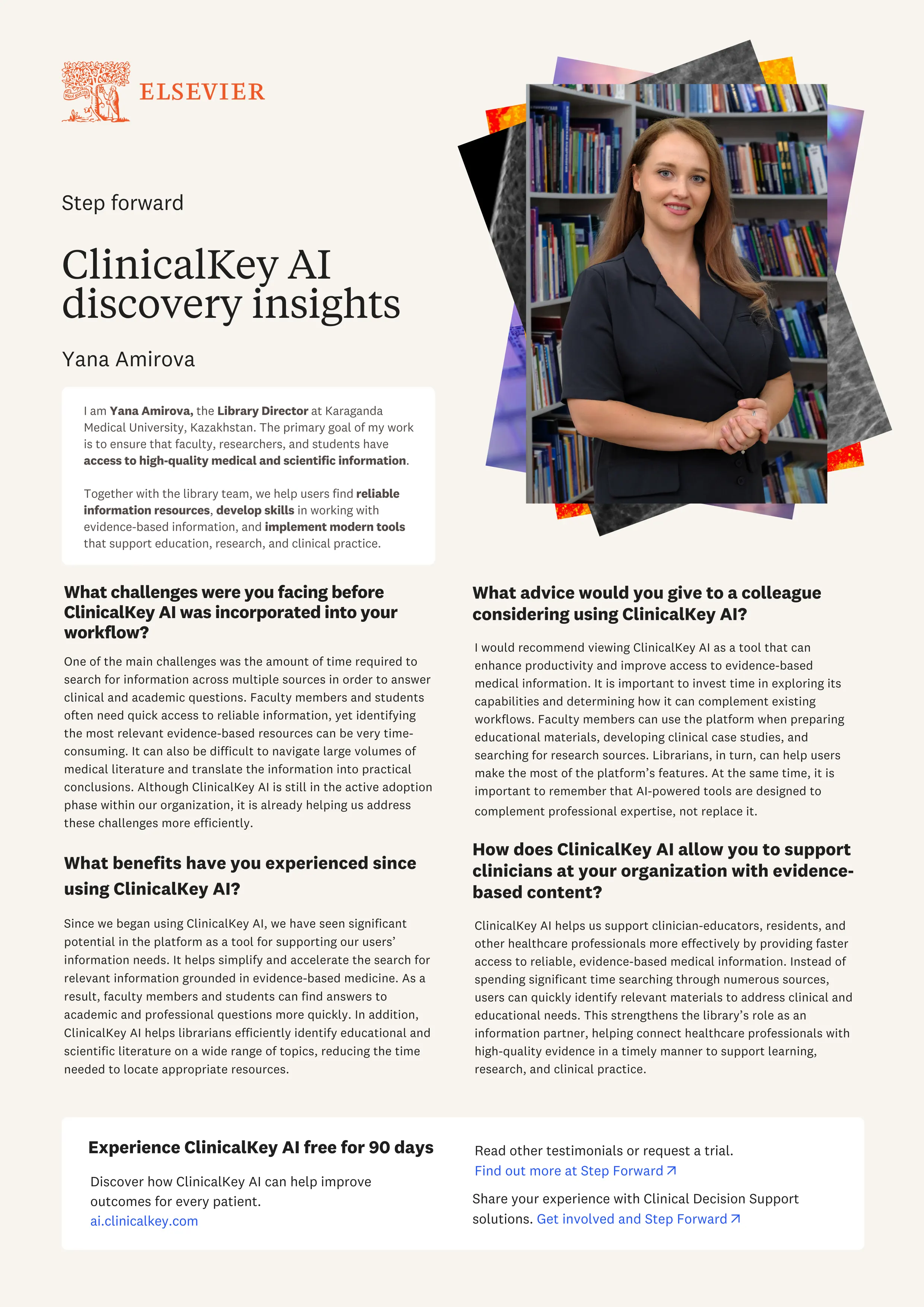
ClinicalKey AI Discovery Insights: Yana Amirova
Download here abre em uma nova guia/janela