
Circularity is a strategy, not a cost
21 juillet 2026
Par Ann-Marie Roche

Thorin Flynt from Evonik on why the companies leading the transition aren’t waiting for anyone.
CO₂ has a bad reputation. But this reflects a failure of vision, says Thorin Flyntopens in new tab/window, VP of Regional Development at specialty chemicals company Evonikopens in new tab/window, who often cites the systems theorist and inventor Buckminster Fuller: “Pollution is nothing but resources we’re not harvesting. We allow them to disperse because we’ve been ignorant of their value.”
It’s the inspiration behind the Evonik Rheticus project, which was covered in a recent edition of Elsevier’s Sustainability in Action webinar series, ‘Green Chemistry in Motion: how Rheticus converts CO₂ into high-value productsopens in new tab/window’. The webinar features Thorin and biochemical engineer Juliane Merzopens in new tab/window, who heads the initiative. The central question is: Can CO₂ be a raw material rather than a waste product?
While excess CO₂ drives climate change, other organisms treat CO₂ not as a poison but as a nutrient – from the plant kingdom to a wide array of bacteria and other microorganisms.
Evonik brings considerable resources: €14 billion in annual sales, 31,000 people, and 100-plus production sites worldwide. “But with a project like Rheticus, and like most of what we do, you can’t do it alone,” says Thorin.
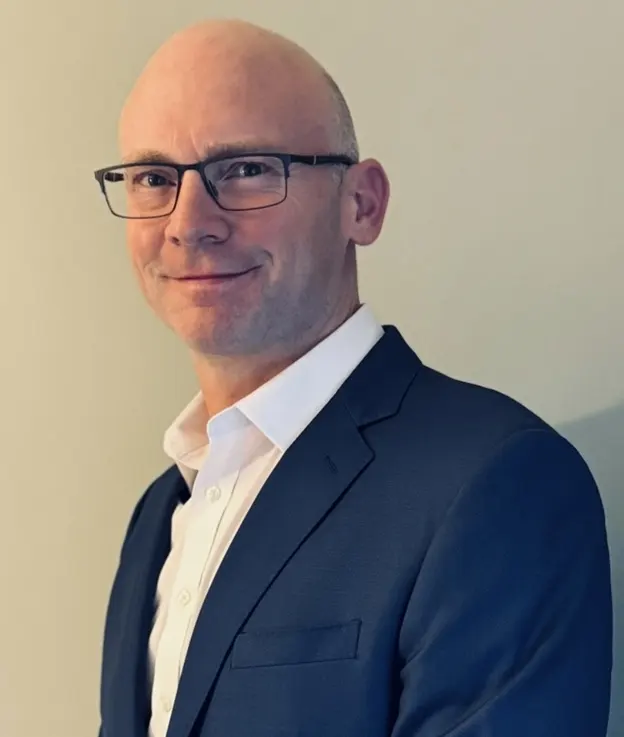
Thorin Flynt, VP of Regional Development at Evonik
Where profits and circularity can co-exist
Thorin has spent 25 years in the chemicals industry, most of it in commercial roles – sales, procurement, and other external-facing functions. He took on his current sustainability role about a year ago with a clear mandate: identify where profitability and sustainability overlap, then ensure the technology is real.
This is about helping Evonik’s 13 business lines reach their sustainability targets, including converting all operations to 100% green power by 2030. This involves vetting startups that might offer innovative solutions and introducing them to colleagues working at Evonik production sites.
“It’s less about handing something off and more about building alignment across the people who can make it work,” says Thorin. “I might help frame the opportunity and bring the right partners into the conversation, but the real shaping happens with our plant and NextGen Technology teams. They understand the operational realities, challenge the assumptions, and refine whether a technology can integrate and deliver value.”
Evonik also creates products to help its customers meet their sustainability targets. Rheticus is part of this broader portfolioopens in new tab/window of CO₂ and bio-based initiatives, which includes green hydrogen membranesopens in new tab/window, commercial bio-surfactantsopens in new tab/window and a new catalyst that replaces toxic carbon monoxide with CO₂ in ester synthesisopens in new tab/window.
CO₂ in, hexanoic acid out
Rheticusopens in new tab/window is a two-stage biological process that converts CO₂ and green hydrogen into hexanoic acid – a platform chemical used in cosmetics, animal nutrition, coatings, and agriculture. Naturally occurring anaerobic bacteria perform the conversion: one microorganism converts CO₂ and hydrogen into acetate, and a second elongates acetate into hexanoic acid. It runs on renewable energy and biogenic CO₂. The resulting product has a negative carbon footprint.
What started in 2017 as one-liter shake flasks is now a pilot plant in Marl, Germany, which has been running continuously for over 50,000 hours. “You can assume with this kind of long-term investment, we’ve all had our wow moment internally, in terms of being confident Rheticus can scale,” notes Thorin.
At Evonik, none of these efforts are treated as a compliance cost. “When sustainability is fully integrated along with performance, it becomes a driver of competitiveness, resilience, and long-term growth,” says Thorin.
Hire for idealism. Then give it a reality check.
When Thorin runs sustainability orientation sessions for new intakes, he is surprised by the engagement. “For guys like me in my late 40s, I’ve seen the ebbs and flows of interest in sustainability. For these people, it’s different. They’re inquisitive; they challenge the status quo. For me, that’s very encouraging.”
“I want to support that idealistic view, but I think we need to balance it with realistic expectations. We can be both idealistic and realistic. That’s how we dream. That’s how we develop innovative technologies like Rheticus and bring them to market.”
Partners are not optional
Evonik’s collaborators include other companies, universities, and research groups worldwide. While Evonik used its collaboration network to develop Rheticus technology, it continually engages with external groups worldwide on other projects and innovations. These include MIT for student immersion, Greentown Labs, the Leibniz Institute for Catalysis, and Ruhr University for the bimetallic catalyst.
“We’re not too proud to admit that innovation needs to be pursued beyond the walls of our own R&D facilities,” Thorin says. Evonik's bio-surfactants are a case in point. Now in commercial production for Unilever at a plant in Slovakia, they were years in the making, moving from lab concept to market only after extended collaboration.
University collaborations work the same way, bringing researchers into applied work early. “It helps them see that what they’re doing isn’t just theoretical work that will never see the light of day.” And those same researchers, Thorin points out, are future industry and government leaders – the people who will ultimately shape not only the next wave of sustainable innovation but also the legislation needed to support it.
Advocacy is part of the job
“Companies that lead don’t wait for sustainability expectations to solidify. They help shape the standards, policies, and customer understanding that enable new technologies to scale,” says Thorin. For example, Evonik is helping to shape greenhouse gas mass-balance accounting standards alongside industry peers and trade groups. “We need a cohesive, viable path to reduce emissions in this industry. If you’re not part of that conversation, you can find yourself on the outside looking in.”
“The industry is no longer just looking at Cradle to Grave but at Cradle to Cradle. That’s something we need to keep pushing if we want to justify our social license to operate. The public needs to see that our industry is acting as a good steward of the environment. Our shareholders need to see that their investments are going toward sustainable growth.”
Crosscurrents and catalysts
Globally, the picture is uneven. Europe has uniform recycled-content mandates and pro-green policies, even if permitting could be streamlined. China is making significant progress on green hydrogen and more sustainable feedstocks – “China is pointed in the right direction, even if another coal-based powerplant seems to pop up every week” – while the U.S. has hit what Thorin calls “an air pocket” on sustainable hydrogen, following the rolling back of the Inflation Reduction Act’s Section 45V tax credits.
The rollback has introduced near-term uncertainty for green hydrogen project development. However, Thorin believes that “this pause is better understood as a market recalibration rather than a reversal of direction, as developers reassess project economics and policy clarity.”
As the U.S. adjusts, Thorin notes that the country is pivoting towards blue hydrogen to meet growing market demand, adding, “Our microorganisms are color blind when it comes to hydrogen. While the Product Carbon Footprint can further benefit from green hydrogen, blue, gray, etc. also work, as the bulk of the PCF benefit comes from the CO₂ byproduct utilization itself.”
One recent shift works in Rheticus’s favor: a federal provision has equalized the tax credit for CO₂ utilization with the credit for sequestration – both now at $85 per metric ton. “You used to get a lower credit for utilizing CO₂ than for putting it in the ground. That made no sense. Now the incentive is aligned with actually reducing emissions. For Rheticus in the U.S., that’s a tailwind.”
“I believe the prevailing trend is moving up and to the right.”
An invitation to close the circle
When asked for the one message he’d put out if he had the full industry’s attention, Thorin’s commercial instincts kick in. “It takes two to tango. We invest in AI, in people, and in the best engineers, chemists, and product developers in the world. But that’s only part of the value chain. There’s no harm in calling us for an open discussion about how Rheticus might help reduce your CO₂ emissions and deliver value on the back end.”
Fuller said we let pollution happen because we couldn’t see its value. Rheticus is what it looks like when someone can.
Watch the full webinar on demand: ‘Green Chemistry in Motion: how Rheticus converts CO₂ into high-value productsopens in new tab/window‘.
Related Articles:
Speaking the language of chemistry
Innovating for impact with green chemistry
Innovating differently: The role of R&D in a net-zero future
Contributeur

Ann-Marie Roche
Senior Director of Customer Engagement Marketing
Elsevier
En savoir plus sur Ann-Marie Roche