
Can smart watches and other fitness and wellness trackers do more harm than good for some people?
Philadelphia | 22 de febrero de 2023
Certain wearable gadgets have the potential to interfere with pacemakers and other implanted cardiac electronic devices, according to a new study in Heart Rhythm
In recent years, wearable devices such as smartwatches and rings, as well as smart scales, have become ubiquitous – “must-haves” for the health conscious to self-monitor heart rate, blood pressure, and other vital signs. Despite the obvious benefits, certain fitness and wellness trackers could also pose serious risks for people with cardiac implantable electronic devices (CIEDs) such as pacemakers, implantable cardioverter defibrillators (ICDs), and cardiac resynchronization therapy (CRT) devices, reports a new studyopens in new tab/window published in Heart Rhythmopens in new tab/window, the official journal of the Heart Rhythm Society, the Cardiac Electrophysiology Society, and the Pediatric & Congenital Electrophysiology Society, published by Elsevier.
Investigators evaluated the functioning of CRT devices from three leading manufacturers while applying electrical current used during bioimpedance sensing. Bioimpedance sensing is a technology that emits a very small, imperceptible current of electricity (measured in microamps) into the body. The electrical current flows through the body, and the response is measured by the sensor to determine the person’s body composition (i.e., skeletal muscle mass or fat mass), level of stress, or vital signs, such as breathing rate.
“Bioimpedance sensing generated an electrical interference that exceeded Food and Drug Administration-accepted guidelines and interfered with proper CIED functioning,” explained lead investigator Benjamin Sanchez Terrones, PhD, Department of Electrical and Computer Engineering, University of Utah, Salt Lake City, UT, USA. He emphasized that the results, determined through careful simulations and benchtop testing, do not convey an immediate or clear risk to patients who wear the trackers, but noted that the different levels emitted could result in pacing interruptions or unnecessary shocks to the heart. Dr. Sanchez added, “our findings call for future clinical studies examining patients with CIEDs and wearables.”
The interaction between general electrical appliances, and more recently smart phones, with CIEDs has been subject to study within the scientific community over the past few years. Nearly all, if not all, implantable cardiac devices already warn patients about the potential for interference with a variety of electronics due to magnetic fields – for example, carrying a mobile phone in your breast pocket near a pacemaker. The rise of wearable health tech has grown rapidly in recent years, blurring the line between medical and consumer devices. Until this study, objective evaluation for ensuring safety has not kept pace with the exciting new gadgets.
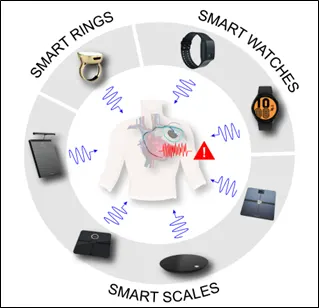
Caption: A shock to the system. Certain fitness and wellness trackers could pose serious risks for people with cardiac implantable electronic devices (CIEDs) such as pacemakers, implantable cardioverter defibrillators (ICDs), and cardiac resynchronization therapy (CRT) devices (Credit: Heart Rhythm).
“Our research is the first to study devices that employ bioimpedance-sensing technology as well as discover potential interference problems with CIEDs such as CRT devices. We need to test across a broader cohort of devices and in patients with these devices. Collaborative investigation between researchers and industry would be helpful for keeping patients safe,” noted Dr. Sanchez Terrones.
---
Notes for editors
The article is “Safety evaluation of smart scales, smart watches, and smart rings with bioimpedance technology shows evidence of potential interference in cardiac implantable electronic devices,” by Gia-Bao Ha, BSc, Benjamin A. Steinberg, MD, MHS, FACC, FHRS, Roger Freedman, MD, Antoni Bayés-Genís, MD, PhD, FESC, FHFA, and Benjamin Sanchez, PhD (https://doi.org/10.1016/j.hrthm.2022.11.026opens in new tab/window). The article appears online in advance of Heart Rhythm, volume 20, issue 4 (April 2023) published by Elsevier.
The article is openly available for 30 days at https://www.heartrhythmjournal.com/article/S1547-5271(22)02696-0/fulltextopens in new tab/window.
Research reported in this publication was supported by the National Heart, Lung, And Blood Institute of the National Institutes of Health under Award Number K23HL143156.
Full text of the article is also available to credentialed journalists upon request; contact Jane Grochowski at +1 406 542 8397 or [email protected]opens in new tab/window. Journalists who wish to interview the study authors should contact Benjamin Sanchez Terrones, PhD, at +1 617 595 9515 (mobile), [email protected]opens in new tab/window, or Vince Horiuchi, Public Relations Associate, College of Engineering, at +1 801 585 7499 (office), +1 801 556 5187 (mobile), [email protected]opens in new tab/window.
About Heart Rhythm
Heart Rhythmopens in new tab/window, the official Journal of the Heart Rhythm Societyopens in new tab/window, the Cardiac Electrophysiology Societyopens in new tab/window, and the Pediatric & Congenital Electrophysiology Societyopens in new tab/window, is a unique journal for fundamental discovery and clinical applicability. It integrates the entire cardiac electrophysiology (EP) community from basic and clinical academic researchers, private practitioners, engineers, allied professionals, industry, and trainees, all of whom are vital and interdependent members of our EP community. www.heartrhythmjournal.comopens in new tab/window
About the Heart Rhythm Society
The Heart Rhythm Societyopens in new tab/window is the international leader in science, education, and advocacy for cardiac arrhythmia professionals and patients, and the primary information resource on heart rhythm disorders. Its mission is to improve the care of patients by promoting research, education, and optimal healthcare policies and standards. The Heart Rhythm Society is the preeminent professional group representing more than 7,300 specialists in cardiac pacing and electrophysiology from more than 70 countries. www.HRSonline.orgopens in new tab/window
About Electrophysiology
Electrophysiology is a branch of cardiology focusing on the electrical system of the heart. Electrophysiologists specialize in the diagnosis of cardiac rhythm disorders and their treatment, including the implantation of cardiac rhythm management devices (pacemakers, defibrillators, etc.).
Acerca de Elsevier
Elsevier es líder global en información avanzada y soporte para la toma de decisiones. Durante más de un siglo, ha ayudado a avanzar la ciencia y la salud para promover el progreso humano. Apoya a comunidades de investigación académicas y corporativas, médicos, enfermeras, futuros profesionales de la salud y educadores en 170 países, proporcionándoles conocimientos críticos y soluciones innovadoras que combinan contenido científico y médico confiable con tecnologías de IA de vanguardia. Elsevier promueve la inclusión y la sostenibilidad incorporando estos valores en sus productos y cultura. La Elsevier Foundation respalda investigaciones y asociaciones de salud alrededor del mundo.
Elsevier forma parte de RELX, proveedor global de herramientas de análisis y decisión basadas en información para clientes profesionales y de negocios. Para más información, visite www.elsevier.com y síganos en redes sociales: @ElsevierConnect.
Contacto
JG