How deep is your deep research?
When a report starts to shape real decisions, the evidence path matters more than the prose.
Across the AI market, deep research is converging on a familiar pattern. Systems plan, search, read, iterate and synthesize. Where they diverge is the evidence layer beneath that workflow.
As these systems shape which claims move forward into papers, reviews, briefs and R&D decisions, the core question is no longer whether they can generate a polished report. It is whether the evidence behind that report can be verified quickly enough to support responsible reuse.
That question matters across industry, academia and government alike. The pressure differs: publication, policy and compliance. But the failure mode is the same: a claim that travels further than the evidence behind it.
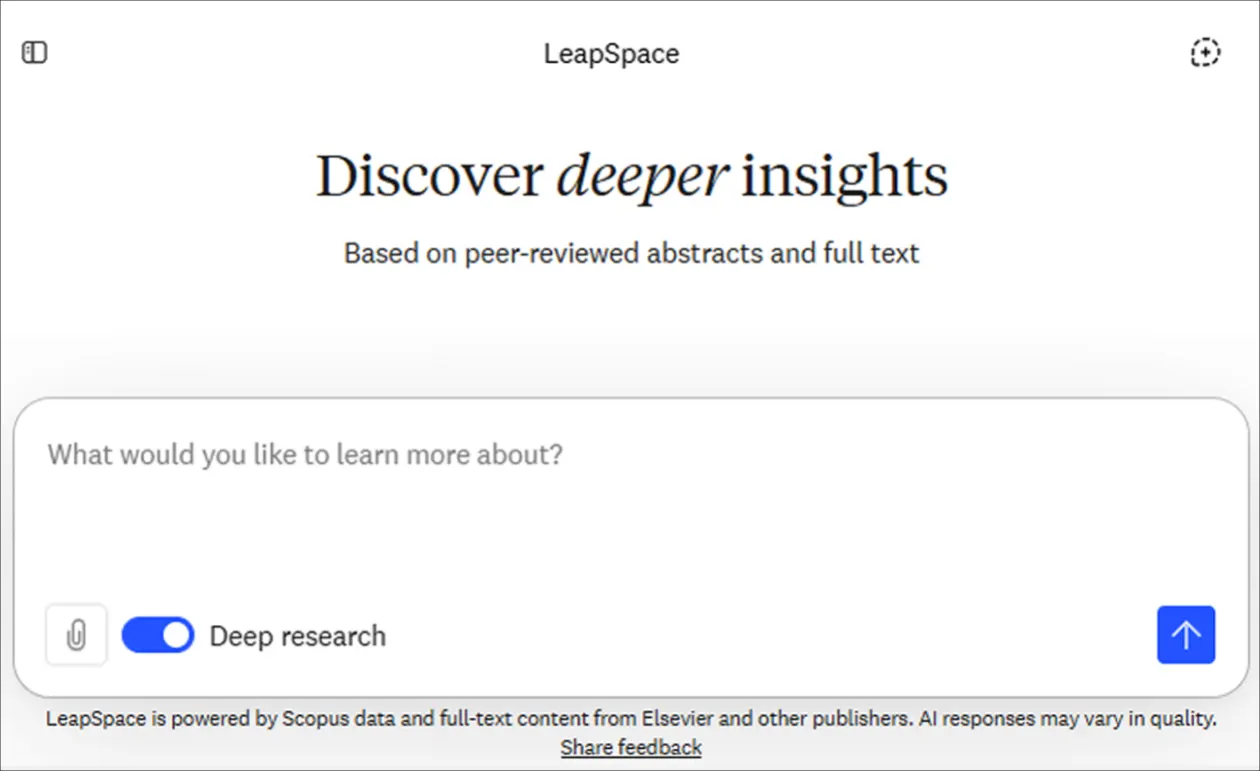
Fig. 1. LeapSpace Deep research operating mode
From fluent output to inspectable evidence
Elsevier’s Researcher of the Future report shows that 84% of researchers use AI in their work, yet only 22% trust it. That gap is not a rejection of AI. It is a demand for workflows that make evidence easier to inspect before reuse.
The real difference between deep research systems is what sits beneath the output: what content the system can reach, how retrieval is constrained and how clearly claims connect to sources.
LeapSpace Deep Research is designed to make that architecture visible. It unpacks a question into a multi-agent run across publisher-neutral and peer-reviewed scientific content, iterating through search, reading, refinement and synthesis. The steps remain visible throughout: what was searched, how the scope evolved and where the report’s claims come from.
What makes LeapSpace different?
Many AI research tools respond to questions directly. LeapSpaceopens in new tab/window Deep Research doesn’t always do that. And that’s the point. It breaks a question into sub-agents, explores it from different perspectives, builds from the evidence up rather than pattern-matching to a familiar response and draws links across distinct knowledge domains. The result is not always a direct response. Sometimes the response must be assembled from smaller pieces. That is how the workflow handles questions that genuinely require synthesis, not just retrieval.
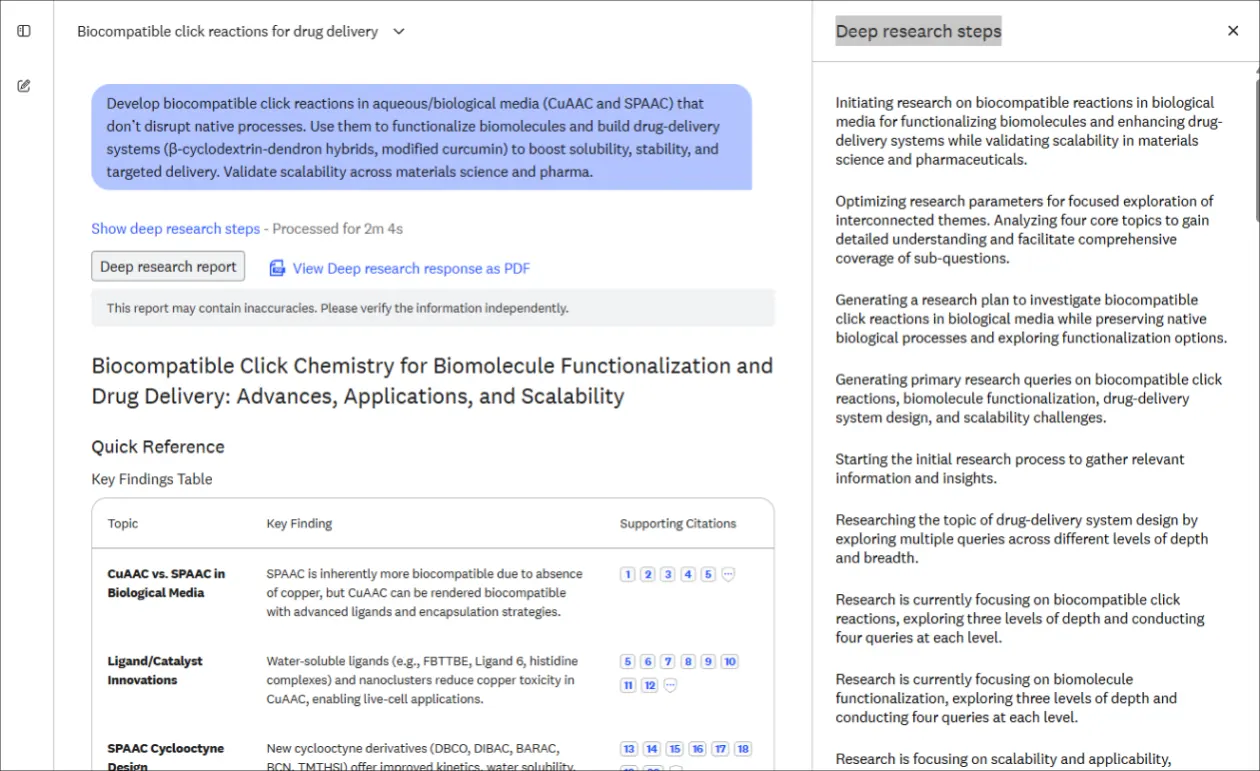
Fig. 2: Deep Research steps: Planning, sub-queries, retrieval, coordination and report writing remain visible.
A research-grade evidence stack
That workflow is only as strong as the evidence stack beneath it. LeapSpace combines 20M+ versions of record, mostly published from 2000 onwards, with 107+ million interconnected Scopus records spanning more than 7,000 publishers. It also distinguishes between what it cites rather than treating all sources the same. Full text is where methods, results, figures and limitations become inspectable. Scopus records are where abstracts, citation context and author profiles support broader discovery and filtering. Deep Research may cite either full text or Scopus records, depending on which supports the statement. Results are ranked by relevance, with a small boost for recency and retracted articles are excluded.
LeapSpace’s ranking is publisher-neutral, with no preferential treatment based on publisher, and retracted articles are actively excluded.
Research reuse rarely depends on summaries alone. It depends on whether a user can move from claim to source, from source to method and from method to well supported judgment. Users can also incorporate uploaded PDFs when institutional settings allow.
FULL TEXT 20M+ versions of record indexed in Scopus - mostly published after 2000 | ABSTRACTS AND METADATA The Scopus corpus of 107+ million interconnected records | FUNDING OPPORTUNITIES International and local awards |
|---|---|---|
Elsevier: - 12 M articles (including from society-owned journals), book series, handbooks and major reference works - ~1.1 million book chapters Non-Elsevier - 10M+ OA (CC-BY) and subscription journal article agreements | - 29,972+ active journals - 493,729+ books - 28.6+ M OA items - 7,000+ publishers - 25.4+ M author profiles - 94,000+ organization profiles | - 40,000+ active and recurring funding opportunities, with strongest coverage in North America, the UK, Australia, and the EU - $100+ B (USD) worth of active funding opportunities - 16,000+ government and private funding organizations |
Data correct as of August 2026. New content is added daily. Retracted articles are excluded, where identified
Explore core features and content in the LeapSpace Reference Guideopens in new tab/window.
Cross-domain questions, one underlying requirement
Deep Research earns its keep on the harder questions: the ones where a direct search won’t do, where evidence needs to be weighed across sources, and where the gap between a fluent answer and a defensible one actually matters. The examples below span engineering, energy, pharma, medtech, chemicals, academic research and government evidence work – starting points, not limits. The domains differ. The requirement is the same: a structured, referenced report that makes scope explicit, surfaces limitations and keeps claims traceable.
Domain | Example use case | Example prompt |
|---|---|---|
Engineering | CAPEX retrofit decision brief for motor-driven systems | Which interventions deliver the highest measured efficiency gains, and what are the reliability trade-offs in real plants? |
Energy | Energy-transition technology scouting brief | Compare leading low-carbon hydrogen pathways since 2019 by performance, cost drivers, TRL, bottlenecks and evidence strength. Produce a shortlist with citations, plus diagram. |
Chemicals and Materials | Evidence review for PFAS impact on vegetable cultivation | Which tissues accumulate the most, what mechanisms drive growth impacts and what mitigation approaches have evidence? Structured report plus limitations plus citations. |
Technology | Systematic review plus architecture trade-offs | For solid-state circuit breakers in DC microgrids and MVDC, what are the leading architectures and trade-offs in interruption, losses, coordination and standards? |
Pharma and Biotech | Decision brief for indication expansion or repurposing | Which existing anti-inflammatory drugs have the strongest evidence for Parkinson’s progression, why and what are the key limitations? |
Medtech | Clinical evaluation brief for device adoption | What is the impact of AI-assisted colonoscopy on ADR, false positives, procedure time and adverse events, and where does the evidence not generalize? |
Academic | Cross-disciplinary literature-gap and study-design brief | On [topic], what is established, what is contested and what is still missing since 2019? Compare frameworks and methods, identify the strongest evidence gaps and recommend three defensible next-study designs. |
Government | Policy evidence brief for intervention options and trade-offs | For [policy topic], what does the peer-reviewed literature since 2019 show about effectiveness, implementation constraints, equity impacts, unintended consequences and where the evidence is strongest or mixed? |
Table 2. LeapSpace Deep Research use case and prompt examples. Use these prompts to get started in LeapSpace.
Explore deep research cross-domain examples in the LeapSpace Use Cases and Prompt Guideopens in new tab/window.
The report as evidence package
A LeapSpace Deep Research report begins with Quick Reference and Key Findings, then lays out the direct answer, study scope, assumptions, limitations and suggested further research. That structure shifts the practical question from “Did the AI generate something fluent?” to “Is this evidence base strong enough to support review, refinement and reuse?”
LeapSpace Deep Research demo
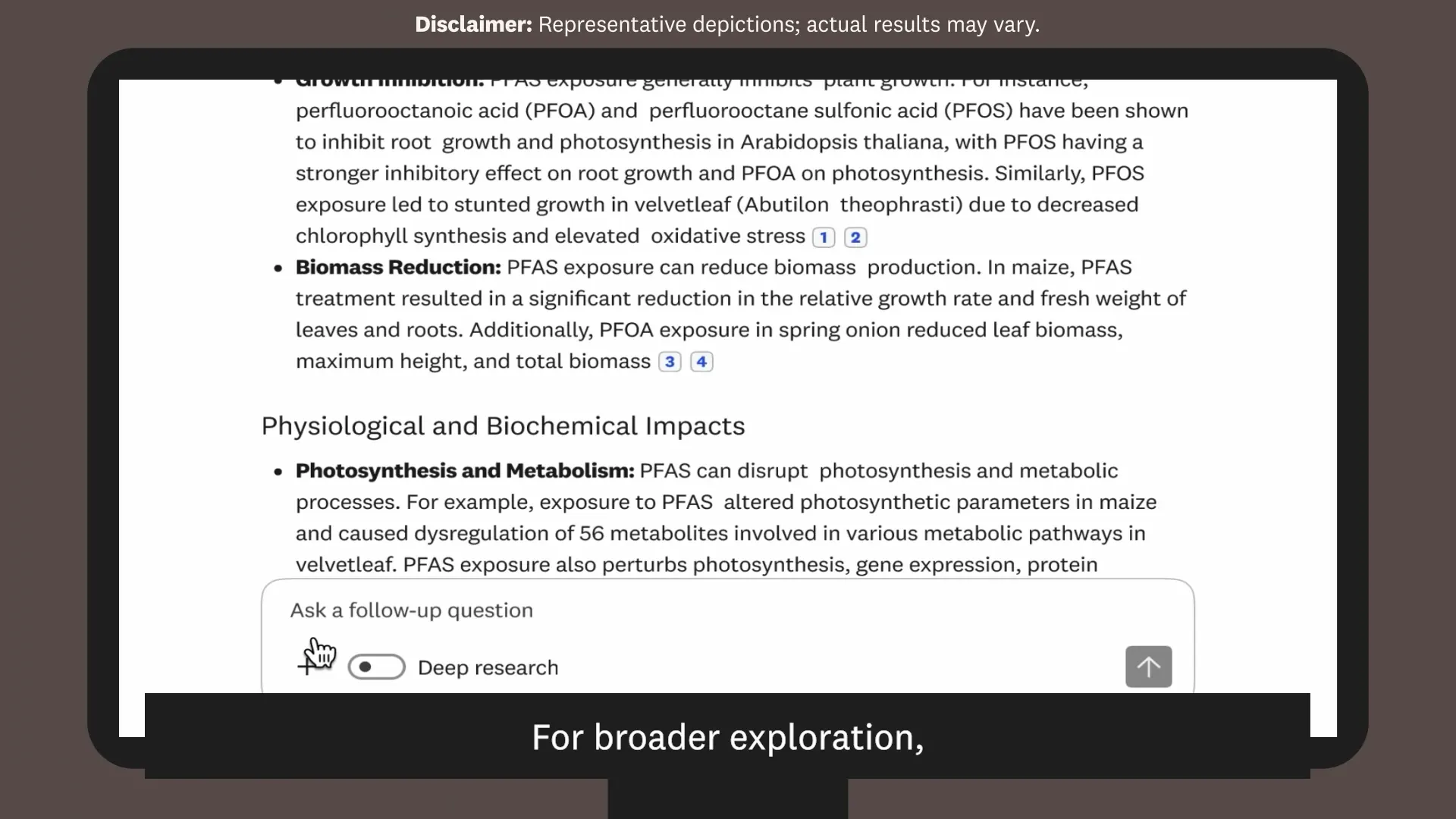
LeapSpace Deep Research demo
Researchers frequently face competing demands between comprehensive literature reviews and lab work. LeapSpace accelerates literature search and analysis without requiring advanced techniques such as Boolean logic. In Deep Research mode, you get detailed, reference-rich reports with traceable sources drawn from Scopus abstracts and peer-reviewed full-text articles. Based on my early experience, LeapSpace brings a wide range of research tasks into a single workspace, giving scientists more time to think deeply and collaborate more effectively.Senior Information Specialist
Global pharmaceutical company
Verification by design
The report is where verification starts, not where it ends. For any claim, the path runs to Reference details, excerpts from full text and Scopus records; from there to Link to statement, which helps assess whether the cited passage supports the claim; and from there to Claim Radar, which indicates whether the wider research aligns, contradicts or shows mixed evidence on the same point. For a claim heading into a review, a brief or a decision, that chain is what makes reuse more robust.
As Adrian Raudaschl, Senior Director of Product Management at Elsevier, puts it, Claim Radar shifts the question from alignment with one source to alignment with the wider research ecosystem.
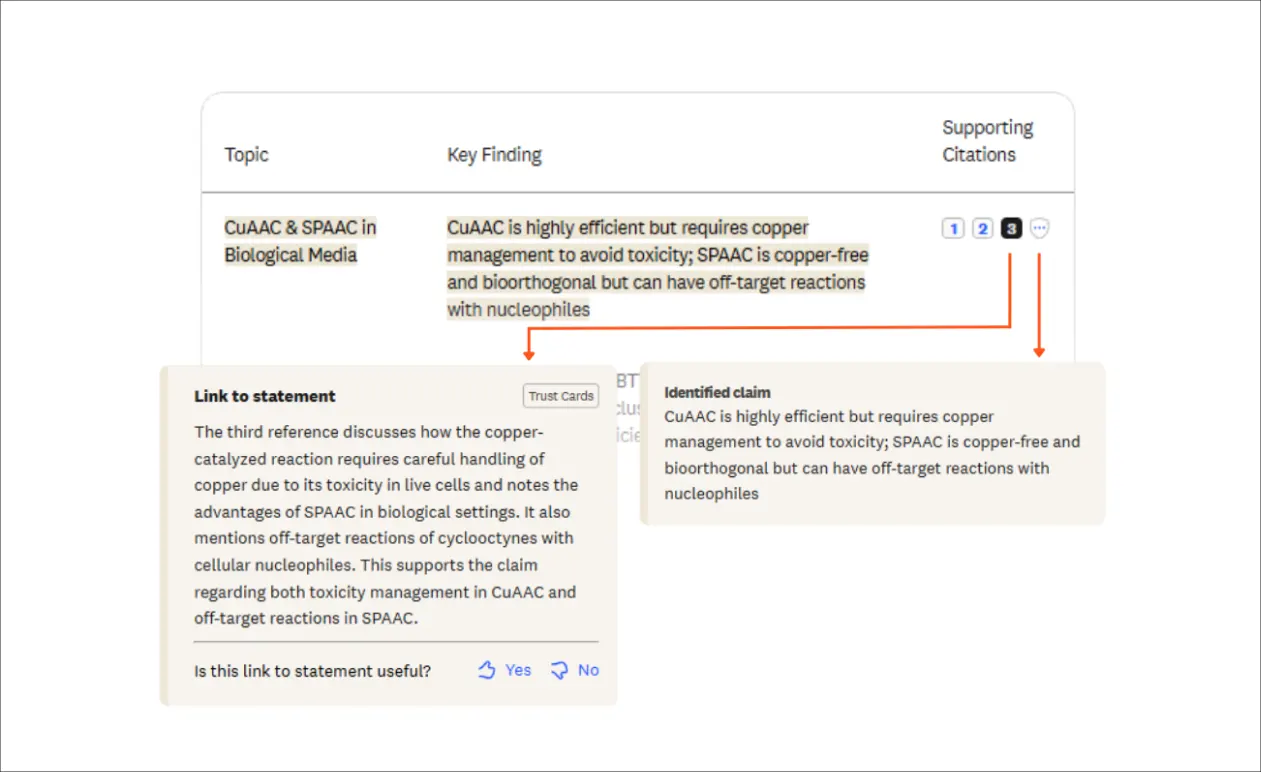
Fig. 3. Reference details, Link to statement and Claim Radar within the same workflow.
The wider workspace
Deep Research is the core, but the workspace extends further. From the same interface, you can move from evidence synthesis to identifying researchers active in the field via Scopus author profiles, or surface funding opportunities aligned with the topic. Treat both as pointers, not endorsements. Follow them to source before acting.
Research that holds up
General-purpose tools remain useful for breadth. But when the task involves methods, limitations, cross-disciplinary evidence and claims that must withstand scrutiny, fluency is no longer the decisive issue. Inspectability is.
LeapSpace was created with researchers in mind, which means I have more trust in it. It helps refine where I want to go in my research, validates certain directions to explore, and makes it easier to learn outside of my domain. LeapSpace has also propelled me to a point in my reading I wouldn’t reach otherwise. I run Deep Research Reports in the background and then save them for my train journey.
Paul Preuschoff
Human Computer Interaction Researcher, RWTH Aachen University
That is where LeapSpace Deep Research is designed to operate: not as a longer report generator, but as a workflow for evidence under scrutiny.
Next steps:
Run a new deep research use case today in LeapSpaceopens in new tab/window.
Try this prompt: Develop biocompatible click reactions in aqueous/biological media (CuAAC and SPAAC) that don’t disrupt native processes. Use them to functionalize biomolecules and build drug-delivery systems (β-cyclodextrin–dendron hybrids, modified curcumin) to boost solubility, stability, and targeted delivery. Validate scalability across materials science and pharma.
Explore additional LeapSpace resources and research workflows in the LeapSpace Resource Center