
Maximizing the impact of library collections
5 juin 2026

Discover how libraries can use impact-led collection assessment to demonstrate strategic value and align with institutional priorities.
Why does the impact lens matter in collection assessment?
In today’s challenging landscape, where librarians are constantly asked to deliver more with less, it’s no longer enough to measure the library’s value using metrics like ROI alone. Librarians need to tell a richer, more nuanced story of how their collection delivers impact for their institution.
An impact lens offers a way of reading your collection data with a different purpose in mind. Traditional collection reporting is excellent at showing efficiency (what you paid, what was used, and where demand is rising and falling). Impact-led assessment adds to those signals by asking the “so what?” that institutional leaders care about: what that access enables.
This approach shifts the focus from activity to contribution, so you can describe not only how the collection performs, but how it supports and advances institutional goals. Ultimately, it represents a transition from measuring the cost of the collection to measuring the value of the collection.
Assessing your collection through an impact lens can help you:
Better understand how the collection meets the needs of your library’s users
Demonstrate the strategic value of your library’s collection to senior leadership
What story does your data tell?
When you look beyond narrow financial metrics like cost-per-use, your data can tell a much richer story about the role your collection plays across the institution. An impact lens helps reveal not just usage, but how that use supports learning, research and wider institutional goals.
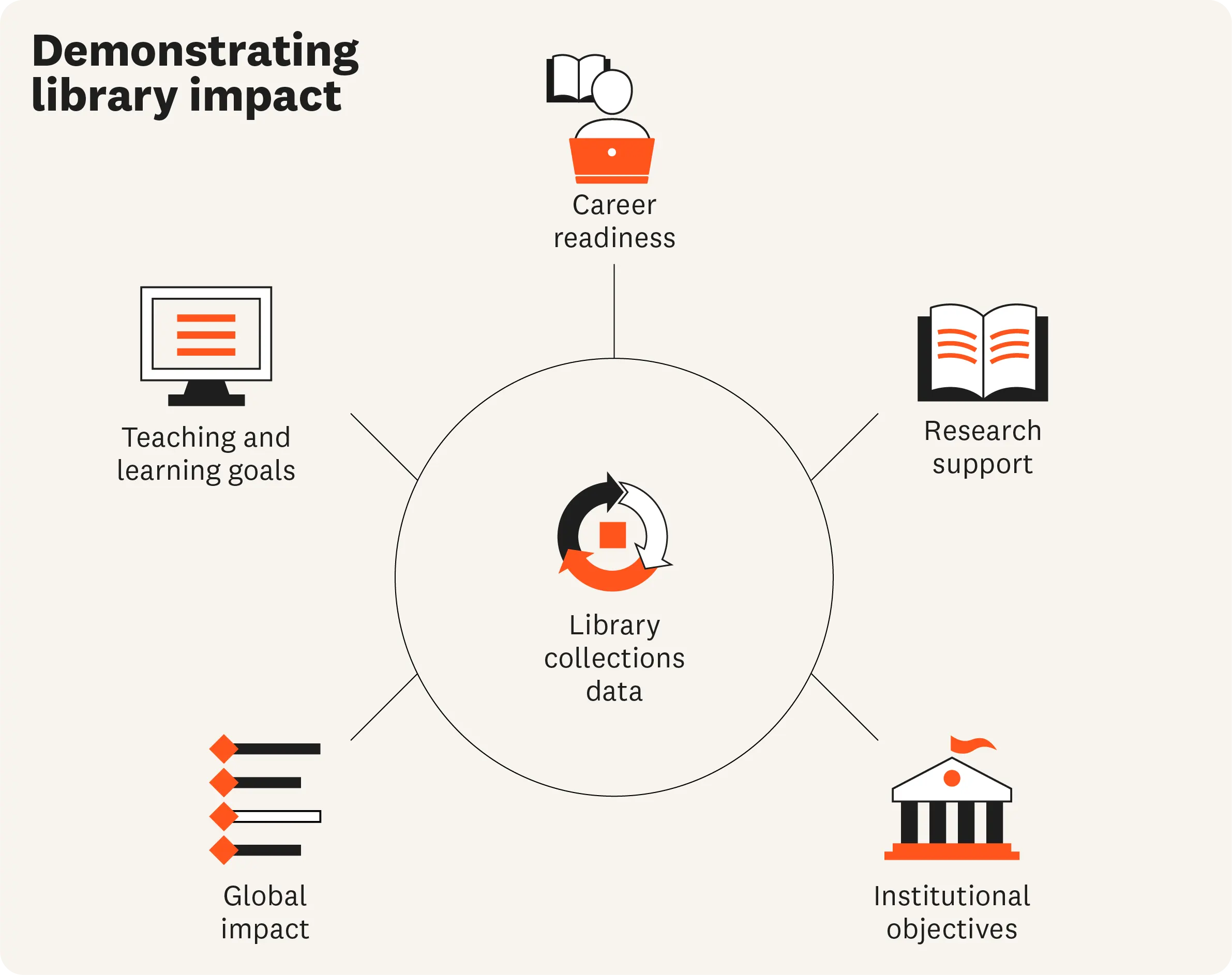
Demonstrating Library Impact
A collection that supports your users
An important part of that story is whether the collection meets the varied and complex needs of your library users.
For students, that may mean access to trusted foundational content that supports both teaching and learning. Books, reference works and journals each play different roles in the learning journey. Together they can show how the collection supports everything from early orientation in a new subject to deeper engagement with current research. Looking at the balance of content types, patterns of use across disciplines, and where demand is growing can help librarians demonstrate that the collection is designed to support the full learning experience for students.
The same is true for career readiness. Students need more than just access to course materials: they also need exposure to current topics, interdisciplinary ways of working and content that helps them beyond the classroom. Your collection data can help show whether students are engaging with materials that prepare them for professional contexts. In this sense, the collection is not only supporting academic success, but also equipping students with the knowledge and confidence they will carry forward into employment.
For researchers, your collections enable stronger, more connected scholarship. Collections should be seen as more than resources, but as catalysts for innovation and collaboration. When libraries can show that their collections support growing research areas, interdisciplinary work, or alignment with institutional research priorities, they demonstrate real contribution. That is a much more compelling message for institutional leaders because it shows your collection meets the needs of your library community.
A collection that delivers strategic value for the institution
An impact-led approach to collection assessment is also valuable because it helps the library connect their decisions to the priorities of institutional leaders—and that connection really matters. Only 51% of library directors believe senior leaders see the library as aligned with institutional priorities (Hulbert, 2023).
This is where collection data can become particularly powerful. Senior leaders are rarely asking only whether a resource was well used or whether spend was justified. More often, they want to understand whether the library is helping the institution succeed more broadly. Is it:
Strengthening research excellence?
Supporting student outcomes?
Enabling interdisciplinary work?
Contributing to societal goals or strategic initiatives?
Usage and ROI data can answer part of that story, but impact data helps answer the questions leaders care about most.
For example, a library might use collection data to show how access to foundational texts and current research support research quality and visibility. If the collection is aligned to priority disciplines, supports interdisciplinary discovery, and enables researchers to move effectively between books and journals, that can contribute to stronger outputs, broader collaboration and improved institutional reputation.
Similarly, a library can frame collection value in terms of teaching and learning outcomes. A collection that supports curriculum delivery, gives students access to high-quality trusted materials, and helps them build broader subject understanding contributes to the student experience in ways that matter institutionally. Better-supported learning drives higher student satisfaction, improved course performance and progression, and a clearer case for the library as a key contributor to recruitment and retention.
There is also a wider strategic dimension. Many institutions now articulate goals around real-world impact, whether through sustainability, public engagement, health, equity or the UN Sustainable Development Goals (SDGs). Evaluating collections through an impact lens can help demonstrate support for environmental sustainability goals, health initiatives and other efforts that advance human progress. A collection that supports interdisciplinary work across books and journals may be especially well placed to contribute here, because real-world challenges rarely sit neatly within a single discipline.
Asking better questions of your data
Ultimately, taking an impact-led approach to collection assessment means asking different questions.
Not just, “What was used?” but also, “What did that access make possible?”.
This shift can help libraries make more confident collection decisions. It can highlight where the collection is strongly aligned, where there are gaps, and where further investment could create the greatest benefit. This kind of assessment can bring clarity to collection decisions by identifying where to grow the collection for maximum benefit and resource efficiency.
Telling a richer story
Assessing collections through an impact lens is about taking a more holistic view of value. That means combining traditional performance indicators with broader evidence of contribution. Quantitative data is still essential, but it becomes more meaningful when paired with qualitative insight, institutional context and a clear understanding of strategic priorities.
For librarians, that creates a stronger narrative they can present to leadership: one that shows the collection as a strategic asset that supports learning, enables research, advances institutional goals and contributes to positive change.
To explore this approach in more depth, download our guide for librarians: Uncovering hidden impact: A guide to maximizing collection data
References:
Hulbert, I. G. (2023, March 30). US Library Survey 2022. Ithaka S+R. https://sr.ithaka.org/publications/us-library-survey-2022/opens in new tab/window