Verify AI-generated insights with Trust Cards
Discover how Trust Cards give you valuable information to assess insights quickly and move forward with confidence.

Make informed decisions with Trust Cards
Researchers rely on trusted signals when evaluating research sources — a respected journal title, a notable institution or author, or indicators such as citations — to quickly assess what to read and what to skip.
But when a generative AI tool synthesizes information from multiple, uncertain sources, the signals are not always clear.
According to Elsevier's recent report on how AI is influencing their work, 84% of researchers are using AI in some capacity, but remain cautious about accuracy, transparency, and verification.
Verifying an AI-generated insight shouldn't require opening multiple browser tabs or manually cross-referencing citations to make informed decisions. Yet that is still a common challenge with AI tools.
LeapSpace’s Trust Cards are designed to change that.
Evaluate sources at the point of discovery
Trust Cards address this challenge by making source evaluation immediate and granular. When you click on a reference in a LeapSpace response, a panel appears with bibliographic details accompanied by the signals researchers have come to rely on: besides the title and authors, journal and year, LeapSpace shows you citation scores, source availability, and much more.
If you enter a query such as "How can seaweed cultivation contribute to global protein supply while capturing carbon?" LeapSpace searches across its corpus of 20+ million full-text peer-reviewed articles and books from Elsevier, over 1,000 content licensing partners, and 107+ million scientific records from 7,000+ publishers on Scopus, and shows the steps it takes in real time. It generates a list of concrete insights, each tagged by one or more reference numbers.
Rather than just showing a citation link or a snippet preview, when you click through a citation tag, Trust Cards explicitly surface the connection between the insight, the underlying source, and where the supporting evidence appears. For each reference, Trust Cards state how the AI-generated insight aligns with the cited source—either supporting, contradicting, or neutral.
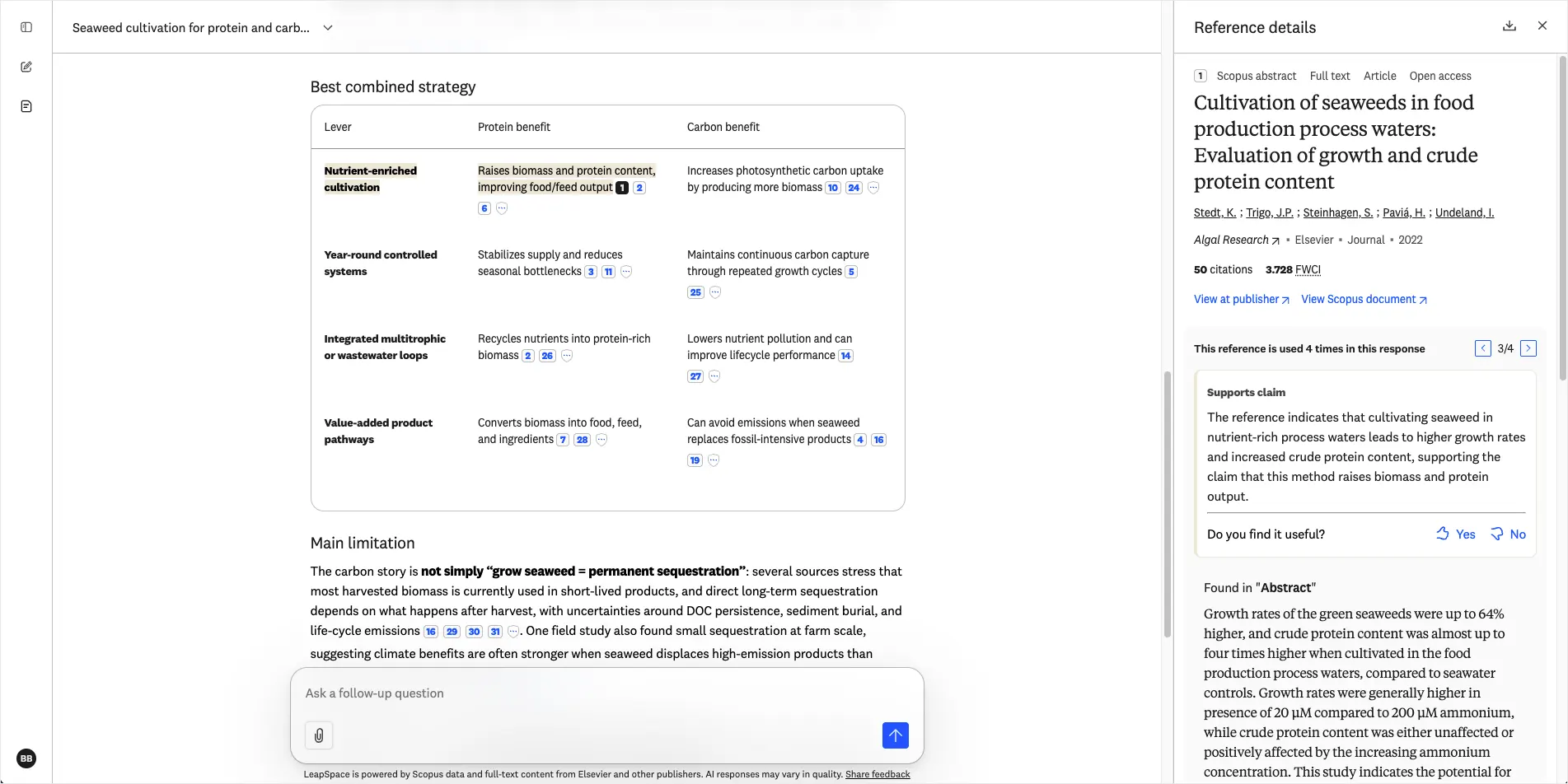
The reference details panel opens on the right side of the screen to show the Trust Card and abstracts to check claims.
The Trust Card also explains how the cited source supports the insight—in this case, by indicating that cultivating seaweed in nutrient-rich process waters leads to higher growth rates and increased crude protein content. For additional validation support, you can also read the abstract for the paper in the same panel.
Want to jump into reading the original source? Insights can easily be traced back to their peer-reviewed sources through the embedded links in the reference. The reference details panel shows the reference type, full-text and open access status, and provides a direct link to the original paper on the publisher’s platform when access is available.
You can click through the "View" link to review the source more thoroughly or save it, or move on to the next reference or insight—all without losing momentum.
Saving time without sacrificing rigor
Another example where Trust Cards can be useful is in evaluating methodologies.
If LeapSpace generates an insight about the effectiveness of a particular methodology, the Trust Cards can indicate whether the cited source directly tested the method, referenced it as one of several approaches, or discussed it in a different context altogether. This makes it easy to see whether a source provides strong support for a methodology or further verification is needed before investing time in reading the full paper.
By explaining why sources were cited and highlighting contradictions, Trust Cards help reinforce—not replace—critical thinking, helping researchers calibrate the strength of the evidence.
Regardless of the type of query, Trust Cards give you valuable information to assess insights quickly and move forward with confidence.
Building confidence in using AI for research workflows
LeapSpace provides Trust Card functionality across both abstracts and full-text content. Rather than needing to switch between an AI interface and original sources to validate accuracy, Trust Cards reduce the friction in your process while reinforcing good research practice.
For librarians helping faculty and students navigate AI-assisted research, Trust Cards offer a concrete way to model responsible AI use. This feature transforms abstract principles about AI transparency into something tangible: a workflow where source verification is integrated, visible, and routine.
As generative AI continues to reshape research processes, tools that embed accountability into every interaction as a core design choice — not an afterthought — will help play a critical role in building trust and confidence for researchers using AI.
Next steps
Interested in learning more about LeapSpace? Sign up for email updates to get the latest news and articles with best practices, user insights, and product updates.