
Start your trial today. Experience ClinicalKey AI free for 90 days.

Unfortunately we don't fully support your browser. If you have the option to, please upgrade to a newer version or use Mozilla Firefox, Microsoft Edge, Google Chrome, or Safari 14 or newer. If you are unable to, and need support, please send us your feedback.
Addressing bias and hallucinations is key in healthcare AI, with regular, rigorous evaluations involving clinicians and data experts ensuring responses are accurate, safe, and trustworthy. This ongoing process helps build confidence in AI tools' reliability and safety.
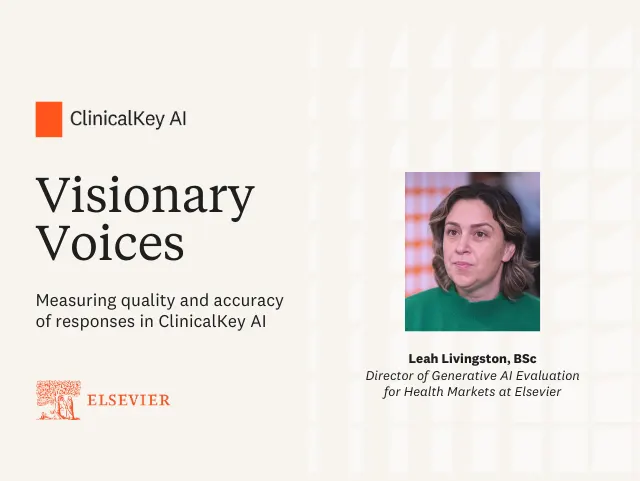
In this installment of the Visionary Voices series, data scientist Leah Livingston shares how metrics like accuracy and potential harmfulness are important factors in determining the effectiveness of responses provided in ClinicalKey AI.
By empowering healthcare professionals with intelligent tools, we're creating pathways to smarter diagnostics, safer treatments, and truly personalized patient care.
ClinicalKey AI integrates the latest information from a wide range of sources such as journals, clinical overviews, drug monographs and books. This approach not only enhances the quality of the decision-making process but saves time and resources. Instead of manually sifting through numerous documents, clinicians receive a distilled and comprehensive overview, enabling them to make informed choices quickly.
To learn how ClinicalKey AI can support your practice, contact us or try it yourself opens in new tab/windowopens in new tab/window today.