

Making clinical AI work in the NHS: evidence, governance and the path to adoption
22 October 2026
Overview
The Elsevier–Royal Society of Medicine Dialogue
On 3 September 2026, Elsevier and the Royal Society of Medicine brought 59 people together at 1 Wimpole Street, London: NHS clinicians, health system professionals and Elsevier colleagues. It was an invitation-only morning on AI in clinical practice.
The programme combined frontline clinical experience, health law expertise and digital transformation leadership. Participants included clinical directors, chief clinical information officers, medical directors, clinical operations leads and patient safety specialists.
This paper sets out what the room concluded, where it disagreed and what it recommends to health system leaders.
Clinical AI can be deployed safely and at scale in NHS settings. It needs governance built before deployment, tools designed around the clinical workflow and a workforce trained to interrogate what AI tells them.
That was the central conclusion of a morning that set aside whether AI belongs in clinical practice. Clinicians and patients already use these tools. The practical question is whether that use is governed, evidence-based and safe, or unmonitored and untraceable.
Four sessions explored the gap between personal and institutional adoption, why promising pilots stall, where liability sits when AI contributes to a clinical decision and what evidence persuades an NHS board.
The challenge
Adoption has outpaced governance. Just 40% of clinicians(1) rate their institution as good or very good at AI governance, and ECRI ranked the misuse of AI chatbots in healthcare as the most significant health technology hazard for 2026(2) — a finding that applied to general-purpose tools such as ChatGPT, Claude and Grok, and explicitly excluded chatbots built on curated medical evidence. The tools are in wide use. The governance often is not.
Jan Herzhoff, President of Elsevier Health Markets, opened the morning by describing this as the practical work now in front of health systems. The United Kingdom has long been good at generating innovation and running successful pilots, and finds it harder to move from pilot to scale. Generative AI sharpens the problem: it makes solutions far easier to build, but leaves governance, workforce adoption and evidence generation largely untouched.
Four challenges framed the discussion
Healthcare organisations are struggling to translate rapid AI adoption into trusted, governed and clinically accountable decision-making. Four challenges followed from that.
Governance is lagging behind adoption. Clinicians are already using AI tools, often outside formal oversight processes. Organisations must establish governance, evaluation frameworks and accountability mechanisms fast enough to keep pace with use.
Trust and evidence remain inconsistent. Many AI tools provide outputs without clear evidence, transparency or explainability. Clinicians need confidence that recommendations are grounded in trusted, verifiable sources.
Workflow integration remains difficult. Even effective AI tools fail when they create extra steps, disrupt workflows or require clinicians to leave existing systems. Adoption depends on fitting naturally into clinical practice.
Workforce readiness and training gaps persist. Clinicians need new skills to evaluate, question and appropriately use AI-generated outputs. Education must evolve alongside technology to support safe implementation.

What clinical AI looks like in practice
Clinical AI delivers the greatest value in complex, time-constrained decisions A consistent theme ran through the morning. Clinical AI is most valuable when clinicians face complex decisions, limited guidance and significant time pressure. Participants working in acute and emergency settings described this as the point at which rapid access to structured, referenced evidence makes the most difference to a decision.
Value is highest when uncertainty is highest The greatest benefit was described in atypical presentations and in situations where established guidance was limited or difficult to apply. In these cases clinicians could rapidly access structured, referenced evidence that would otherwise take significant time to identify and review.
Trust is built through transparency Participants placed considerable weight on a tool acknowledging when the available evidence did not directly address a clinical question. They viewed this transparency as a strength, reinforcing confidence in the output and distinguishing evidence-based clinical AI from general-purpose tools that may generate answers regardless of the strength of supporting evidence.
AI supports clinical judgement, it does not replace it Clinicians consistently emphasised that the value of an output depends on the quality of the clinical question and the user’s ability to interpret the result. The technology expands access to evidence and supports clinical reasoning, but responsibility for the decision remains with the clinician. This reinforced the importance of training, clinical expertise and appropriate use.
Adoption begins with learning and workflow integration Participants described early use focusing on retrospective review, education and reflective learning before application in time-sensitive settings. They also noted that adoption ultimately depends on how well a tool fits existing workflows. Clinicians are more likely to adopt technologies that reduce friction and help them reach trusted evidence efficiently, particularly in high-pressure environments where cognitive workload affects decision-making.
When adding tools to clinical workflows, it’s imperative that they’re seamless and reduce friction rather than add to it.
Dr Rahul Goyal
Consultant Physician and Clinical Executive at Elsevier
Why promising pilots stall
Pilots rarely fail because the technology does not work. More often, they stall because organisations underestimate the people, process and governance changes required to support adoption at scale. The expert panel, chaired by Dr Keith Grimes, identified three recurring barriers: change management, stakeholder alignment and delayed implementation planning.
Successful adoption is a people challenge Dr Richard Daniels emphasised that technology is often the easiest part of implementation. The more difficult work involves clinical leadership, communication, training, sponsorship and redesigning workflows around new tools. Without clear ownership and engagement, even promising technologies struggle to gain traction.
The panel also noted that those who commission a pilot are often not the people expected to use it. When implementation goals are defined without sufficient clinical input, expectations can diverge from frontline realities, slowing adoption and reducing long-term impact.
Clinical value must be clear from the start Dr Shibani Nicum argued that organisations do not always answer the most important question: why should a clinician use this? Technical performance alone rarely drives adoption. Clinicians need to see a clear benefit, whether through improved access to evidence, greater efficiency, better patient outcomes or more equitable care.
The panel agreed that demonstrating value in the context of everyday clinical practice is often more important than showcasing technical capability.
Delayed decisions create implementation debt Borrowing from the concept of technical debt, speakers described how important questions about governance, interoperability, workflow integration and workforce readiness are often deferred during pilot programmes. While this can accelerate initial deployment, unresolved issues frequently become barriers when organisations attempt to scale successful pilots.
As participants noted throughout the session, implementation planning is most effective when it begins alongside pilot design rather than after a proof of concept has demonstrated success.
Workflow determines adoption The panel repeatedly returned to a simple principle: clinicians adopt tools that reduce friction and abandon those that add it. Successful implementation requires fitting technology into existing clinical workflows rather than expecting clinicians to adapt to the technology.
Governance, liability and evidence
The panel emphasised that governance should not be viewed as a barrier to innovation, but as an enabler of safe and scalable adoption. As healthcare organisations move from experimentation to implementation, questions of accountability, evidence and oversight become increasingly important.
Healthcare is an innately risky business - things go wrong all the time. As soon as we introduce technology, that view changes. We think technology has to be perfect in a way we do not expect humans to be. 
Dr Richard Daniels
Paediatrician, Imperial College Healthcare NHS Trust
Accountability remains with clinicians and organisations Summer Maine, Senior Corporate Counsel for Elsevier Health, noted that liability in clinical AI continues to be assessed against the same reasonable clinician standard that applies across healthcare. Where clinicians review the supporting evidence, apply professional judgement and document their decision-making, liability exposure remains manageable.
Speakers also stressed that risk increases when AI outputs are accepted without appropriate review, or when systemic pressures such as understaffing and excessive workload make critical evaluation difficult. In these situations, responsibility extends beyond the individual clinician to the organisation and its operating environment.
Governance must be built in from the start Building on earlier discussion about implementation debt, panellists argued that governance, clinical safety, interoperability and workforce readiness should be addressed during planning rather than after deployment. Waiting until a pilot proves successful often makes these issues more difficult and costly to resolve at scale.
Dr Yat Wah Li described governance as a shared responsibility, with distinct obligations for suppliers, healthcare organisations and healthcare professionals. Each layer plays a role in ensuring safe and effective AI adoption.
Evidence standards must evolve with the technology The panel agreed that traditional evaluation approaches may not be sufficient for technologies that evolve over time. Dr Shibani Nicum compared the challenge to drug development, noting that prospective studies remain important but cannot be the sole measure of effectiveness for continuously updated systems.
Participants emphasised the importance of ongoing monitoring and post-deployment evaluation. Unlike medicines, AI systems can change through updates and new data inputs, requiring continuous assessment rather than one-time approval.
The greater risk is unsanctioned AI use Several speakers noted that clinicians and patients are already using general-purpose AI tools to answer healthcare questions. Organisations that fail to provide trusted, governed alternatives are not preventing AI use; they are pushing it into environments with less oversight, transparency and accountability.

What convinces boards
Boards are moved by evidence from a comparable environment, a clinical case paired with an economic one, and a credible plan for implementation. Boards are increasingly interested in AI, but enthusiasm alone rarely secures investment or organisational commitment. Decision-makers want evidence that a solution addresses a meaningful clinical or operational challenge, can be implemented safely and will deliver measurable value.
Evidence from a comparable environment carries the most weight Panellists described “tried and tested” as a term used frequently across the NHS, because it points to an evidence base drawn from what is perceived to be the same environment, or a very similar one. Where a tool has demonstrably worked somewhere recognisable, boards take it seriously. The metrics that accompany that evidence matter too: participants identified productivity gains, efficiency savings and return on investment as the measures that move a board discussion.
Clinical impact is generally more persuasive than technical sophistication. Boards look for clear evidence that a tool can improve decision-making, support clinicians, reduce inefficiencies or help address workforce pressures.
The blind spot is how far that evidence transfers Peer-site evidence is also where boards are most often misled. One panellist drew the comparison with drug research: the blind spot lies in how a solution performs in the context of the environment it is actually being placed into. Where the patient population, the users and the infrastructure differ from the setting that generated the evidence, both implementation and adoption become harder than the original results suggest.
Participants were candid that resourcing compounds this. Teams are already being asked to do more with less, the relevant expertise is often constrained or not yet in place, and that shapes how quickly an organisation can realistically move — against an expectation that adoption should have happened already.
If you can demonstrate at board level that you understand this is a multi-year change programme — that you’re not just going to come in and change things overnight, that you have a programme of support for implementation — that would land really well. Because for them, they like the idea, but how on earth are they going to do it? And if you’ve already thought that through, that probably is a winner. 
Dr Shibani Nicum
Consultant Medical Oncologist and Associate Professor, University College London
An implementation model turns interest into commitment Evidence of effectiveness remains important, but leaders are equally focused on delivery: whether clinicians will use the solution, whether it integrates into existing workflows and whether it can scale beyond a pilot. Several panellists noted that a supplier able to show a phased programme of support, with proof the model has worked elsewhere, answers the question boards find hardest.
Governance decides the final question Confidence ultimately depends on governance, clear accountability and a plan for ongoing evaluation. Dr Rahul Goyal described what organisations are guarding against: “They hate being a liability sink. They don’t want to be the last man standing for what a vendor is trying to bring to them.” Where a supplier provides genuine due diligence, performance measurement and ongoing evaluation, the risk sitting with the organisation reduces — and, in his words, “that’s a true partnership, where the liability lies where it should lie.”
Summer Maine added a consideration now beginning to land in board discussions: “If it’s becoming adopted in a widespread way, it really quickly starts moving into a standard of care. And you don’t want to be the hospital or the physician using practices that aren’t meeting a new standard of care.”
Increasingly, the question boards are asking is whether their organisation can adopt AI responsibly, govern it effectively and deliver sustainable value at scale.
Recommendations
Participants were clear that the practical work of responsible AI adoption rests with clinical leadership, not with technology suppliers or regulators alone. The six recommendations below come from the discussion. Each includes an action for health system leaders.
1. Governance: build it before deployment, not after Put the governance framework in place before a tool goes live. That means a named, active clinical risk owner with protected time, DCB0160 clinical safety documentation and an acceptable risk position agreed at board level. Participants expect retrofitting governance to cost more and work less well.
2. Workflow: design to remove friction, not to enforce compliance Map the clinical workflow before deployment and count the steps between a clinician’s question and a usable answer. Then reduce them. Participants saw friction as a leading influence on adoption. Where adoption is low, look for friction before assuming clinician resistance.
3. Unsanctioned AI: offer a governed alternative, not just a restriction Find out what your clinical workforce actually uses, not only what policy permits. Where people turn to general-purpose AI for clinical questions, give them a governed, evidence-grounded alternative that fits the workflow. Restriction without provision moves risk rather than reducing it.
4. Evidence: require traceable sources, not just outputs Specify in procurement that clinicians can follow a recommendation back to its source material and judge whether it applies to the patient in front of them. Traceability helps make a clinical decision defensible under the reasonable clinician standard, and sets specialist clinical tools apart from general-purpose models.
5. Monitoring: plan for a tool that will change Unlike a medicine, AI software changes with every update. Build re-evaluation triggers into deployment plans and design post-market surveillance from the start. Frameworks written for static medical devices do not fit systems that evolve continuously.
6. Workforce: train clinicians to interrogate AI, not just use it Prepare clinicians to question what a tool tells them: how it was developed, what its limits are and when to override it. Participants agreed that AI literacy belongs in core medical education, not as an optional extra. Elsevier’s Generative AI Academy for Health is free and covers these competencies.
These recommendations align with independent guidance. Alongside naming the misuse of AI chatbots as the most significant health technology hazard for 2026, ECRI advises healthcare organisations to verify AI outputs, establish AI governance committees, provide clinicians with AI training and audit AI tool performance regularly. |
|---|
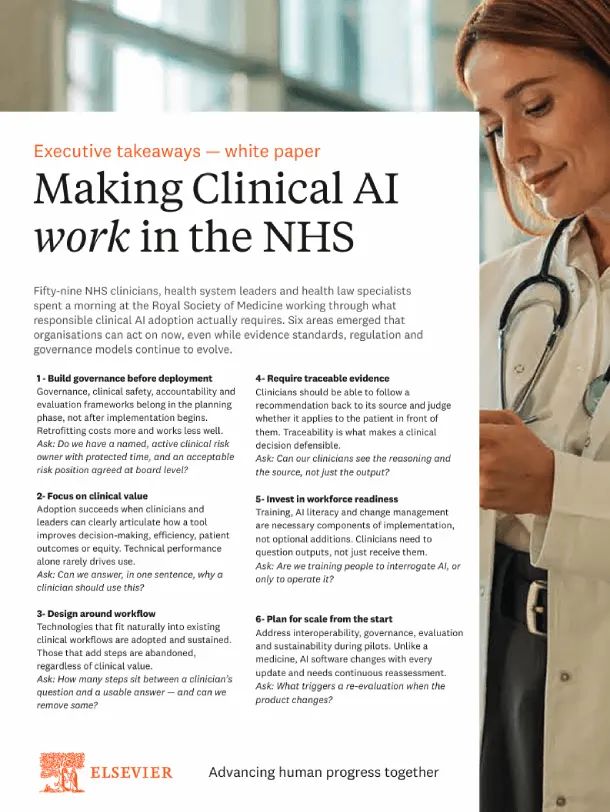
Making clinical AI work in the NHS: evidence, governance and the path to adoption
Download here opens in new tab/windowClinicalKey AI: Trusted content. Powered by responsible AI.

Conclusion
The discussion made clear that the question facing healthcare organisations is no longer whether AI will influence clinical care. It already does.
The challenge now is building the governance, evidence frameworks, workforce capabilities and clinical workflows needed to ensure that influence is transparent, safe and accountable.
Organisations that succeed will not necessarily be those that deploy the most AI. They will be those that can adopt it responsibly, scale it effectively and maintain trust in the decisions it supports.
Sources
(1) Elsevier. Clinician of the Future 2026.
(2) ECRI. Top 10 Health Technology Hazards for 2026. Published 21 January 2026.
NHS England. DCB0160: Clinical Risk Management — its Application in the Deployment and Use of Health IT Systems.
General Medical Council. Guidance on the use of artificial intelligence in clinical practice.
About this paper
This paper was produced by Elsevier following the Elsevier–Royal Society of Medicine Thought Leadership Dialogue on AI in Clinical Practice, “Transforming Patient Care with AI: Outcomes, Safety, and Quality at Scale”, held at the Royal Society of Medicine, 1 Wimpole Street, London, on 3 September 2026.