
SEO for scientific articles: Practical SEO tips for journal editors and authors
2 February 2026
|
8 min read
By David Bowers, Astrid Van Hoeydonck

Knowing a few core SEO principles is a practical way for editors and authors to boost the discoverability of their articles. Search engines and research platforms such as Google Scholar, PubMed, and Scopus rely on structured metadata, clear titles, and contextual signals when deciding which articles to surface.
This article offers practical advice to help you optimize these elements and increase the chances your work will be discovered, shared and cited.

Major indexing systems, including Google Scholar, depend on the article’s underlying HTML and webpage metadata.
Metadata and Article XML
Major indexing systems, including Google Scholar, depend on the article’s underlying HTML and webpage metadata. Journal platforms like ScienceDirect automatically generate HTML tags, but optimization also depends on the content within the tags. This content is directly tied to the submitted manuscript:
The title is carried into the page <title> tag, the H1 tag, and is often the clickable link in search results.
The abstract is placed into the “og:description” and “citation abstract” tags for search engines; it may also be truncated and used as the snippet in a search result.
Keywords signal relevance to users and may be used as filters within journal site searches (e.g., search filters).
Author names and affiliations disambiguate identity and link to author profiles.
Publication date, journal title, and DOI ensure the article is correctly cited and indexed.
Editors maximize the use of metadata and authors can help by supplying complete information during submission, including Scopus Author ID, ORCID iDs and standardized institutional names.
Accurate and Compelling Titles
Titles are often your only chance to persuade readers to visit your article. To maximize the SEO impact of your title, make it descriptive, precise, relevant, and unique. Consider length, jargon and acronyms.
Descriptive and Precise
The title should accurately reflect the specific focus and main findings / unique contributions of the article.
Identify the most important keywords and concepts and place them early in your title, since search engines give higher weight to leading words.
Example: Instead of “A Novel Look at Tropical Deforestation”, consider “Satellite Remote Sensing for Monitoring Tropical Deforestation in the Amazon”. The second version contains more searchable terms (“satellite remote sensing,” “monitoring,” “tropical deforestation”) and is therefore likely to match more user queries.
Relevant
While scientific papers can reach a broad audience, your target audience will be researchers or practitioners in your field.
Think of your readership, and what terms they would use when looking for your article or to find material on that topic in a search engine / database.
Use specific terminology, and vocabulary that is commonly used within your domain.
Tools like Google Scholar’s search autocomplete, and Google’s “People also ask” feature can help you find relevant search terms.
If in doubt, remember that the inclusion of core research terms is more important than clever phrasing.
Unique
Avoid titles too similar to your previous articles. Search engines may treat them as duplicates, reducing visibility.(e.g. “Satellite Remote Sensing for Monitoring Tropical Deforestation in the Amazon: a Literature Review” and “Satellite Remote Sensing for Monitoring Tropical Deforestation in the Amazon: Overview of Techniques”.
Search your candidate title in Google Scholar. If similar titles exist, adjust yours to ensure uniqueness.
Title length
Accuracy, relevance and uniqueness matter more than brevity. Trim parts that don’t contribute to these objectives.
Jargon and abbreviations
Use field-specific vocabulary while ensuring it matches terms your audience is likely to search for.
Effective Abstracts
Abstracts serve two audiences simultaneously: human readers scanning for relevance and search engines parsing meaning.
Abstracts should echo the main terminology of the paper and the core concepts naturally, without “keyword stuffing”. It’s ok to repeat your most important keywords a few times but do not artificially repeat these keywords beyond their natural occurrence. Since Google often displays only the beginning of the abstract, place the key concept or finding within the first 1-2 sentences.
Supplying abstracts in multiple languages can improve discoverability.
Article Keywords
When journals use them, we recommend selecting three to six terms that reflect central concepts and common terminology in the field. Tools like NLM’s MeSHopens in new tab/window (Medical Subject Headings) are useful guides. Consider including Table of Contents headings as keywords if the journal is divided into subject areas.
On some platforms keywords are also used for functionality, either to run a search based on the term, filter search results, or creating article collections.
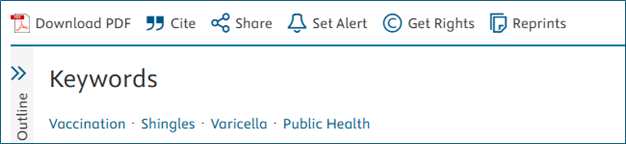
We recommend selecting three to six terms that reflect central concepts and common terminology in the field.
Article Section Headings
Section headings should accurately describe the content and,where relevant, include key terms and concepts. Thhis helps search engines rank your article for relevant search queries.
Alternative (alt) text for your images
Consider providing alternative text for figures, if your publisher supports this. Alt text improves accessibility for readers with visual impairments and helps search engines understand image content.
The Editor’s Role
While authors craft titles, abstracts, and keywords, editors shape the broader environment. Clear submission guidelines that include SEO advice, making abstracts and identifiers a requirement, and consistent style across issues all strengthen discoverability.
Editors can also enforce ethical SEO practices by ensuring titles, abstracts, and keywords are relevant to the article.
Social Media, Tagging, and Shareability
While Google doesn’t rank articles based on “likes,” social media plays an indirect but powerful role. Posts that generate engagement also create backlinks and traffic, which search engines reward.
Authors should create a short, plain-language summary when sharing their work. They are encouraged to use hashtags relevant to their field, such as #ComputerScience or #Engineering. Tagging co-authors, institutions, and funders widens reach. Authors should share the article page URL (the canonical page) over the article DOI. This grows backlinks and is the destination the DOI would redirect to anyway.
Editors and journals should promote new articles through their official journal and society accounts. They can encourage authors to reshare these posts to extend visibility. Platforms should include social sharing buttons on article pages to make it easier for readers to spread the work further. Using Open Graph and X Card metadata ensures that posts automatically populate a title, image, and abstract snippet, making them more engaging. These are already in place on Elsevier platforms.
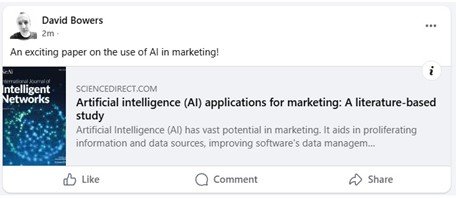
Using Open Graph and X Card metadata ensures that posts automatically populate a title, image, and abstract snippet, making them more engaging.
Conclusion
Improving discoverability is a shared responsibility. Publishers optimize platforms for discovery, authors craft titles, abstracts and keywords with search in mind, and editors ensure metadata is correct and workflows are SEO-friendly. By combining metadata accuracy with thoughtful communication, scholarly articles are more likely to reach their intended audience.
Contributors


Astrid Van Hoeydonck
Senior Product Manager, Accessibility & SEO
Elsevier