
Introducing CiteScore 2025: A Comprehensive and Transparent Metric for Journal Impact
Developed by the International Center for the Study of Research (ICSR) team, CiteScore offers a fairer and more comprehensive assessment of a journal’s research-based contributions.
We are thrilled to announce the release of CiteScore 2025, a powerful metric that provides transparent insights into journal citation impact. Developed by the International Center for the Study of Research (ICSR) team, CiteScore offers a fairer and more comprehensive assessment of a journal’s research-based contributions. With its greater stability, consistency, and transparency, CiteScore empowers researchers, librarians, publishers, editors, and research offices to make well-informed decisions and showcase the effectiveness of their publication strategies.
Explore CiteScore 2025 metricsopens in new tab/window
What is CiteScore? CiteScore is a metric calculated for active titles rigorously screened and selected by independent Content Selection Advisory Boards (CSAB) for both English and non-English language titles. It leverages Scopus’s comprehensive dataset to provide annual values and monthly tracking, allowing users to identify the most relevant journals and define their publication strategies.
Key Highlights of CiteScore 2025 Release:
Expanded Coverage: Includes 32,089 active titles, with 1,594 titles receiving their first CiteScore. This broader coverage ensures a more complete dataset for evaluating journal impact.
More Open Access Titles: The release includes 8,640 open access titles, with 55 of them ranking #1 in their respective categories. This highlights the growing importance of open access research.
Diverse Subject Categories: Covers 334 subject categories, with History being the largest subject area, comprising 1,888 titles. This diversity allows users to explore impact across various fields.
High Impact Titles: Identifies 13,131 titles with CiteScore but no Impact Factor in 2024. Among them, 701 titles are highly ranked in their respective areas, placing them in the top 10%.
Multilingual Support: 7,220 of CiteScore titles (23%) publish in 50+ languages other than English, providing a global perspective on research impact
Growing Impact: 736 titles experienced a CiteScore increase of 100% or more between 2024 and 2025, showcasing the dynamic nature of research impact.
Why Choose CiteScore? CiteScore offers several advantages over traditional metrics like the Journal Impact Factor (JIF):
Fairer Comparison: CiteScore includes only peer-reviewed publication types, preventing gaming and ensuring a level playing field for all journals.
Robust Assessment: Citations are counted cumulatively over a longer citation window, up to four years. This comprehensive approach provides a more stable and reliable assessment.
Early Impact Indication: CiteScore calculates impact for journals with just a single year of publication, giving new journals, including Open Access and China-focused journals, an early indication of their citation impact.
Responsible Use of Metrics: Elsevier is committed to the responsible use of metrics and has signed the Leiden Manifesto and Principles of the San Francisco Declaration on Research Assessment (DORA). CiteScore is part of this effort to promote a range of metrics for academic and government research.
CiteScore Methodology
The CiteScore methodology better reflects citation impact of a journal’s research-based contributions with greater stability, consistency in the time periods used, and remains comprehensive, current, clear, and free. It was developed by the ICSR (International Center for the Study of Research) team, based on extensive market research and leverages the inherent weaknesses of the JIF as a journal-level citation metric.
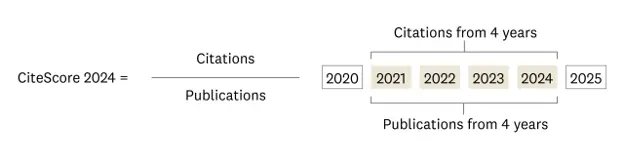
Comprehensive: CiteScore is available for all serial titles, not just journals. More than 32,089 titles are included
Current: The CiteScore Tracker is updated monthly. New titles in Scopus typically receive CiteScore metrics the year after they are included in Scopus.
Clear (transparent, simple and easy to understand): CiteScore offers complete transparency of the underlying data, as opposed to the opacity of JIF. With CiteScore, anyone can validate a CiteScore value by clicking into the numerator (citations) and denominator (documents).
Free: Unfettered access (for Scopus subscribers and non-subscribers) to CiteScore imposes no barriers to adoption.
How Can CiteScore Benefit You? CiteScore caters to a wide range of personas and use cases:
Researchers: Determine which serial titles to read, where to publish research, and showcase research outputs using a broader range of relevant titles and metrics.
Librarians: Support portfolio management, make informed decisions on journal subscriptions, and train students in working with freely available, comprehensive, current, and clear metrics.
Research Offices: Analyze publication strategies, encourage researchers to publish in journals aligned with institutional strategy, and compare relevant journals, especially for China-focused and Open Access journals.
Funding Bodies: Support rewarding and stimulating good research by using CiteScore as part of prominence scores and topic prominence in SciVal. Gain insights into which fields to invest in the future.
Publishers and Editors: Establish and monitor publication strategies, compare performance with competitors, and track progress using the CiteScore Tracker.