
Editor in a (60-second) spotlight – Wei-Ning Xiang
2017年11月24日
|
4 分鐘閱讀
Wei-Ning Xiang

"To sustain a crucial work-life balance on the journey toward scholarly excellence, yoga practice helps"
© istockphoto.com/LightFieldStudios
Name: Wei-Ning Xiang
University: Tongji University, Shanghai, China and The University of North Carolina at Charlotte, USAopens in new tab/window
Role at university: Professor, Department of Geography and Earth Sciences
Journal: Landscape and Urban Planning opens in new tab/window
Journal role: Co-Editor-in-Chief
Average number of submissions per year: 1,200
Rejection rate: 80%
CiteScore: 4.97
IF 2016: 4.563
What inspired your career in research? Role models are an enduring and unparalleled source of inspiration for my scholarly career and research moves. Born into a scholarly family, I was initially inspired by my parents, a high school math teacher mom and a chemical engineer dad, to be a teacher with a single and noble ambition to share the wealth of knowledge with younger generations. Privileged later in my life to study under some of the world’s finest professors in geography, landscape architecture, urban and regional planning who are not only erudite teachers but also topnotch researchers, I was motivated to be a scholar with a dual and still noble ambition to further and impart knowledge through research and teaching. Nearly three decades into my academic career, I was lately impelled to be a scholar-practitioner with a triple and even greater ambition to generate useful knowledge, share the intellectual wealth, and influence ecological practice through practice research and teaching. My role models are ecophronetic scholar-practitioners in ecological practice research who advanced rigorous knowledge that benefits practitioners and enlightens scholars.
How would you describe a typical working day? Typically, I wake up at 6am, read books and articles while having coffee and tea, then practice one-hour yoga; in the morning and afternoon working hours, I teach classes, work on research projects, or do editorial work; in the evening, I practice one-hour yoga before dinner, then check emails, watch news and movies, go to bed around 11pm.
How do you measure success in your work? To earn respect from colleagues I work with, from students and authors I provide services to, and from readers I write articles for.
Do you have any particular advice for younger researchers? To sustain a crucial work-life balance on the journey toward scholarly excellence, yoga practice helps. “Practice (yoga) and all is coming” (Guruji K. Pattabhi Jois, an Indian yoga teacher and Sanskrit scholar).
What drove you to become an editor? Unique opportunities for giving back, providing services, and enrichment are the major motivations. Being an editor, I am privileged with ample opportunities (1) to give back to the community of international scholars that has been providing me so generously with intellectual nourishment for scholarly growth and development; (2) to facilitate the advancement of human knowledge and celebrate the scholarly achievements of colleagues from around the world; and (3) to enrich my own intellectual life by learning new ideas and interesting projects, contemplating the validity and values of research behind them, and communicating with authors from diverse cultural and disciplinary backgrounds.
What is the most rewarding aspect of editorial work for you and what do you find difficult about the role? The enjoyment of guiding authors of promising manuscripts through the editorial process toward acceptance; the challenge of receiving reviewer’s reports on time.
What is the most important attribute in your opinion for being an editor? To be a reliable editorial services provider who operates with a humble attitude while meeting rigorous scholarly benchmarks.
Name one item/tool/resource that you cannot do without in your editorial role? The collective wisdom and team work. Take the editorial structures as an example. The current co-editors-in-chief (co-EIC) structure was the brainchild of Dr. Paul Gobster, our journal’s sole editor-in-chief from 2010 to 2011, and co-EIC between 2011 and 2014; the newly instituted associate editors (AEs) structure was initiated by Professor Joan Nassauer, co-EIC of the journal since 2014. As the journal’s co-EIC since 2011, I feel extremely fortunate to have the opportunity working with Paul (now an AE) and Joan, and a group of capable AE colleagues, and that the journal’s success is truly a testimony of collective wisdom and outstanding team work!
What would you be doing now if you were not a professor? A yoga teacher.
What is the most interesting image/photograph you have come across in your journal? Two juxtaposed photos showing a building whose design and construction are inspired by ant hills (Varenyam, et al, 2016, p.63, below).
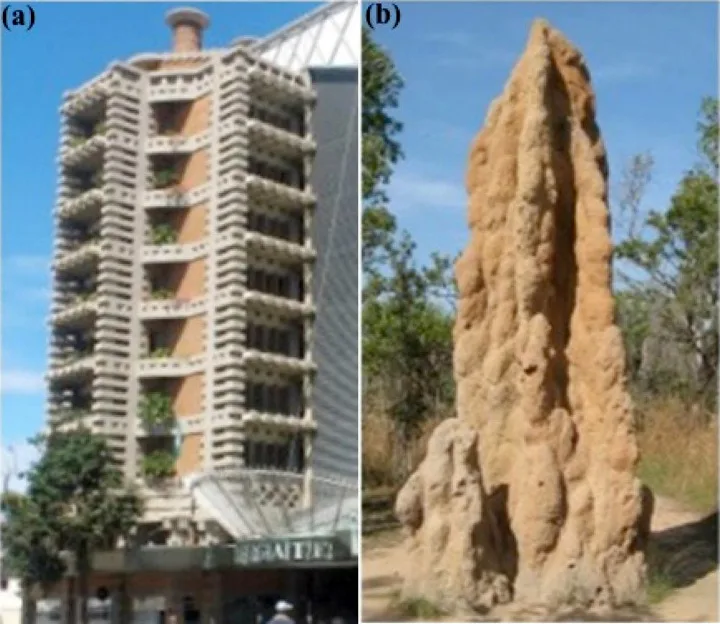
Fig. 1. (a) The Eastgate Building in Harare, Zimbabwe, inspired from (b) ant hills.
貢獻者
WX