
Training Dairy Cows with Positive Reinforcement Can Turn Otherwise Stressful Events into Play
2024년 3월 14일
|
Philadelphia
The results of a Journal of Dairy Science® study support the use of training to improve positive emotional states and welfare of dairy cows during handling
Dairy cows receive a huge amount of care during their lives on a farm, but procedures, especially restraining during procedures, can be stressful for some animals. Positive reinforcement training—or training with a reward to achieve a desired behavior—has shown promise to reduce this fear in other species. In a recent studyopens in new tab/window in the Journal of Dairy Scienceopens in new tab/window, published by the American Dairy Science Association and Elsevier, a team of researchers set out to understand whether this training technique holds promise for cattle as well. They demonstrated that it not only helps shape dairy cow behavior but can improve their emotional state and overall welfare along the way.
Jennifer Heinsius, PhD student in the Faculty of Land and Food Systems, Animal Welfare Program, University of British Columbia, explained, “A growing body of research shows that training with positive reinforcement enhances animal welfare.”
Opportunities to learn can reduce distress responses to procedures such as veterinary care, reduce the risk of injury, and help animals feel comfortable with new stimuli.
Heinsius noted, “As yet, very little of this research has been devoted to farm animals, so we set out to test the effects of training dairy cows with positive reinforcement in a cattle chute—a common experience for dairy cows undergoing veterinary care or husbandry.”
The team started with a group of 20 Holstein dairy heifers ranging from three to six months old, who had previous experience in the cattle chute area and with human handling. The animals were randomly assigned to either a group receiving positive reinforcement training or a control group receiving standard farm handling in the chute. The study involved 28 training sessions for each animal over four days a week with one session per day. Heifers were first brought to a waiting area (“start box”) and were then allowed to enter the training area, where they had access to the chute.
For the training group, grain was used as a food reinforcement to progress through the stages. Heifers were trained to touch a target with their muzzle; this target was then gradually moved until the animals were fully entering the chute.
Control heifers were also familiarized with the same chute but were not provided a food reward and were instead guided by a handler using words of encouragement, calm body movements, and gentle nudging to prevent them from backing up.
To assess how these two groups of animals perceived their experience, the researchers recorded anticipatory and play behaviors during the period when the heifers were waiting in the start box before entering the training area to start their daily training session.
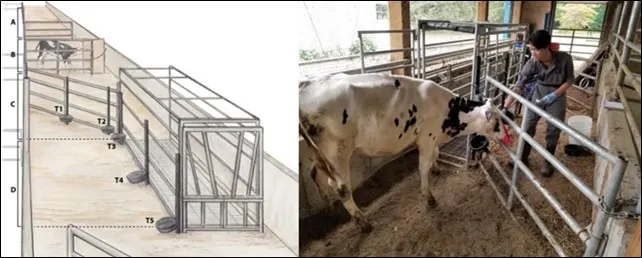
Caption: The drawing on the left shows the area where heifers were trained. Anticipatory and play behaviors were recorded in the “start box” (area B in the diagram) while cattle were waiting to enter the training area (C and D above). Heifers in the training treatment learned that they would receive a food reward to initially approach (locations T1 and T2) and then enter (T3 to T5) a restraint chute. On the right is a photo showing a heifer undergoing training. Providing positive reinforcement training to dairy cattle can lead to animals that anticipate and are more likely to consider human handling as positive (Credit: University of British Columbia).
Heinsius explained, “Overall, the dairy heifers trained with positive reinforcement showed more anticipatory behaviors in the start box than the control group; specifically, they transitioned between behaviors more frequently, indicating they were anticipating the start of their training sessions and the food reward.”
The training group also displayed more play behavior, such as jumping and running, indicating that the animals considered the training experience to be positive.
Heinsius elaborated, “Critically, the increases in play behaviors suggest that positive reinforcement training had a positive effect on the animals’ emotional state before handling, and to our knowledge this study is the first to assess the effect of training on emotional states in cattle.”
The study team stressed the need for further research—such as the long-term benefits of the training—and underscored the practical limitations attached to the time investment required to teach and train individual cows.
Heinsius outlined, “We hope to see future work to improve the efficiency of training methods and working with cattle earlier in life. And promising automated approaches might be developed using existing on-farm automation such as computerized feeders.”
Overall, this initial study is a first step to understanding the effectiveness of training heifers using positive reinforcement, and the results suggest it could be an important tool to help relieve stress and fear during important on-farm events in a dairy cow’s life—potentially improving the experience for both the animals and their handlers.
Notes for editors
The article is “Training dairy heifers with positive reinforcement: Effects on anticipatory behavior,” by Jennifer L. Heinsius, Julia Lomb, Joseph H.W. Lee, Marina A.G. von Keyserlingk, and Dan M. Weary (https://doi.org/10.3168/jds.2023-23709opens in new tab/window). It appears in the Journal of Dairy Science, volume 107, issue 2 (February 2024), published by the American Dairy Science Associationopens in new tab/window and Elsevier.
The article is openly available at https://www.journalofdairyscience.org/article/S0022-0302(23)00664-1/fulltextopens in new tab/window and the PDF version is available at https://www.journalofdairyscience.org/action/showPdf?pii=S0022-0302%2823%2900664-1opens in new tab/window.
Full text of this article is also available to credentialed journalists upon request; contact Eileen Leahy at +1 732 406 1313 or [email protected]opens in new tab/window. Journalists wishing to interview the authors should contact the corresponding author, Dan Weary, PhD, of the Faculty of Land and Food Systems, Animal Welfare Program, The University of British Columbia, at [email protected]opens in new tab/window.
About the Journal of Dairy Science
The Journal of Dairy Science® (JDS), an official journal of the American Dairy Science Association® (ADSA), is co-published by Elsevier and ADSA. It is the leading general dairy research journal in the world. JDS readers represent education, industry, and government agencies in more than 70 countries, with interests in biochemistry, breeding, economics, engineering, environment, food science, genetics, microbiology, nutrition, pathology, physiology, processing, public health, quality assurance, and sanitation. JDS has a 2022 Journal Impact Factor of 3.5 and five-year Journal Impact Factor of 4.2 according to Journal Citation Reports™ (Source: Clarivate™ 2023). www.journalofdairyscience.orgopens in new tab/window
About the American Dairy Science Association (ADSA®)
The American Dairy Science Association (ADSA) is an international organization of educators, scientists, and industry representatives who are committed to advancing the dairy industry and keenly aware of the vital role the dairy sciences play in fulfilling the economic, nutritive, and health requirements of the world’s population. It provides leadership in scientific and technical support to sustain and grow the global dairy industry through generation, dissemination, and exchange of information and services. Together, ADSA members have discovered new methods and technologies that have revolutionized the dairy industry. www.adsa.orgopens in new tab/window
엘스비어 소개
엘스비어는 첨단 정보와 의사결정 지원 분야의 글로벌 선도 기업으로 100년 넘게 과학과 헬스케어의 발전을 지원하며 인류 진보에 기여해 왔습니다. 우리는 170개국 이상에서 학술 및 기업 연구 커뮤니티, 의사, 간호사, 미래의 의료 전문가와 교육자들을 지원합니다. 근거에 기반한 신뢰할 수 있는 과학·의학 콘텐츠와 최첨단 AI 기술을 결합해 중요한 통찰과 혁신적인 솔루션을 제공해, 의미있는 성과를 이루도록 돕고 있습니다. 또한 다양성과 지속 가능성을 제품과 기업 문화 전반에 내재화하며, 우리가 속한 커뮤니티와 협력합니다. 엘스비어 재단opens in new tab/window은 전 세계에서 연구와 보건 파트너십을 지원합니다.
엘스비어는 전문가 및 기업 고객에게 정보 기반의 분석과 의사결정 도구를 제공하는 글로벌 기업 RELXopens in new tab/window의 일원입니다. 자세한 내용은 www.elsevier.com에서 확인할 수 있으며, 소셜미디어 @elsevierconnect를 통해 최신 소식을 받아보실 수 있습니다.
연락처
JT
EL