
Shorten the Blanking Period After Atrial Fibrillation Ablation, Experts Say
2024년 4월 17일
|
Philadelphia
New evidence published in Heart Rhythm underpins why the blanking period should be shortened
New evidence-based research calls into question the conventional three-month blanking period immediately after atrial fibrillation (AF) ablation, when early occurrences of AF are thought not to predict long-term AF recurrence. Two articles and an accompanying editorial in Heart Rhythmopens in new tab/window, the official journal of the Heart Rhythm Society, the Cardiac Electrophysiology Society, and the Pediatric & Congenital Electrophysiology Society, published by Elsevier, address the controversy and recommend shortening the blanking period.
Early recurrence of atrial tachyarrhythmia (ERAT) is commonly seen following catheter ablation of AF, with reported incidences of up to 61% in the first three months. ERAT is often attributed to transient inflammation induced by tissue damage during ablation and short-term imbalances in autonomic innervation. This forms the physiologic rationale for the accepted convention of a three-month blanking period, during which arrhythmia recurrences are presumed to be relatively benign and not indicative of treatment failure. However, this reasoning disregards valuable data regarding early arrhythmia recurrences and their potential significance.
The authors of the editorialopens in new tab/window accompanying the two articles in Heart Rhythm call for the three-month blanking period to be reconsidered and posit that it might be time to "blank the blanking period" altogether. Lead author Jonathan M. Kalman, MBBS, PhD, from the Department of Cardiology, Royal Melbourne Hospital, Australia, says, "With increasing data indicating that early AF recurrence is a predictor of late recurrence, the three-month blanking period has been called into question. Although clinical trials assessing AF ablation have traditionally defined treatment success by the time to first AF recurrence, the use of such a binary efficacy outcome lacks clinical grounding and represents an oversimplification of the impact of ablative therapy."
Lead author of the article “Defining the blanking period, using continuous ECG monitoring, after cryoballoon pulmonary vein isolationopens in new tab/window,” Dan Musat, MD, from The Valley Hospital and The Snyder Center for Comprehensive Atrial Fibrillation, Ridgewood, NJ, USA, notes, "Multiple studies have challenged the duration of the blanking period. Our study used continuous monitoring and showed that both the timing of the last ERAT episode and the burden of ERAT show congruent results; any ERAT after the first month portends a worse outcome. Our data show that the ~1/3 of patients in whom ERAT occurs and/or have a burden of >0% after the first month post-cryoballoon pulmonary vein isolation, are at significantly higher risk of long-term recurrent AF. These findings lead us to consider changing the duration of the blanking period post-AF ablation to one month from the current three months."
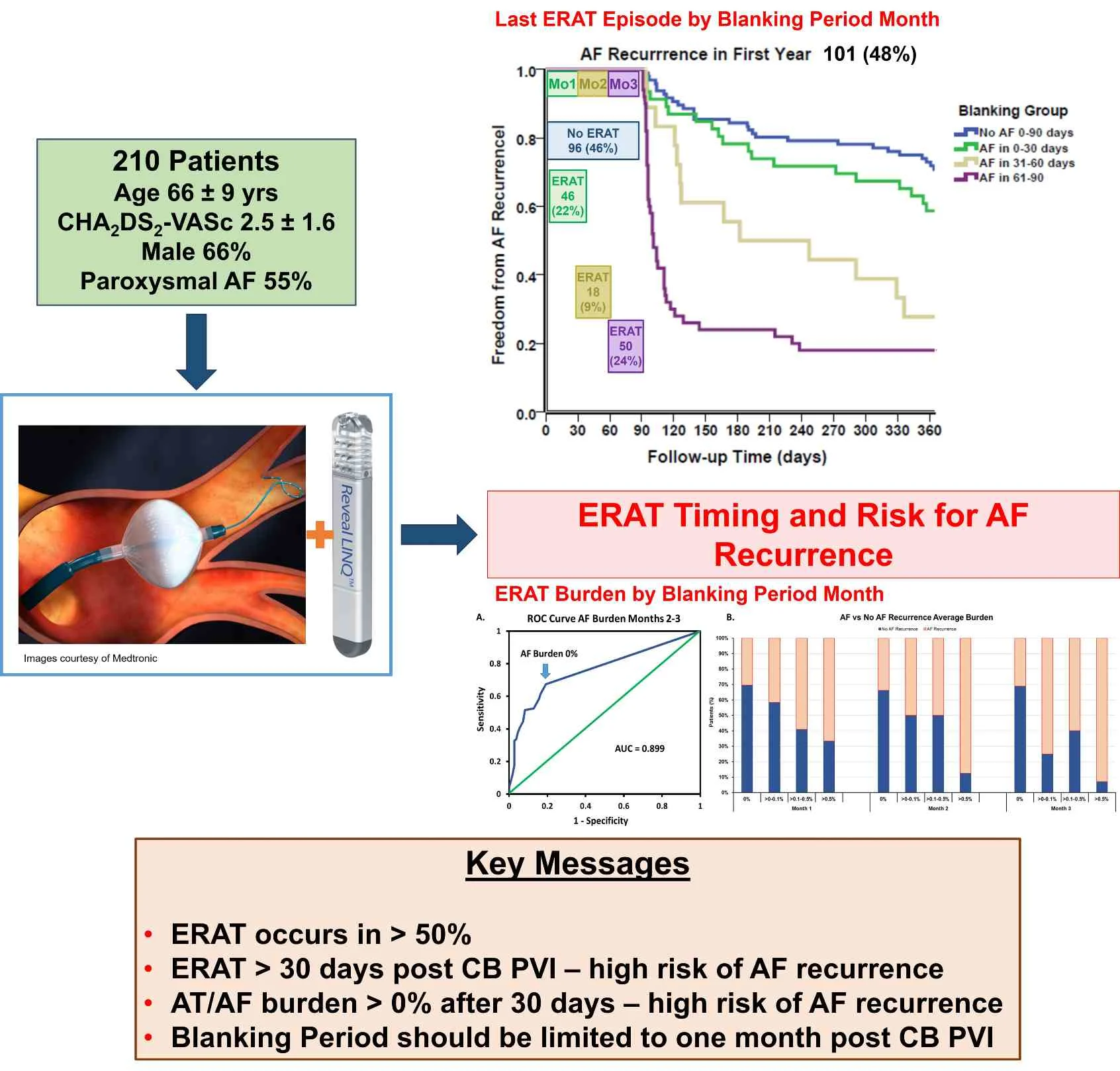
Caption: Based on continuous monitoring of early recurrence of atrial tachyarrhythmia immediately after patients have undergone atrial fibrillation ablation, Musat et al.opens in new tab/window recommend shortening the blanking period from three months to one (Credit: Dan Musat).
Co-author Suneet Mittal, MD, from The Valley Hospital and The Snyder Center for Comprehensive Atrial Fibrillation, Ridgewood, NJ, USA, adds, “Our findings also demonstrate the value of continuous long-term ECG monitoring, because information about the presence and burden of AF can help inform clinical decision-making in patients following cryoballoon pulmonary vein isolation.”
In "Early atrial fibrillation recurrence post catheter ablation: Analysis from insertable cardiac monitor in the era of optimized radiofrequency ablationopens in new tab/window," De Becker et al. also emphasize the importance of continuous monitoring. They compiled data from Close-To-Cure and Close Maze studies, encompassing 165 patients who underwent radiofrequency (RF) ablation for paroxysmal or persistent AF. All patients were implanted with an insertable cardiac monitor two to three months before ablation. The study found that patients experiencing ERAT had a substantially higher risk of late recurrence, and the burden of ERAT during the blanking period was a significant predictor.
Lead investigator Benjamin De Becker, MD, from the Cardiology Department, AZ Sint Jan, Bruges, Belgium, explains, "During the blanking period, ERAT burden and ERAT occurring during the third month are independently associated with late recurrence. ERAT occurring after 64 days post-ablation was associated with a very high risk of late recurrence in both paroxysmal and persistent AF patients, suggesting that the conventional blanking period could be shortened. A blanking period post-AF ablation is mandatory to avoid unnecessary ablation because of procedural-induced arrhythmogenicity, and to avoid the occurrence of later repermeabilization of the RF lesions, which could require further reablation. Our research proposes that a two-month post-ablation blanking period would be an acceptable tradeoff, minimizing the risk of an unnecessary repeat procedure. After this two-month period, atrial tachyarrhythmia occurrence is highly predictive of subsequent recurrences."
Professor Kalman concludes, "In light of this new evidence, a more stringent interpretation of these studies' findings might be that the very notion of a blanking period should be reconsidered. We believe that these data support a recommendation to eliminate the blanking period."
Notes for editors
The articles are:
"Defining the blanking period, using continuous ECG monitoring, after cryoballoon pulmonary vein isolation," by Dan L. Musat, MD, Nicolle S. Milstein, MS, Matthew Saberito, MS, Advay Bhatt, MD, FHRS, Mohammadali Habibi, MD, Tina C. Sichrovsky, MD, FHRS, Mark W. Preminger, MD, Richard E. Shaw, PhD, Suneet Mittal, MD, FHRS (https://doi.org/10.1016/j.hrthm.2024.02.014opens in new tab/window).
The article is openly available for 30 days at https://www.heartrhythmjournal.com/article/S1547-5271(24)00132-2/fulltextopens in new tab/window. Journalists who wish to interview the study's authors should contactErin Blake at +1 201 291 6407 or [email protected]opens in new tab/window.
“Early atrial fibrillation recurrence post catheter ablation: Analysis from insertable cardiac monitor in the era of optimized radiofrequency ablation,”byBenjamin De Becker, MD, Milad El Haddad, Msc, PhD, Maarten De Smet, MD, PhD, Clara François, MD, René Tavernier, MD, PhD, Jean-Benoit le Polain de Waroux, MD, PhD, Mattias Duytschaever, MD, PhD, Sébastien Knecht, MD, PhD (https://doi.org/10.1016/j.hrthm.2024.01.020opens in new tab/window).
The article is openly available for 30 days at https://www.heartrhythmjournal.com/article/S1547-5271(24)00074-2/fulltextopens in new tab/window.
The editorial is “Early postablation atrial fibrillation recurrence: Time to blank the blanking period?,”by Sohaib Virk, BMed/MD, BSc (Med), MMed, and Jonathan M. Kalman, MBBS, PhD
(https://doi.org/10.1016/j.hrthm.2024.01.041opens in new tab/window).
The editorial is openly available for 30 days at https://www.heartrhythmjournal.com/article/S1547-5271(24)00095-X/fulltextopens in new tab/window.
The articles appear online in advance of Heart Rhythm, Volume 21, Issue 5 (May 2024) published by Elsevier.
Full text of the articles is also available to credentialed journalists upon request; contact Jane Grochowski at +1 406 542 8397 or [email protected]opens in new tab/window.
About Heart Rhythm
Heart Rhythmopens in new tab/window, the official Journal of the Heart Rhythm Societyopens in new tab/window, the Cardiac Electrophysiology Societyopens in new tab/window, and the Pediatric & Congenital Electrophysiology Societyopens in new tab/window, is a unique journal for fundamental discovery and clinical applicability. It integrates the entire cardiac electrophysiology (EP) community from basic and clinical academic researchers, private practitioners, engineers, allied professionals, industry, and trainees, all of whom are vital and interdependent members of our EP community. www.heartrhythmjournal.comopens in new tab/window
About the Heart Rhythm Society
The Heart Rhythm Societyopens in new tab/window is the international leader in science, education, and advocacy for cardiac arrhythmia professionals and patients, and the primary information resource on heart rhythm disorders. Its mission is to improve the care of patients by promoting research, education, and optimal healthcare policies and standards. The Heart Rhythm Society is the preeminent professional group representing more than 8,000 specialists in cardiac pacing and electrophysiology from more than 94 countries. www.HRSonline.orgopens in new tab/window
엘스비어 소개
엘스비어는 첨단 정보와 의사결정 지원 분야의 글로벌 선도 기업으로 100년 넘게 과학과 헬스케어의 발전을 지원하며 인류 진보에 기여해 왔습니다. 우리는 170개국 이상에서 학술 및 기업 연구 커뮤니티, 의사, 간호사, 미래의 의료 전문가와 교육자들을 지원합니다. 근거에 기반한 신뢰할 수 있는 과학·의학 콘텐츠와 최첨단 AI 기술을 결합해 중요한 통찰과 혁신적인 솔루션을 제공해, 의미있는 성과를 이루도록 돕고 있습니다. 또한 다양성과 지속 가능성을 제품과 기업 문화 전반에 내재화하며, 우리가 속한 커뮤니티와 협력합니다. 엘스비어 재단opens in new tab/window은 전 세계에서 연구와 보건 파트너십을 지원합니다.
엘스비어는 전문가 및 기업 고객에게 정보 기반의 분석과 의사결정 도구를 제공하는 글로벌 기업 RELXopens in new tab/window의 일원입니다. 자세한 내용은 www.elsevier.com에서 확인할 수 있으며, 소셜미디어 @elsevierconnect를 통해 최신 소식을 받아보실 수 있습니다.
연락처
JG