
Researchers find promising candidate to treat irreversible lung and eye diseases in extremely premature infants
2023년 12월 11일
|
Philadelphia
Novel findings reported in The American Journal of Pathology implicate granulocyte colony-stimulating factor (G-CSF) in both bronchopulmonary dysplasia and retinopathy in premature babies
Advancements in the care of premature babies are leading to improved survival rates. However, the incidence of neonatal diseases with life-long consequences such as bronchopulmonary dysplasia (BPD) and retinopathy of prematurity (ROP) is increasing. A novel study has implicated granulocyte colony-stimulating factor (G-CSF) in both BPD and ROP, making it a promising therapeutic candidate. The resultsopens in new tab/windowappear in The American Journal of Pathologyopens in new tab/window, published by Elsevier.
BPD, also called chronic lung disease of immaturity, afflicts approximately one third of all extremely premature infants, causing lifelong lung damage. It occurs in approximately 80% of infants born between 22 and 24 weeks of gestation. There is no effective treatment other than supportive care. BPD often occurs alongside the neonatal eye disease ROP, which impairs vision irreversibly, suggesting a related pathogenesis. However, specific mechanisms of BPD and ROP remain unknown.
Lead investigator Margaret L. Hibbs, PhD, Leukocyte Signalling Laboratory, Department of Immunology, Central Clinical School, Monash University, explains, “Our laboratory focuses on inflammation and its underlying mechanisms, and we have been studying myeloid colony-stimulating factors for many years. Previous work by us reported that G-CSF was pathogenic in chronic obstructive pulmonary disease (COPD), and this has now been shown by others to occur in asthma. Given the links between early life lung disease and COPD, it seemed reasonable to hypothesize that G-CSF may also be implicated in the neonatal lung disease BPD.”
Investigators used a neonatal mouse model of coincident BPD and retinopathy to screen for candidate mediators. Equal numbers of male or female mice were assigned randomly to normoxia (21% oxygen) or hyperoxia (75% oxygen) and were exposed within 12 hours of birth. The study revealed that G-CSF was significantly induced in mouse lung wash fluid and plasma in response to hyperoxia. This was validated in human disease as preterm infants with more severe BPD had increased plasma G-CSF.
Neonatal mice deficient in G-CSF exhibited significantly reduced alveolar damage and, correspondingly, showed minimal impairment of lung function following exposure to hyperoxia. This was associated with an ameliorated oxidative stress response, reduced lung epithelial cell proliferation, decreased migration of myeloid cells from the periphery into the lungs, and diminished myeloid cell activation. Deficiency of G-CSF also protected against retinopathy, suggesting wide-ranging protection.
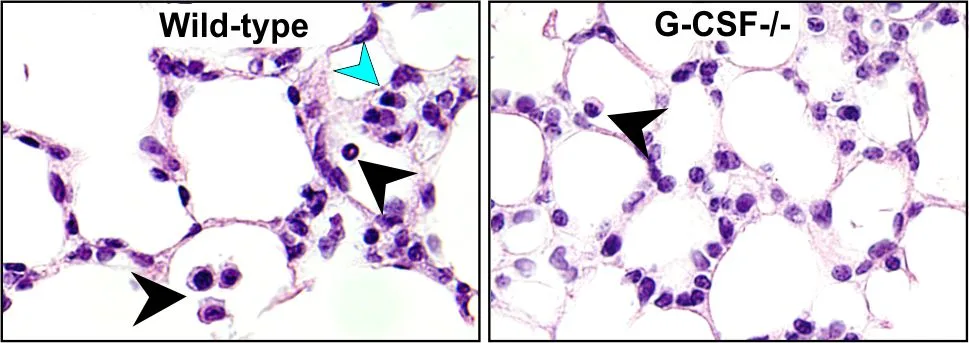
Caption: In response to a high oxygen insult, the lungs of wild-type mice (left-hand side) show alveolar simplification and enlargement, septal wall thickening (blue arrow), and leukocyte infiltration (black arrows), all features seen in human disease. Deficiency of granulocyte colony-stimulating factor (G-CSF) in mice (G-CSF-/-) markedly protects the lungs from these traits (right-hand side) (Credit: The American Journal of Pathology).
Professor Hibbs notes, “Inflammation is highly implicated in the pathogenesis of BPD, so we speculated that G-CSF–dependent inflammation might be involved in this lung disease, but the surprise was that deficiency of G-CSF also protected against retinopathy. While more needs to be done to expand these findings, recent studies implicate neutrophils in ocular diseases such as ROP and diabetic retinopathy, and G-CSF is the major regulator of neutrophil development survival and activation.”
Co-investigator Evelyn Tsantikos, PhD, Department of Immunology, Central Clinical School, Monash University, comments, “These studies produced some surprises including the unexpected protection that G-CSF deficiency afforded to the endothelial compartment. While this may relate to the reduced oxidative burden, G-CSF receptors have been shown to be expressed on endothelial cells, so we are keen to investigate this finding further.”
First author Lakshanie C. Wickramasinghe, PhD, Department of Immunology, Central Clinical School, Monash University, adds: “These studies highlight the value of collaborative research – we could not have achieved the best research outcomes without involving clinical collaborators, Professor Atul Malhotra, who provided a first-hand look into the respiratory interventions provided in the neonatal intensive care unit; and Professor Anne Hilgendorff and Dr. Alida Kindt, who performed translational studies in BPD patients demonstrating significantly elevated levels of G-CSF in infants with more severe BPD.”
Professor Hibbs concludes, “Our studies identify a new mechanism in BPD that is therapeutically tractable and may help rescue the lungs and sight of infants from life-long damage. Neonatal lung and eye diseases are currently managed and treated as independent conditions. However, our findings suggest that G-CSF is a pathological mechanism common to both, which may advance a new therapeutic strategy to improve the care and long-term outcomes of these vulnerable premature infants.”
---
Notes for editors
The article is “Granulocyte Colony-Stimulating Factor is a Determinant of Severe Bronchopulmonary Dysplasia and Coincident Retinopathy,” by Lakshanie C. Wickramasinghe, Evelyn Tsantikos, Alida Kindt, April L. Raftery, Timothy A. Gottschalk, Jessica G. Borger, Atul Malhotra, Gary P. Anderson, Peter van Wijngaarden, Anne Hilgendorff, and Margaret L. Hibbs (https://doi.org/10.1016/j.ajpath.2023.07.006opens in new tab/window). It appears in The American Journal of Pathology, volume 193, issue 12 (December 2023), published by Elsevier.
The article is openly available at https://ajp.amjpathol.org/article/S0002-9440(23)00311-5/fulltextopens in new tab/window.
The animal studies in the paper were funded by the National Health and Medical Research Council of Australia. Graduate student (Lakshanie C Wickramasinghe) was supported by a Research Training Program stipend, which is provided by the Australian Government.
Full text of the article is also available to credentialed journalists upon request. Contact Eileen Leahy at +1 732 238 3628 or [email protected]opens in new tab/window to request a PDF of the article. To request an interview with the authors please contact Margaret L. Hibbs, PhD, at [email protected]opens in new tab/window.
About The American Journal of Pathology
The American Journal of Pathologyopens in new tab/window, official journal of the American Society for Investigative Pathologyopens in new tab/window, published by Elsevier, seeks high-quality original research reports, reviews, and commentaries related to the molecular and cellular basis of disease. The editors will consider basic, translational, and clinical investigations that directly address mechanisms of pathogenesis or provide a foundation for future mechanistic inquiries. Examples of such foundational investigations include data mining, identification of biomarkers, molecular pathology, and discovery research. High priority is given to studies of human disease and relevant experimental models using molecular, cellular, and organismal approaches. https://ajp.amjpathol.orgopens in new tab/window
엘스비어 소개
엘스비어는 첨단 정보와 의사결정 지원 분야의 글로벌 선도 기업으로 100년 넘게 과학과 헬스케어의 발전을 지원하며 인류 진보에 기여해 왔습니다. 우리는 170개국 이상에서 학술 및 기업 연구 커뮤니티, 의사, 간호사, 미래의 의료 전문가와 교육자들을 지원합니다. 근거에 기반한 신뢰할 수 있는 과학·의학 콘텐츠와 최첨단 AI 기술을 결합해 중요한 통찰과 혁신적인 솔루션을 제공해, 의미있는 성과를 이루도록 돕고 있습니다. 또한 다양성과 지속 가능성을 제품과 기업 문화 전반에 내재화하며, 우리가 속한 커뮤니티와 협력합니다. 엘스비어 재단opens in new tab/window은 전 세계에서 연구와 보건 파트너십을 지원합니다.
엘스비어는 전문가 및 기업 고객에게 정보 기반의 분석과 의사결정 도구를 제공하는 글로벌 기업 RELXopens in new tab/window의 일원입니다. 자세한 내용은 www.elsevier.com에서 확인할 수 있으며, 소셜미디어 @elsevierconnect를 통해 최신 소식을 받아보실 수 있습니다.
연락처
EL
CCP
Chhavi Chauhan, PhD
Director of Scientific Outreach
The American Journal of Pathology
+1 240 283 9724
Chhavi Chauhan, PhD 이메일