
Novel device holds promise for diagnosing tuberculosis in the “missing millions”
2023년 6월 22일
|
Philadelphia
Investigators collaborating on a new chip-based technology using dielectrophoresis to selectively isolate Mycobacterium tuberculosis from sputum samples of suspected tuberculosis patients in under-served communities report promising results in The Journal of Molecular Diagnostics
According to the World Health Organization, each year there are approximately three million undiagnosed cases of tuberculosis (TB) globally, which are characterized as the “missing millions.” In this cutting-edge studyopens in new tab/window scientists test a diagnostic device using dielectrophoresis that holds promise for improving TB detection and treatment of patients in high-endemic, under-resourced areas. Bringing diagnostics to the patients who need it most will help meet global targets to reduce the burden of TB. Their results appear in The Journal of Molecular Diagnosticsopens in new tab/window, published by Elsevier.
A unique industry-academia partnership between the TB research team at St George’s University of London, Institute for Infection and Immunity, and QuantuMDx, a medical technology company based in the UK, presented an opportunity to prioritize the development of a cheap, rapid, accurate, and portable TB diagnostic test to analyze sputum samples for Mycobacterium tuberculosis (Mtb) from suspected TB patients.
Lead investigator Philip D. Butcher, PhD, St George’s, University of London, explained, “The global burden of TB is not improving. Although it is infectious, it is highly treatable. However, affordable diagnostics suitable for implementation at the point of care are needed to reach the ‘missing millions.’ Our TB research group at St George’s has a longstanding appreciation of the global imperative for improved diagnostics for TB, and we realized that novel technologies may provide an answer. We saw an opportunity by collaborating on a new chip-based technology using dielectrophoresis to selectively isolate Mtb bacilli from sputum samples.”
The investigators describe a prototype microfluidic lab-on-a-chip system called CAPTURE-XT® from QuantuMDx that can process solubilized sputum from suspected TB patients, capture Mtb bacilli for visual analysis (as a substitute for smear microscopy), and provide a purified sample for molecular confirmation by quantitative PCR (qPCR) and ultimately for genotypic drug-susceptibility analysis. CAPTURE-XT® technology relies on the principle of dielectrophoresis – a little-utilized technique that can be tuned to selectively attract or repel specific particles or cells based upon their dielectric properties. In this case, it is the Mtb bacteria that cause TB that are specifically captured and concentrated, while the other sputum contents are washed away.
After optimization using a panel of 50 characterized sputum samples, the performance of the prototype was assessed by a blinded screening of 100 characterized and bio-banked sputum samples provided by the Foundation for Innovative New Diagnostics (FIND).
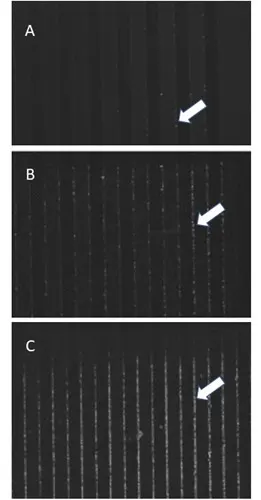
Caption: Capture of Mycobacterium tuberculosis bacterial particles on the edges of the electrodes by dielectrophoresis using the CAPTURE-XT® chip. Representative sputum samples from: A: smear negative, but culture positive (very low bacillary load); B: smear positive grade +1; C: smear positive grade 2+. A correlation between smear positive grading of the sputum sample and the visual count of captured particles of bacilli (indicated by arrows) is seen (Credit: Adapted from Moore et al., TheJournal of Molecular Diagnostics).
Concordance with culture diagnosis was 100% for smear negative samples and 87% for smear positive samples. Of the smear positive samples, the high burden sample concordance was 100%. These results demonstrate the potential of the technology to provide a powerful sample preparation tool that could function as a front-end platform for enhanced molecular detection. This versatile tool could equally be applied as a visual detection diagnostic, potentially associated with bacterial identification for low-cost screening.
Jonathan O’Halloran, PhD, founder and Chief Executive Officer of QuantuMDx Group Ltd said, “The CAPTURE-XT® technology is truly revolutionary and will have an impact in many different diseases from sepsis to oncology (circulating tumor cells). This application in Mtb is truly exceptional as its ultra-low cost and ultra-high sensitivity will profoundly improve equitable access to quality diagnoses for hundreds of millions of people. This chip-based technology exploits the physiological property of the TB bacteria to be specifically collected onto the device so that small numbers can be visualized on the chip electrodes and act as a visual readout to replace the lab-based sputum smear/microscopic methods, which typically have low detection rates and require training laboratory staff, at molecular-like sensitivities and at a fraction of the price. Moreover, when used as a front-end to downstream cellular, protein, and molecular devices, the possibilities are almost limitless.”
Professor Butcher concluded, “Collaboration between University-based academic researchers and biotechnology industry scientists presents a way forward to develop new approaches for some of the world’s greatest healthcare challenges, such as TB. This new chip-based technology could bring diagnostics to the patients that need it and also, by more accessible case-finding, prevent the further spread of this disease.”
Co-author Heather Murton, PhD, LEX Diagnostics, Melbourn, UK, and formerly of QuantuMDx Group Ltd, said, “Tuberculosis is one of the oldest challenges faced in human healthcare. This technology has the potential to meet the expectations for a mobile TB diagnostic, and it is exciting to see a seemingly abstract physics principle successfully applied to a neglected disease area.”
TB is the 13th leading cause of death worldwide, and until COVID-19 was the leading cause of death from a single infectious disease – more than malaria and HIV. Globally it infects 10 million individuals and kills 1.4 million individuals every year, of whom 230,000 are children.
Diagnostics with increased sensitivity and expanded drug susceptibility testing are also needed to address drug resistance and diagnose low-bacterial burden cases.
---
Notes for editors
The article is“A Novel Microfluidic Dielectrophoresis Technology to Enable Rapid Diagnosis of Mycobacteria tuberculosis in Clinical Samples,” by Catherine M. Moore, Jasvir Dhillon, Rebecca Flynn, Krzysztof Gizynski, Candice Adams, George Morgan, David McGurk, Eduardo Boada, Shireen Shabestary, Jonathan Peat, Jonathan O’Halloran, Neil G. Stoker, Philip D. Butcher, and Heather Murton (https://doi.org/10.1016/j.jmoldx.2023.04.005opens in new tab/window). It appears in The Journal of Molecular Diagnostics, volume 25, issue 7 (July 2023) published by Elsevier.
The article is openly available at https://www.jmdjournal.org/article/S1525-1578(23)00098-3/fulltextopens in new tab/window.
Funding for this project was provided by QuantuMDx Group Ltd under a service agreement with St George’s, University of London. QuantuMDx thanks the Foundation for Innovative New Diagnostics (FIND) for provision of bio-banked sputum samples.
Full text of this study is also available to credentialed journalists upon request; contact Eileen Leahy at +1 732 238 3628 or [email protected]opens in new tab/window. Journalists wishing to interview the authors should contact St George’s, University of London press office at +44 (0) 7909 523089 or [email protected]opens in new tab/window. Press contact for QuantuMDx is Tracey Cadman at +44 (0) 7495 341931 or [email protected]opens in new tab/window.
About The Journal of Molecular Diagnostics
The Journal of Molecular Diagnosticsopens in new tab/window, the official publication of the Association for Molecular Pathology, co-owned by the American Society for Investigative Pathology, and published by Elsevier, seeks to publish high quality original papers on scientific advances in the translation and validation of molecular discoveries in medicine into the clinical diagnostic setting, and the description and application of technological advances in the field of molecular diagnostic medicine. The editors welcome review articles that contain: novel discoveries or clinicopathologic correlations, including studies in oncology, infectious diseases, inherited diseases, predisposition to disease, or the description of polymorphisms linked to disease states or normal variations; the application of diagnostic methodologies in clinical trials; or the development of new or improved molecular methods for diagnosis or monitoring of disease or disease predisposition. www.jmdjournal.orgopens in new tab/window
엘스비어 소개
엘스비어는 첨단 정보와 의사결정 지원 분야의 글로벌 선도 기업으로 100년 넘게 과학과 헬스케어의 발전을 지원하며 인류 진보에 기여해 왔습니다. 우리는 170개국 이상에서 학술 및 기업 연구 커뮤니티, 의사, 간호사, 미래의 의료 전문가와 교육자들을 지원합니다. 근거에 기반한 신뢰할 수 있는 과학·의학 콘텐츠와 최첨단 AI 기술을 결합해 중요한 통찰과 혁신적인 솔루션을 제공해, 의미있는 성과를 이루도록 돕고 있습니다. 또한 다양성과 지속 가능성을 제품과 기업 문화 전반에 내재화하며, 우리가 속한 커뮤니티와 협력합니다. 엘스비어 재단opens in new tab/window은 전 세계에서 연구와 보건 파트너십을 지원합니다.
엘스비어는 전문가 및 기업 고객에게 정보 기반의 분석과 의사결정 도구를 제공하는 글로벌 기업 RELXopens in new tab/window의 일원입니다. 자세한 내용은 www.elsevier.com에서 확인할 수 있으며, 소셜미디어 @elsevierconnect를 통해 최신 소식을 받아보실 수 있습니다.
연락처
EL
CCP
Chhavi Chauhan, PhD
Director of Scientific Outreach
The American Journal of Pathology
+1 240 283 9724
Chhavi Chauhan, PhD 이메일