
New study identifies potential therapeutic target for colonic disorders
2022년 10월 11일
|
Philadelphia
Inhibiting neuropilin 2 in smooth muscle of mice enhances contraction and motility of the distal colon, investigators report in The American Journal of Pathology
Colonic motility disorders, especially problems associated with constipation and diarrhea, are common in adults and children, greatly impacting quality of life. A new studyopens in new tab/window in The American Journal of Pathologyopens in new tab/window, published by Elsevier, identifies neuropilin 2 (NRP2) as a novel regulator of distal colonic smooth muscle motility. Its ability to regulate cytoskeletal tone and restrain abnormal smooth muscle contraction may provide opportunities in the future to inhibit or activate signaling and thereby regulate smooth muscle activity in patients suffering from colonic motility disorders.
“Normal visceral smooth muscle activity is central to the function of many body systems including the gastrointestinal and urinary tracts, but it is much less studied than vascular smooth muscle,” explained co-lead investigator Maryrose P. Sullivan, PhD, Department of Surgery, Harvard Medical School; and Division of Urology, VA Boston Healthcare System, Boston, MA, USA. “Earlier studies by our group that showed robust expression of Nrp2 in smooth muscle of the colon prompted us to understand its functional significance in contraction and colonic motility.”
The investigators found extensive NRP2 expression in the distal colon that was especially prominent in circular and longitudinal smooth muscles in both humans and mouse models. They used genetically modified mice to determine the impact of Nrp2 deletion on contractility of the colon. Having demonstrated extensive expression of Nrp2 in smooth muscle of the gastrointestinal tract, they determined the functional consequences of Nrp2 gene deletion in vitro and motility analysis in intact mice. Their findings showed colonic tissues displayed increased evoked contraction in mice with global or smooth muscle–specific deletion of Nrp2. Mice with inducible, smooth muscle–specific Nrp2 deletion also showed an increase in colonic motility.
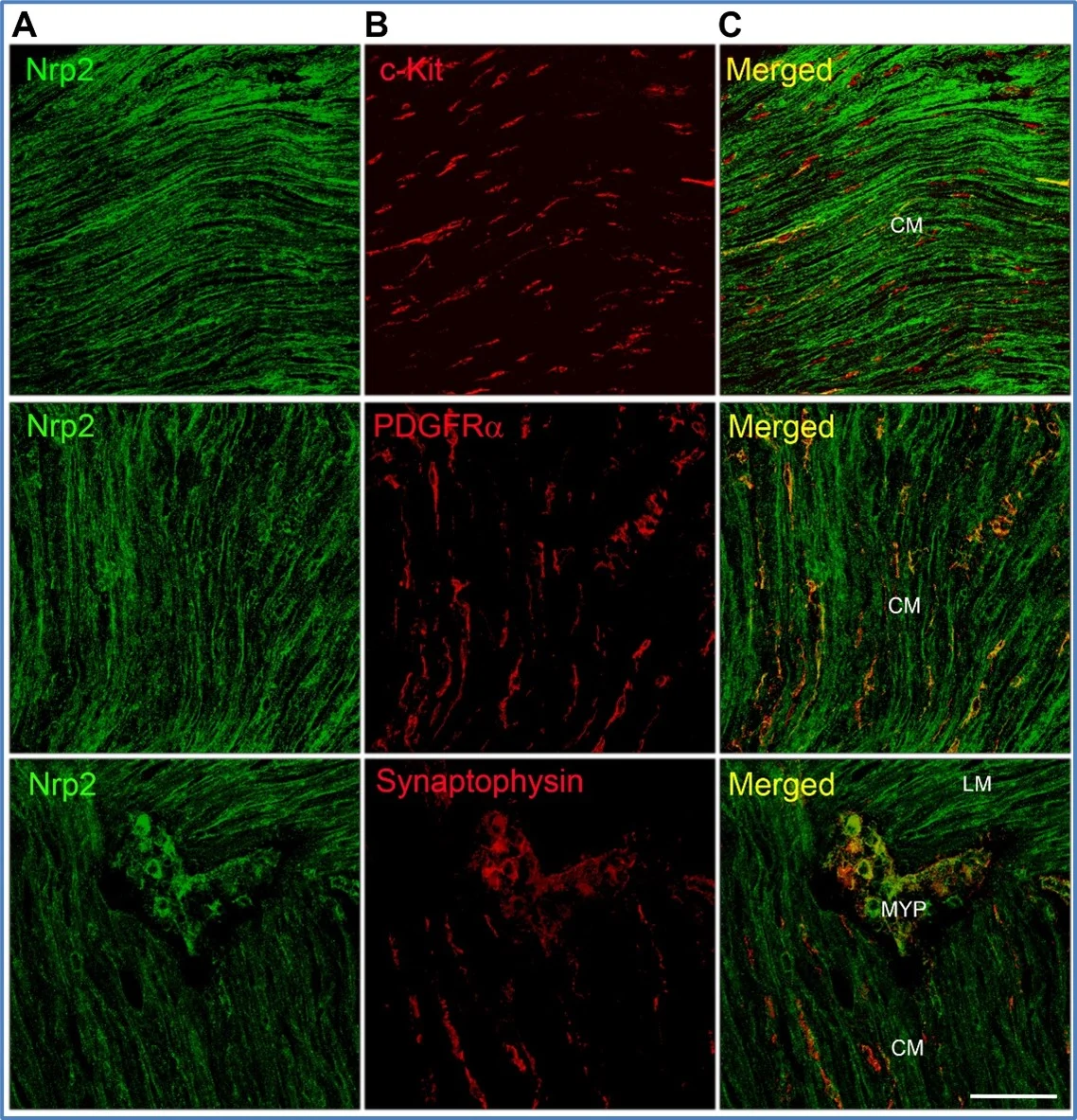
Pictured above: Neuropilin 2 (Nrp2, green) is prominently distributed in longitudinal and circular colonic smooth muscle. Colocalization, shown in the merged images, indicates Nrp2 is also expressed in interstitial cells of Cajal, marked by type III receptor tyrosine kinase cancer biomarker (c-Kit), platelet-derived growth factor receptor alpha (PDGFRa)-positive cells and neural structures marked by synaptophysin. MYP, myenteric plexus. CM, circular muscle; LM, longitudinal muscle (Credit: Vivian Cristofaro and Maryrose Sullivan).
“We were intrigued by the emergence of functional changes as early as a week after deletion of Nrp2,” said co-lead investigator Rosalyn M. Adam, PhD, Urological Diseases Research Center, Boston Children’s Hospital; and Department of Surgery, Harvard Medical School, Boston, MA, USA. “The relatively rapid detection of differences in contractile behavior of colonic muscle argues against major structural changes to the tissue, but rather suggests changes in cellular signaling. Delineating the signaling networks regulated by Nrp2 in smooth muscle is a major focus of our ongoing research.”
Dr. Sullivan and Dr. Adam observed that their study provides an important addition to understanding mechanisms of regulation of visceral smooth muscle and suggests that Nrp2 may be an actionable target in diseases characterized by abnormal smooth muscle contraction.
“Although studies in patients are many years away, ongoing studies in our group are focused on development of small molecule inhibitors designed to inhibit Nrp2. These efforts may provide opportunities in the future to inhibit signaling via Nrp2 and regulate smooth muscle activity in patients. This is particularly relevant for diseases in which visceral smooth muscle is impaired, since effective pharmacotherapy for these conditions is not currently available,” they noted.
Alterations in colonic motility can result from a variety of conditions, including congenital anomalies such as Hirschsprung disease, diabetes, inflammation, infection, gut dysbiosis, and nerve damage secondary to spinal injury. Furthermore, changes in the magnitude and/or coordination of contractile activity throughout the gastrointestinal tract can lead to dysfunctional motility with ensuing disturbances in intestinal flora, inflammation, and nutrient absorption, often with serious health consequences.
---
Notes for editors
The article is “Neuropilin 2 Is a Novel Regulator of Distal Colon Contractility,” by George Lambrinos, Vivian Cristofaro, Kristine Pelton, Alexander Bigger-Allen, Claire Doyle, Evalynn Vasquez, Diane R. Bielenberg, Maryrose P. Sullivan, and Rosalyn M. Adam (https://doi.org/10.1016/j.ajpath.2022.07.013opens in new tab/window). It appears online in advance of The American Journal of Pathology, volume 192, issue 11 (November 2022), published by Elsevier.
Full text of the article is available to credentialed journalists upon request. Contact Eileen Leahy at +1 732 238 3628 or [email protected]opens in new tab/window to request a PDF of the article. To request an interview with the authors please contact the Media Relations Group, Boston Children’s Hospital, at [email protected]opens in new tab/window
About The American Journal of Pathology
The American Journal of Pathologyopens in new tab/window, official journal of the American Society for Investigative Pathologyopens in new tab/window, published by Elsevier, seeks high-quality original research reports, reviews, and commentaries related to the molecular and cellular basis of disease. The editors will consider basic, translational, and clinical investigations that directly address mechanisms of pathogenesis or provide a foundation for future mechanistic inquiries. Examples of such foundational investigations include data mining, identification of biomarkers, molecular pathology, and discovery research. High priority is given to studies of human disease and relevant experimental models using molecular, cellular, and organismal approaches.
엘스비어 소개
엘스비어는 첨단 정보와 의사결정 지원 분야의 글로벌 선도 기업으로 100년 넘게 과학과 헬스케어의 발전을 지원하며 인류 진보에 기여해 왔습니다. 우리는 170개국 이상에서 학술 및 기업 연구 커뮤니티, 의사, 간호사, 미래의 의료 전문가와 교육자들을 지원합니다. 근거에 기반한 신뢰할 수 있는 과학·의학 콘텐츠와 최첨단 AI 기술을 결합해 중요한 통찰과 혁신적인 솔루션을 제공해, 의미있는 성과를 이루도록 돕고 있습니다. 또한 다양성과 지속 가능성을 제품과 기업 문화 전반에 내재화하며, 우리가 속한 커뮤니티와 협력합니다. 엘스비어 재단opens in new tab/window은 전 세계에서 연구와 보건 파트너십을 지원합니다.
엘스비어는 전문가 및 기업 고객에게 정보 기반의 분석과 의사결정 도구를 제공하는 글로벌 기업 RELXopens in new tab/window의 일원입니다. 자세한 내용은 www.elsevier.com에서 확인할 수 있으며, 소셜미디어 @elsevierconnect를 통해 최신 소식을 받아보실 수 있습니다.
연락처
EL
CCP
Chhavi Chauhan, PhD
Director of Scientific Outreach
The American Journal of Pathology
+1 240 283 9724
Chhavi Chauhan, PhD 이메일