
New findings reveal important insights into age-related nonresolving inflammation
2023년 12월 6일
|
Philadelphia
A novel series of studies reported in The American Journal of Pathology indicates that specialized proresolving lipid mediators may improve or augment treatment for age-related organ decline
Aging is associated with chronic, nonresolving inflammation, or “inflammaging,” that can lead to tissue dysfunction.New findingsopens in new tab/window reported in The American Journal of Pathologyopens in new tab/window, published by Elsevier, reveal insights into the cellular programs and factors that promote the resolution of inflammation during aging. These findings may lead to the development of new strategies to limit age-related organ decline.
The resolution of inflammation is an active process that is governed by numerous factors, such as specialized proresolving lipid mediators (SPMs). Recent studies suggest that inflammaging may persist due to an impairment in inflammation-resolution programs and that treatment with SPMs, like resolvins, tempers excessive inflammation and age-related tissue dysfunction.
Co-lead investigators Gabrielle Fredman, PhD, The Department of Molecular and Cellular Physiology, Albany Medical College, and Katherine C. MacNamara, PhD, The Department of Immunology and Microbial Disease, Albany Medical College, explained, “We realized early on in our collaboration that mechanisms associated with inflammation-resolution in aging were vastly underexplored. So, we combined our collective expertise to tackle some gaps in this arena.”
To explore SPM-initiated mechanisms that limit features of inflammaging, researchers conducted a novel series of studies using the ligand, or chemical messenger, Resolvin D2 (RvD2). RvD2 acts via a specific G-protein–coupled receptor called GPR18, which investigators found was associated with maintaining tissue homeostasis during aging.
Using mice to model normal, healthy aging, investigators identified key pathologic changes in the liver that occur in middle-age, including steatosis (fatty liver disease) and collagen deposition. They observed that these changes correlated with a reduction in proreparative (protective) macrophages. Because transcriptional analysis showed that Gpr18 was increased in aged macrophages relative to young, they investigated its role in aging by generating a conditional knockout mouse wherein only myeloid cells lack GPR18 and through treatment of mice with GPR18’s ligand, RvD2.
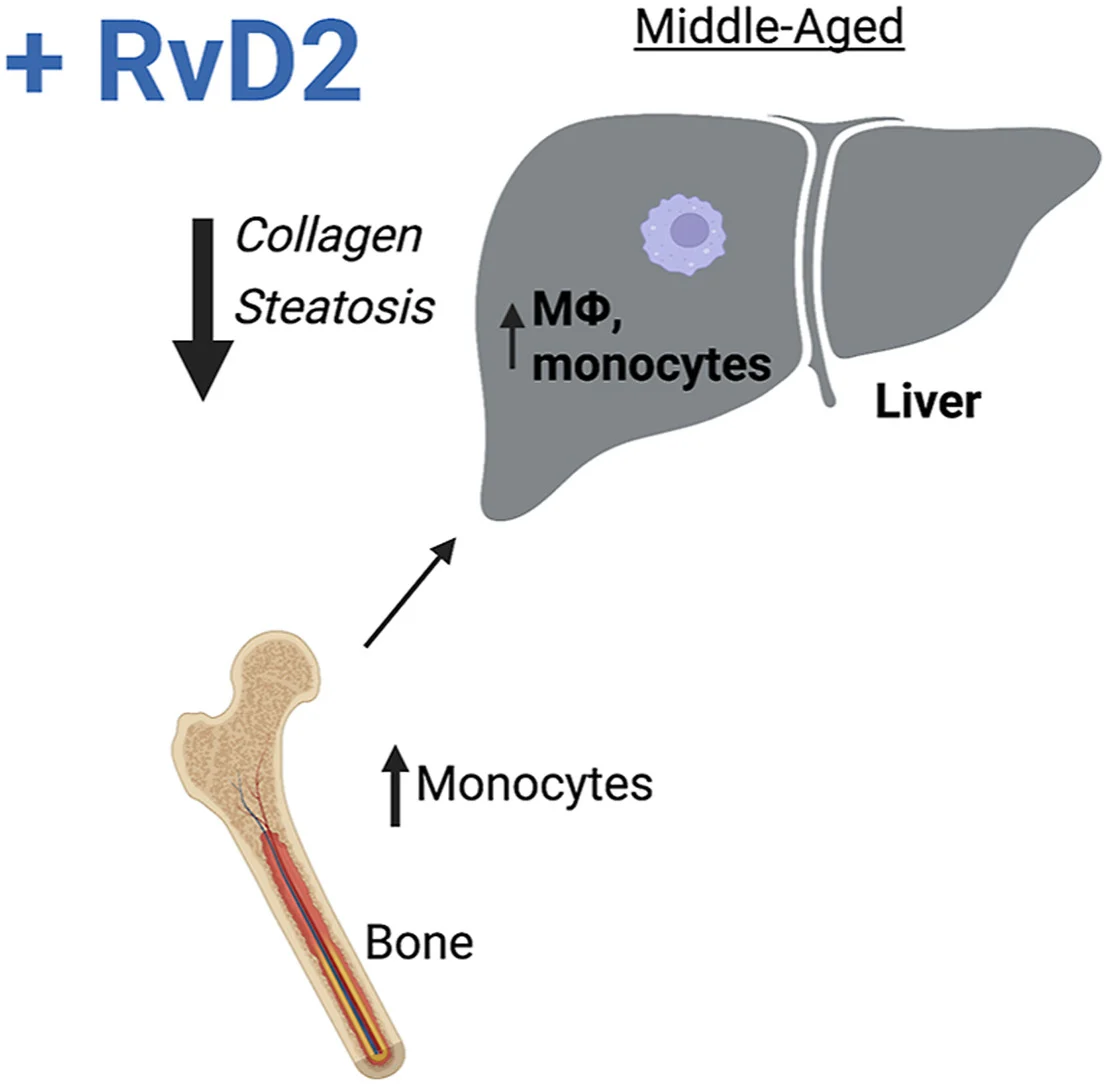
Caption: Resolvin-D2 (RvD2), when added ex vivo, acted directly on the bone marrow to induce a specific increase in monocyte/macrophage progenitors and reduce steatosis and collagen deposition (Credit: The American Journal of Pathology).
Together, their studies demonstrated that myeloid-specific GPR18 limited steatosis and collagen accumulation in the liver. Furthermore, adding RvD2 from an external source to activate GPR18 improved liver histopathology. They also found that RvD2 treatment increased bone marrow and blood monocytes, as well as their precursors. To examine how bone marrow function contributed to liver pathology they conducted bone marrow transplants in which they reconstituted young mice with the marrow from either young or old animals, with or without RvD2 treatment.
Dr. MacNamara noted, “These studies revealed that donor marrow from aged animals was sufficient to induce collagen accumulation in the liver, demonstrating that aging bone marrow contributes to liver pathology. Importantly, however, this could be improved with RvD2 treatment.”
Dr. Fredman commented, “Together, these studies demonstrate that RvD2-GPR18 signaling controls steatosis and fibrosis and provides a mechanistic-based therapy for promoting liver repair in aging.”
The investigators were surprised by the specificity of RvD2’s actions on the bone marrow and the observation that RvD2, when added ex vivo, acted directly on the bone marrow to induce a specific increase in monocyte/macrophage progenitors.
Dr. MacNamara elaborated, “This was exciting because while much has been studied regarding how specialized proresolving lipid mediators impact macrophage function, much less is known about their impact on blood cell production. As monocytes and macrophages are important for tissue homeostasis throughout the body, in essentially all organs, we believe the ability of RvD2 to increase monocyte production will be relevant to many diseases or aging contexts in which tissue repair is hindered.”
Dr. Fredman added, “Perhaps the biggest surprise was that even a very short treatment with RvD2 to older bone marrow in recipient mice had such a profound and durable response. We treated bone marrow transplants for just one week and found that even this transient RvD2 treatment could improve liver pathology four months later. These results suggest that RvD2 may participate in some long-term programming of bone marrow, immune or even liver cells.”
The investigators concluded that these studies provide a proof-of-concept that RvD2 can alleviate established liver scarring or fibrosis, for which there is currently no treatment, and that its action may in part be due to regulation of bone marrow.
According to Dr. MacNamara, “These studies reveal a potential therapy that may improve pathologies associated with aging by improving the process of blood cell production. The idea that bone marrow production can be modulated to generate cells that provide reparative functions may be broadly relevant in aging. Our studies not only highlight the remarkable durability of even transient treatment with RvD2, but they demonstrate the important role of bone marrow and its function in blood cell generation as a key aspect to treating disease. We believe there is tremendous promise of specialized proresolving lipid mediators, like RvD2, as therapies that may improve or augment current treatments.”
---
Notes for editors
The article is “Resolvin D2–G-Protein Coupled Receptor 18 Enhances Bone Marrow Function and Limits Steatosis and Hepatic Collagen Accumulation in Aging,” by Hannah Fitzgerald, Jesse L. Bonin, Sayeed Khan, Maya Eid, Sudeshna Sadhu, Allison Rahtes,, Masharh Lipscomb, Nirupam Biswas, Christa Decker, Melisande Nabage, Ramon Bossardi Ramos, Giesse Albeche Duarte, Michael Marinello, Anne Chen, Hasan Basri Aydin, Hebe Agustina Mena, Kurrim Gilliard, Matthew Spite, C. Michael DiPersio, Alejandro P. Adam, Katherine C. MacNamara, and Gabrielle Fredman (https://doi.org/10.1016/j.ajpath.2023.08.011opens in new tab/window). It appears online in The American Journal of Pathology, volume 193, issue 12 (December 2023), published by Elsevier.
The article is openly available at https://ajp.amjpathol.org/article/S0002-9440(23)00322-X/fulltextopens in new tab/window .
This work was supported by NIH grants HL153019, HL170249, HL106173, R35GM131842, and AR063778.
Full text of the article is also available to credentialed journalists upon request. Contact Eileen Leahy at +1 732 238 3628 or [email protected]opens in new tab/window to request a PDF of the article. To request an interview with the authors please contact Gabrielle Fredman, PhD, at [email protected]opens in new tab/window, or Katherine C. MacNamara, PhD, at [email protected]opens in new tab/window.
About The American Journal of Pathology
The American Journal of Pathologyopens in new tab/window, official journal of the American Society for Investigative Pathologyopens in new tab/window, published by Elsevier, seeks high-quality original research reports, reviews, and commentaries related to the molecular and cellular basis of disease. The editors will consider basic, translational, and clinical investigations that directly address mechanisms of pathogenesis or provide a foundation for future mechanistic inquiries. Examples of such foundational investigations include data mining, identification of biomarkers, molecular pathology, and discovery research. High priority is given to studies of human disease and relevant experimental models using molecular, cellular, and organismal approaches. https://ajp.amjpathol.orgopens in new tab/window
엘스비어 소개
엘스비어는 첨단 정보와 의사결정 지원 분야의 글로벌 선도 기업으로 100년 넘게 과학과 헬스케어의 발전을 지원하며 인류 진보에 기여해 왔습니다. 우리는 170개국 이상에서 학술 및 기업 연구 커뮤니티, 의사, 간호사, 미래의 의료 전문가와 교육자들을 지원합니다. 근거에 기반한 신뢰할 수 있는 과학·의학 콘텐츠와 최첨단 AI 기술을 결합해 중요한 통찰과 혁신적인 솔루션을 제공해, 의미있는 성과를 이루도록 돕고 있습니다. 또한 다양성과 지속 가능성을 제품과 기업 문화 전반에 내재화하며, 우리가 속한 커뮤니티와 협력합니다. 엘스비어 재단opens in new tab/window은 전 세계에서 연구와 보건 파트너십을 지원합니다.
엘스비어는 전문가 및 기업 고객에게 정보 기반의 분석과 의사결정 도구를 제공하는 글로벌 기업 RELXopens in new tab/window의 일원입니다. 자세한 내용은 www.elsevier.com에서 확인할 수 있으며, 소셜미디어 @elsevierconnect를 통해 최신 소식을 받아보실 수 있습니다.
연락처
EL
CCP
Chhavi Chauhan, PhD
Director of Scientific Outreach
The American Journal of Pathology
+1 240 283 9724
Chhavi Chauhan, PhD 이메일