
New cardiac rehabilitation guideline for women designed to improve their longevity and quality of life
2022년 9월 1일
|
Philadelphia
International Council of Cardiovascular Prevention and Rehabilitation clinical practice guideline published in the Canadian Journal of Cardiology provides guidance on delivering women-focused cardiac rehabilitation programs to increase participation and improve
Across the globe, women with cardiovascular disease (CVD) generally experience worse outcomes and are less likely to attend prevention and rehabilitation programs than men. A panel of experts convened by the International Council of Cardiovascular Prevention and Rehabilitation (ICCPR) has developed a clinical practice guideline endorsed by 24 clinical societies worldwide to provide guidance to the cardiac rehabilitation community on how to deliver more effective women-focused programming. The guideline appears in the Canadian Journal of Cardiology, published by Elsevier.
“It has long been established that women are significantly less likely to access and complete cardiac rehab (CR), and that their outcomes are often poorer, despite greater need than men,” explained lead author Sherry L. Grace, PhD, CRFC, Faculty of Health, York University; and KITE-Toronto Rehabilitation Institute and Peter Munk Cardiac Centre, University Health Network, University of Toronto, Toronto, ON, Canada. “Accordingly, ‘women-focused’ models of CR have been developed to better engage women and optimize their outcomes. There is now sufficient evidence on women-focused CR to make recommendations to the CR community.”
This ICCPR clinical practice guideline provides guidance to the CR community on how best to design programs for women with CVD, including stroke and peripheral arterial disease (PAD), and how to increase their engagement, with the goal of optimizing women’s outcomes (i.e., death, hospitalization, function, psychosocial wellbeing, and quality of life). Cost, resource implications, feasibility, and patient preferences are foremost considerations in the recommendations.
The ICCPR identified women-focused CR researchers through a review of the scientific literature and programs offering women-focused CR around the world as identified through ICCPR’s Global Audit. Individuals and programs that consented to participate formed a writing and consensus panel including experts with diverse geographic representation who are multidisciplinary healthcare providers, a policymaker, and patient partners. This group drafted and reviewed the recommendations. The draft then underwent external review from CR societies internationally and was posted online for public comment before finalization. One third of the studies identified in the review that formed the basis for the guideline came from Canada, which is considered to be a leader in women-focused CR.
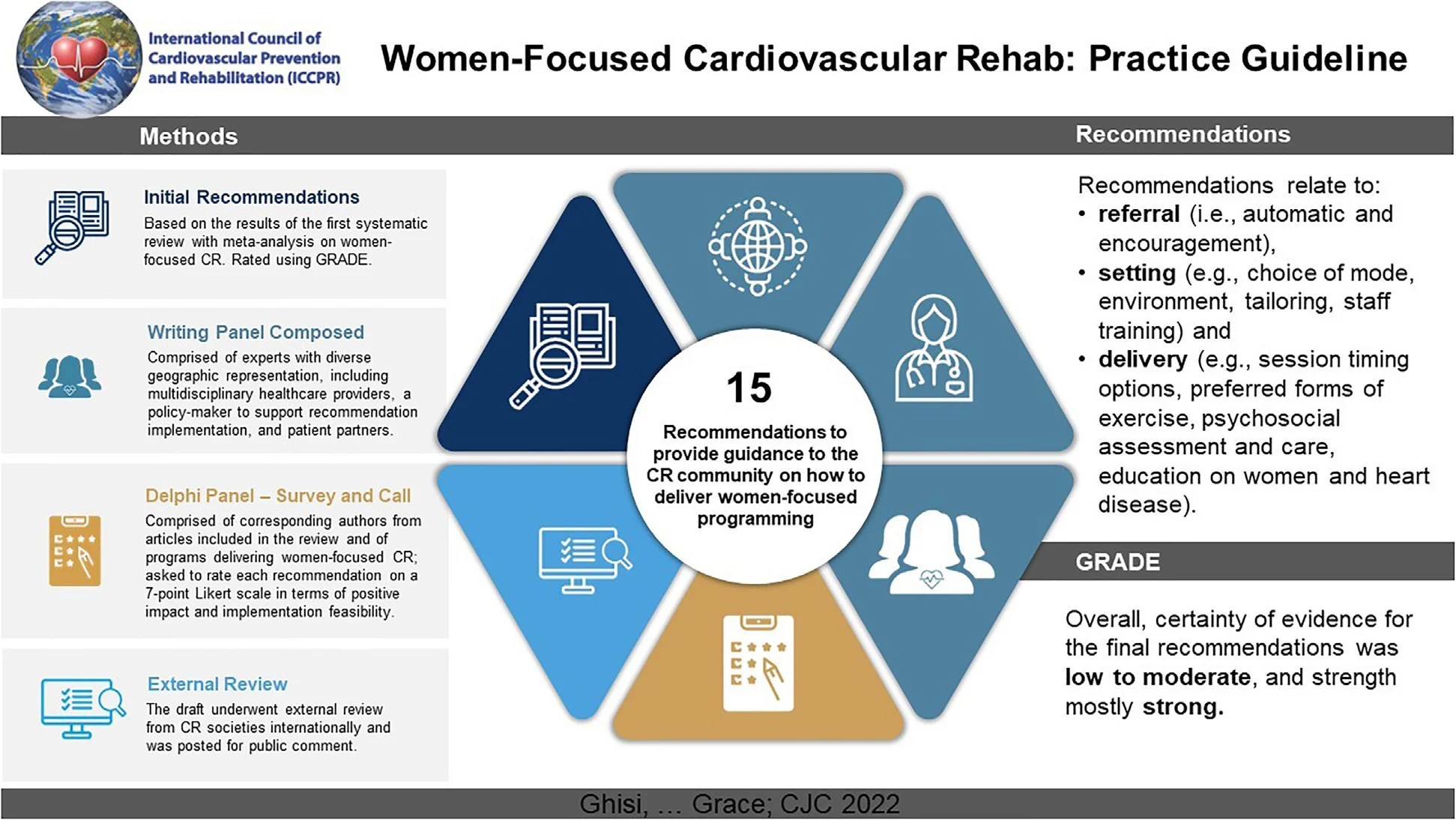
Rigorous methods used to develop the 15 recommendations on delivering women-focused cardiac rehab (Credit: Gabriela Lima de Melo Ghisi, PT, PhD).
The guideline presents 15 recommendations relating to referral (i.e., automatic plus encouragement), setting (e.g., choice of delivery mode, environment, tailoring, and staff training), and delivery (e.g., session timing options, preferred form of exercise, psychosocial assessment and care, and education on women and heart disease). When adopted, these recommendations and the associated tools compiled can feasibly support some degree of women-focused CR as part of any program.
Key recommendations are:
Women should be systematically referred to CR to reduce bias and encouraged to attend before hospital discharge through two-way fulsome discussion to overcome gender-related barriers.
Particular considerations when developing a woman’s tailored rehab plan include considering their contextual and full clinical history, such as any mental health and psychosocial issues, menopausal status, frailty, cancer history, and concerns about urinary incontinence, falls risk/osteoporosis, as well as autoimmune conditions.
All programs should offer women-focused programming, comprising as many of the definitional elements of women-focused CR as possible. Where resources are limited, this could include offering, for example, some women-only virtual education or exercise sessions or peer support programs.
Women should be given a choice in participating in a center-based (clinical or community) or home-based setting, delivered in a women-friendly environment, and their needs/preferences should be taken into consideration when formulating their programs.
Programs should include a strong psychosocial component, choice of exercise modalities, as well as specific education on women and CVD. The psychosocial needs of women should be assessed and addressed in an evidence-based manner (e.g., social support, relationship health, depression, anxiety, stress, socioeconomic issues, informal caregiving activities).
“For the first time, there are a consensus definition and recommendations for women-focused CR, so it is hoped now that many programs will incorporate these elements into their programs,” said Prof. Grace. “If implemented, more women may engage in CR, and as a result have significantly greater quality and quantity of life.”
“The ICCPR acknowledges that across the globe women have experienced worse outcomes from CVD and worse uptake to prevention and rehabilitation programs,” commented Robyn Gallagher, MN, PhD, Chair, ICCPR, and Sydney Nursing School, Faculty of Medicine and Health, The University of Sydney, Sydney, Australia. “The Women-Focused Cardiovascular Prevention and Rehabilitation Clinical Practice Guideline provides recommendations that will help clinicians and health service designers to develop and deliver programs that address this inequity for women, regardless of resource contexts.”
CVD is the leading cause of death among women globally with a prevalence of over 6,400 cases per 100,000. While the global CVD burden has decreased since 1990, it has increased in many African, Asian as well as Western-Pacific countries, and the global decline in prevalence has stagnated since 2010. Fewer women with CVD receive diagnostic tests, secondary prevention drugs, and revascularization procedures compared with men.
---
Notes for editors
The article is “Women-Focused Cardiovascular Rehabilitation: An International Council of Cardiovascular Prevention and Rehabilitation Clinical Practice Guideline,” by Gabriela Lima de Melo Ghisi, PT, PhD; Susan Marzolini, R. Kin, PhD; Jennifer Price, RN, PhD; Theresa M. Beckie, RN, PhD; Taslima Mamataz, MD, MSc; Aliya Naheed, MD, PhD; and Sherry L. Grace, PhD, CRFC (https://doi.org/10.1016/j.cjca.2022.06.021). The article appears online ahead of the Canadian Journal of Cardiology, volume 38, issue 12 (December 2022) published by Elsevier. It includes the list of the 24 international societies that have endorsed this guideline.
Full text of the article is available to credentialed journalists upon request. Contact Eileen Leahy at +1 732 238 3628 or [email protected] to obtain copies. Journalists wishing to speak to the guideline authors should contact Matt LaForge, Senior Writer & PR Specialist, York University, at +1 437 242-1547 or [email protected]opens in new tab/window.
About the Canadian Journal of Cardiology
The Canadian Journal of Cardiologyopens in new tab/window is the official journal of the Canadian Cardiovascular Society. It is a vehicle for the international dissemination of new knowledge in cardiology and cardiovascular science, particularly serving as a major venue for the results of Canadian cardiovascular research and Society guidelines. The journal publishes original reports of clinical and basic research relevant to cardiovascular medicine as well as editorials, review articles, case reports, and papers on health outcomes, policy research, ethics, medical history, and political issues affecting practice.
About the Editor-in-Chief
Editor-in-Chief Stanley Nattel, MD, is Paul-David Chair in Cardiovascular Electrophysiology and Professor of Medicine at the University of Montreal and Director of the Electrophysiology Research Program at the Montreal Heart Institute Research Center.
About the Canadian Cardiovascular Society (CCS)
The CCSopens in new tab/window is the national voice for cardiovascular clinicians and scientists, representing more than 2,300 cardiologists, cardiac surgeons, and other heart health specialists across Canada. We advance heart health for all by setting standards for excellence in heart health and care, building the knowledge and expertise of the heart team, and influencing policy and advocating for the heart health of all Canadians. For further information on the CCS visit https://ccs.ca/opens in new tab/window.
About the International Council of Cardiovascular and Prevention and Rehabilitation (ICCPR) The International Council of Cardiovascular and Prevention and Rehabilitation (ICCPR) brings together Societies around the world dedicated to the secondary prevention of heart diseases. Central to their mission is promoting high-quality cardiac rehabilitation services where they are needed most. Learn more at globalcardiacrehab.comopens in new tab/window.
엘스비어 소개
엘스비어는 첨단 정보와 의사결정 지원 분야의 글로벌 선도 기업으로 100년 넘게 과학과 헬스케어의 발전을 지원하며 인류 진보에 기여해 왔습니다. 우리는 170개국 이상에서 학술 및 기업 연구 커뮤니티, 의사, 간호사, 미래의 의료 전문가와 교육자들을 지원합니다. 근거에 기반한 신뢰할 수 있는 과학·의학 콘텐츠와 최첨단 AI 기술을 결합해 중요한 통찰과 혁신적인 솔루션을 제공해, 의미있는 성과를 이루도록 돕고 있습니다. 또한 다양성과 지속 가능성을 제품과 기업 문화 전반에 내재화하며, 우리가 속한 커뮤니티와 협력합니다. 엘스비어 재단opens in new tab/window은 전 세계에서 연구와 보건 파트너십을 지원합니다.
엘스비어는 전문가 및 기업 고객에게 정보 기반의 분석과 의사결정 도구를 제공하는 글로벌 기업 RELXopens in new tab/window의 일원입니다. 자세한 내용은 www.elsevier.com에서 확인할 수 있으며, 소셜미디어 @elsevierconnect를 통해 최신 소식을 받아보실 수 있습니다.
연락처
EL