
How to achieve a functional cure for chronic hepatitis B
2023년 3월 30일
|
Geneva
Study published in the Journal of Hepatology shows increase in immune control after discontinuation of long-term antiviral therapy
More than half of patients who suffer from chronic hepatitis B have the e antigen (HBeAg)-negative form of the disease. Even after many years of antiviral treatment with nucleos(t)ide analogues (NUC), lasting immune control is almost never seen. According to the current state of knowledge, those affected therefore require lifelong therapy. In the world’s first randomized controlled multicenter study – led by Leipzig University’s Faculty of Medicine and in partnership with the Centre for Clinical Studies (ZKS) – researchers have shown that many HBeAg-negative patients can achieve permanent immune control of hepatitis B if they discontinue antiviral therapy after a certain period of time. Their findingsopens in new tab/window are published in the high-impact journal, the Journal of Hepatologyopens in new tab/window.
Hepatitis B is an inflammation of the liver caused by the hepatitis B virus that can lead to serious problems such as liver cirrhosis or liver cancer and is easily transmitted through body fluids. An estimated 350 million are chronically infected, making chronic hepatitis B one of the most common viral infections worldwide. People with chronic hepatitis B usually have to take antiviral medication for their entire life in order to reduce the viral load and normalize inflammation levels in the liver. Antiviral therapy consists of the administration of nucleoside or nucleotide analogues, which in patients with the HBeAg-negative form almost never leads to the permanent immune control that would allow the termination of treatment. The antiviral therapy is associated with high costs for the healthcare system and can cause serious side effects.
Results currently published in the Journal of Hepatology show in a study of 166 HBeAg-negative patients from 20 clinics across Germany that after 96 weeks of observation many patients who discontinued an effective antiviral treatment that they had taken for at least four years achieved immune control of the disease. In 10% of the patients, immune control was demonstrated through loss of previously detectable hepatitis B surface antigen (HBsAg) in the blood, an event which is considered a functional cure of hepatitis B.
By the end of the study, in about 41% of patients, hepatitis B virus levels in the blood were reduced to below the level of 2,000 units per millilitre, which according to international treatment guidelines means that there is no longer an indication for renewed antiviral therapy. Additionally, 77% of patients no longer had elevated liver inflammation levels. In contrast, no patient who continued antiviral treatment showed HBsAg loss.
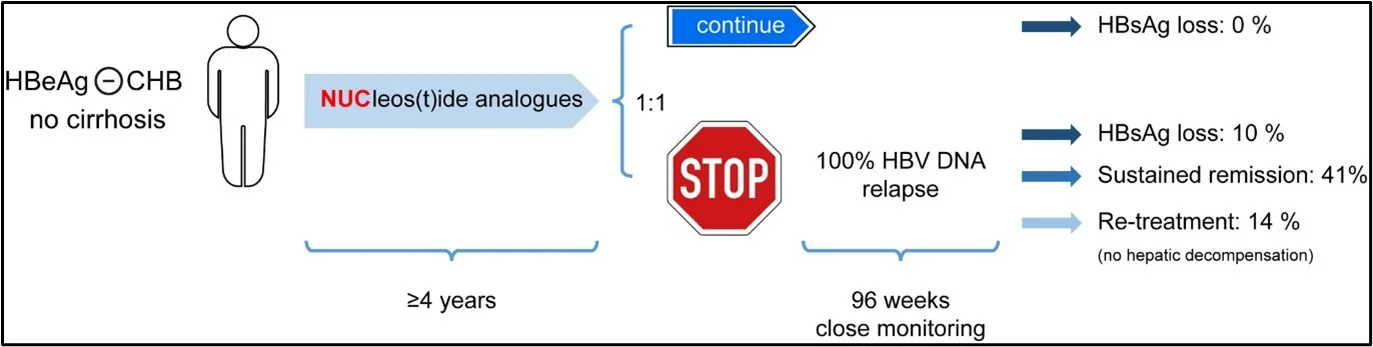
Caption: A multicenter randomized-controlled trial of nucleos(t)ide analogue cessation in HBeAg-negative chronic hepatitis B (Credit: Journal of Hepatology).
Study leader Professor Florian van Bömmel, senior physician in the Department of Hepatology at Leipzig University Hospital said, “We were able to show that in some patients discontinuing long-term therapy with nucleoside or nucleotide analogues after at least four years is more effective than continuing it, and that many patients no longer require antiviral therapy at all after discontinuation. In particular, patients who show low HBsAg levels when they discontinue treatment have a high chance of functional cure.”
After discontinuation of treatment, all of the patients initially experienced a resurgence of hepatitis B virus replication and many also experienced transient renewed liver inflammation. Some patients with severe liver inflammation were then restarted on antiviral therapy to prevent liver damage. Patients with liver cirrhosis were not included in the study for safety reasons. No serious adverse events related to discontinuation of therapy occurred during the study. “However, in other studies, severe cases of hepatic inflammation were observed in a few cases after antiviral therapy was discontinued. Stopping NUC treatment should therefore only be carried out under the supervision of an experienced physician,” said the study leader.
Professor van Bömmel and Professor Thomas Berg, head of the Department of Hepatology at Leipzig University Hospital, are confident that the results of the STOP-NUC trial will have a major impact on the overall development of hepatitis B therapy: “We expect that in the future international guidelines for the treatment of hepatitis B will refer to this study. By the middle of this year, results from the extension of the study will be evaluated and will show whether the number of patients with immune control continues to increase in the long term after discontinuation of antiviral treatment.”
---
Notes for editors
The article is “A multicenter randomized-controlled trial of nucleos(t)ide analogue cessation in HBeAg-negative chronic hepatitis B,” by Florian van Bömmel, Kerstin Stein, Renate Heyne, Jörg Petersen, Peter Buggisch, Christoph Berg, Stefan Zeuzem, Andreas Stallmach, Martin Sprinzl, Eckart Schott, Anita Pathil-Warth, Ulrike von Arnim, Verena Keitel, Jürgen Lohmeyer, Karl-Georg Simon, Christian Trautwein, Andreas Trein, Dietrich Hüppe, Markus Cornberg, Frank Lammert, Patrick Ingiliz, Reinhart Zachoval, Holger Hinrichsen, Alexander Zipprich, Hartmuth Klinker, Julian Schulze zur Wiesch, Anett Schmiedeknecht, Oana Brosteanu, and Thomas Berg (https://doi.org/10.1016/j.jhep.2022.12.018opens in new tab/window). It appears online in the Journal of Hepatology, published by Elsevier.
The article is openly available at https://www.journal-of-hepatology.eu/article/S0168-8278(22)03470-5/fulltextopens in new tab/window.
The STOP-NUC trialopens in new tab/window was funded by the German Federal Ministry of Education and Research (BMBF) (funding code: 01KG1308).
Journalists wishing to interview the authors should contact Professor Florian van Bömmel, Department of Hepatology, Leipzig University Hospital, at +49 341 97-12330 or [email protected]opens in new tab/window.
About the Journal of Hepatology
The Journal of Hepatologyopens in new tab/window, the premier journal devoted to liver diseases, is the official journal of the European Association for the Study of the Liver (EASL). It publishes original papers, reviews, case reports, and letters to the Editor concerned with clinical and basic research in the field of hepatology. The journal has a 2021 Impact Factor of 30.083 (Source: Journal Citation Reports™ from Clarivate, 2022). www.journal-of-hepatology.euopens in new tab/window
About EASL
In the fifty plus years since EASLopens in new tab/window was founded, it has grown from a small organization that played host to 70 participants at its first meeting, to becoming the leading international liver association. EASL attracts the foremost hepatology experts as members and has an impressive track record in promoting research in liver disease, supporting wider education, and promoting changes in European liver policy. www.easl.euopens in new tab/window
엘스비어 소개
엘스비어는 첨단 정보와 의사결정 지원 분야의 글로벌 선도 기업으로 100년 넘게 과학과 헬스케어의 발전을 지원하며 인류 진보에 기여해 왔습니다. 우리는 170개국 이상에서 학술 및 기업 연구 커뮤니티, 의사, 간호사, 미래의 의료 전문가와 교육자들을 지원합니다. 근거에 기반한 신뢰할 수 있는 과학·의학 콘텐츠와 최첨단 AI 기술을 결합해 중요한 통찰과 혁신적인 솔루션을 제공해, 의미있는 성과를 이루도록 돕고 있습니다. 또한 다양성과 지속 가능성을 제품과 기업 문화 전반에 내재화하며, 우리가 속한 커뮤니티와 협력합니다. 엘스비어 재단opens in new tab/window은 전 세계에서 연구와 보건 파트너십을 지원합니다.
엘스비어는 전문가 및 기업 고객에게 정보 기반의 분석과 의사결정 도구를 제공하는 글로벌 기업 RELXopens in new tab/window의 일원입니다. 자세한 내용은 www.elsevier.com에서 확인할 수 있으며, 소셜미디어 @elsevierconnect를 통해 최신 소식을 받아보실 수 있습니다.
연락처
FVB