
Home blood pressure monitoring saves lives, cuts costs, and reduces healthcare disparities
2023년 7월 13일
|
Ann Arbor
New research in the American Journal of Preventive Medicine confirms that regular self-testing better controls hypertension, especially among underserved patients
Expanding home blood pressure monitoring among US adults with hypertension could substantially reduce the burden of cardiovascular disease and save healthcare costs in the long term, according to a new study opens in new tab/windowin the American Journal of Preventive Medicineopens in new tab/window, published by Elsevier. The results of the study show that expanding home monitoring has the potential to address pervasive health disparities facing racial and ethnic minorities and rural residents because it would reduce cardiovascular events among US adults.
Co-lead investigator Yan Li, PhD, Professor, School of Public Health, Shanghai Jiao Tong University School of Medicine, explained, “Our study is among the first to assess the potential health and economic impact of adopting home blood pressure monitoring among American adults with hypertension. We found that it facilitates early detection, timely intervention, and prevention of complications, leading to improved control and better health outcomes.”
Analyzing data from the 2019 Behavioral Risk Factor Surveillance System (BRFSS), investigators projected that implementing home blood pressure monitoring, as opposed to traditional clinic-based care, could result in a reduction of myocardial infarction (MI) cases by 4.9% and stroke cases by 3.8% over 20 years.
Non-Hispanic Blacks, women, and rural residents had more averted cardiovascular events and greater cost savings related to adopting home blood pressure monitoring compared to non-Hispanic Whites, men, and urban residents. Adopting home blood pressure monitoring in rural areas would lead to a potential reduction of 21,278 MI cases per one million people compared to 11,012 MI cases per one million people in urban areas. Rural residents tend to have a higher prevalence of hypertension and uncontrolled hypertension than urban residents and often face additional barriers in accessing primary care services.
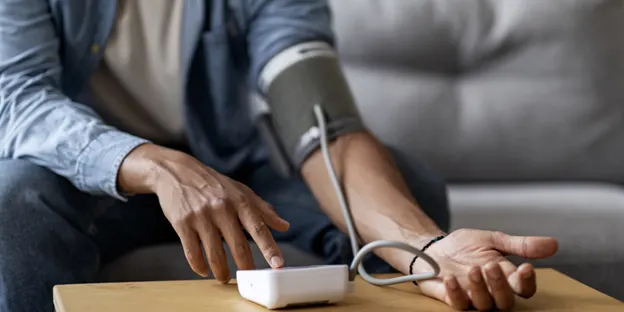
New research in the American Journal of Preventive Medicine confirms that regular home blood pressure monitoring better controls hypertension, especially among underserved patients (Credit: iStock.com/Prostock-Studio).
Estimating healthcare cost parameters based on actual healthcare payment data from the Medical Expenditure Panel Survey (MEPS), researchers projected an average of 4.4% per person annual savings and an average of $7,794 in healthcare costs per person over a span of 20 years in this population due to home blood pressure monitoring adoption and the subsequent reduced cardiovascular disease cases. Previous economic evaluations of home blood pressure monitoring have primarily focused on local health systems or conducted short-term, small-scale randomized controlled trials.
Hypertension -- systolic blood pressure (BP) greater than 130 mmHg or a diastolic BP greater than 80 mmHg or being on medication for it -- is a pressing public health challenge in the US, with significant implications for the development of heart disease and stroke and leads to substantial healthcare costs. Traditional clinic monitoring, the common method for BP measurement and hypertension diagnosis, has a number of drawbacks: Patients may not visit clinics often enough to pick up the problem, and when they do, accuracy may be compromised by the “white coat” (high office BP but normal BP on home measurements) or “masked” (normal/high normal BP in the office but elevated at home) effects.
Home blood pressure monitoring eliminates these impediments and provides more comprehensive and accurate data compared to sporadic measurements obtained during clinic visits. Yet, the highly effective practice has not been widely adopted in the US because of inadequate health insurance coverage, lack of investment in preventive services, and limited health promotion efforts provided by primary care physicians. However, the landscape has changed between 2020 and 2022 when home blood pressure monitoring attracted increasing attention due to healthcare disruptions caused by the COVID-19 pandemic.
Co-lead investigator Donglan Zhang, PhD, Associate Professor, Center for Population Health and Health Services Research, New York University Long Island School of Medicine, commented, “Given that almost half of all adults in the US (47%) are affected by high blood pressure, and considering the persistent health disparities in cardiovascular health, it is very important to advocate for the widespread adoption of effective and cost-saving strategies. Home blood pressure monitoring empowers patients to take a more active role in managing their chronic conditions. Our findings provide compelling evidence for healthcare systems and payers supporting the broader implementation of this intervention.”
---
Notes for editors
The article is “The Health and Economic Impact of Expanding Home Blood Pressure Monitoring,” by Yan Li, PhD; Donglan Zhang, PhD; Weixin Li, MS; Zhuo Chen, PhD; Janani Thapa, PhD; Lan Mu, PhD; Haidong Zhu, MD, PhD; Yanbin Dong, MD, PhD; and José A. Pagán, PhD (https://doi.org/10.1016/j.amepre.2023.05.010opens in new tab/window). It appears online in advance of the American Journal of Preventive Medicine, volume 65, issue 5 (November 2023), published by Elsevier.
The article is openly available for 30 days at https://www.ajpmonline.org/article/S0749-3797(23)00232-5/fulltextopens in new tab/window.
This research study was supported by a grant from the National Institute on Minority Health and Health Disparities (R01MD013886) and a grant from the National Heart, Lung, and Blood Institute (R01HL141427) of the NIH.
Full text of this article is also available to credentialed journalists upon request; contact Jillian B. Morgan at +1 734 936 1590 or [email protected]opens in new tab/window. Journalists wishing to interview the authors should contact Donglan "Stacy" Zhang, PhD, at +1 516 663 3192 or [email protected]opens in new tab/window.
About the American Journal of Preventive Medicine
The American Journal of Preventive Medicineopens in new tab/window is the official journal of the American College of Preventive Medicineopens in new tab/window and the Association for Prevention Teaching and Researchopens in new tab/window. It publishes articles in the areas of prevention research, teaching, practice and policy. Original research is published on interventions aimed at the prevention of chronic and acute disease and the promotion of individual and community health. The journal features papers that address the primary and secondary prevention of important clinical, behavioral and public health issues such as injury and violence, infectious disease, women's health, smoking, sedentary behaviors and physical activity, nutrition, diabetes, obesity, and alcohol and drug abuse. Papers also address educational initiatives aimed at improving the ability of health professionals to provide effective clinical prevention and public health services. The journal also publishes official policy statements from the two co-sponsoring organizations, health services research pertinent to prevention and public health, review articles, media reviews, and editorials. www.ajpmonline.orgopens in new tab/window
엘스비어 소개
엘스비어는 첨단 정보와 의사결정 지원 분야의 글로벌 선도 기업으로 100년 넘게 과학과 헬스케어의 발전을 지원하며 인류 진보에 기여해 왔습니다. 우리는 170개국 이상에서 학술 및 기업 연구 커뮤니티, 의사, 간호사, 미래의 의료 전문가와 교육자들을 지원합니다. 근거에 기반한 신뢰할 수 있는 과학·의학 콘텐츠와 최첨단 AI 기술을 결합해 중요한 통찰과 혁신적인 솔루션을 제공해, 의미있는 성과를 이루도록 돕고 있습니다. 또한 다양성과 지속 가능성을 제품과 기업 문화 전반에 내재화하며, 우리가 속한 커뮤니티와 협력합니다. 엘스비어 재단opens in new tab/window은 전 세계에서 연구와 보건 파트너십을 지원합니다.
엘스비어는 전문가 및 기업 고객에게 정보 기반의 분석과 의사결정 도구를 제공하는 글로벌 기업 RELXopens in new tab/window의 일원입니다. 자세한 내용은 www.elsevier.com에서 확인할 수 있으며, 소셜미디어 @elsevierconnect를 통해 최신 소식을 받아보실 수 있습니다.
연락처
JBM