
Heat related illnesses dramatically on the rise among US Veterans
2023년 8월 22일
|
Philadelphia
Analysis of geographic and demographic patterns reported in The Journal of Climate Change and Health uncovered 18-year increase in heat related illness and suggests that targeted interventions can ease the health consequences of extreme weather
Researchers report a statistically significant and clinically important increase in heat related illnesses among patients at US Department of Veteran Affairs (VA) health facilities across the United States between 2002 and 2019. The studyopens in new tab/window, which appears in The Journal of Climate Change and Healthopens in new tab/window, published by Elsevier, documents far-reaching negative consequences of extreme-weather.
Lead investigator Thomas F. Osborne, MD, VA Palo Alto Healthcare System and Stanford University School of Medicine, commented, “Our goal is to provide the best care for our patients, and understanding health risk is critical to our mission. Our team has incredible analytics staff, which, combined with expertise from partners at the CDC, has empowered us to uncover important insights. The data are a call to action as they expose a steady increase in the incidence of severe heat related illnesses in our US Veteran patient population. Although no one is immune from this danger, those who are traditionally the most vulnerable face the greatest risk of heat related illnesses.”
Not surprisingly, the study found that specific groups of patients, such as those with existing health conditions and within specific ethnic groups, experienced higher rates of heat related illness.
Co-investigator Zachary Veigulis, MS, US Department of Veterans Affairs, Palo Alto Healthcare System, and Department of Business Analytics, Tippie College of Business, University of Iowa, noted, “The extensive electronic health records from the VA, the US’s largest healthcare system, made it possible to understand the scope and scale of the growing danger and predict and identify individuals at greatest risk so we can target interventions.”
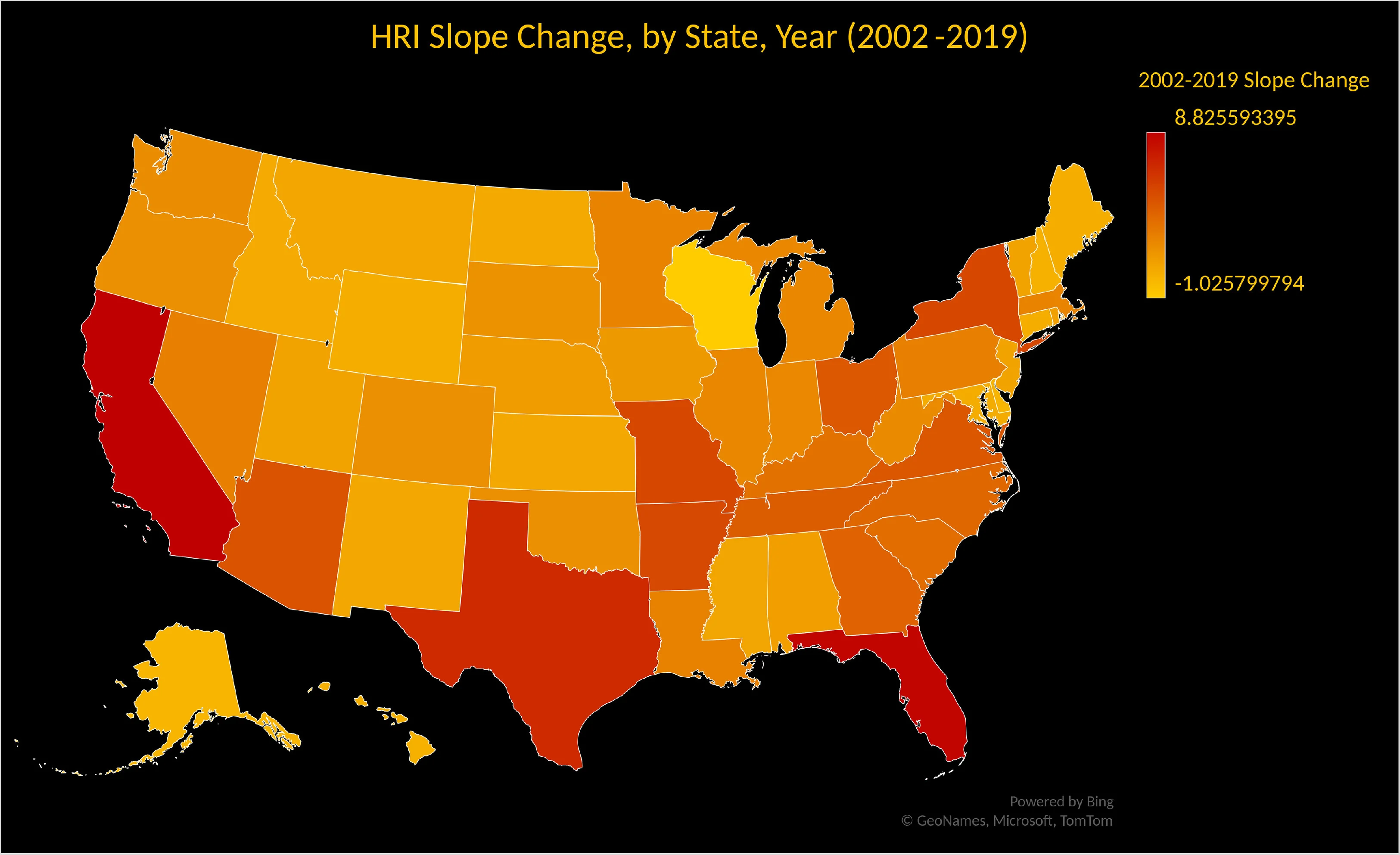
Heat map of all 50 US states and District of Columbia. Color corresponds with slope change of heat related illness (HRI) diagnoses over our assessment period (red=larger positive slope, followed by orange, and the least slope change in yellow). (Credit: The Journal of Climate Change and Health.)
While every state had residents that suffered heat related illnesses during the study period, the state-by-state numbers did not mirror geographic climate trends, possibly because the traditionally warmer states had already adopted policies, procedures, and practices to mitigate the health consequences of environmental heat. Another finding that suggested interventions reduce the growing health risk was the declining rate of heat related illness for homeless US Veterans in the second half of the study’s timeframe, a period after the launch and expansion of additional VA homeless health and wellness programs.
Dr. Osborne added, “This assessment represents a critical first step in understanding the challenge, which is required to inform optimal care and prevention strategies. However, there is much more work to be done. While the physical impact of environmental heat is critically important, it is only one of many climate-related health dangers. Climate change-related health risks such as the unprecedented spread of infectious disease, wildfires, migration, infrastructure damage, as well as food and water insecurity are now central issues of our time. Urgent collaborative action is required to avoid additional suffering.”
---
Notes for editors
The article is “Trends in heat related illness: Nationwide observational cohort at the US department of veteran affairs,” by Thomas F. Osborne, Zachary P. Veigulis, Ambarish Vaidyanathan, David M. Arreola, and Paul J. Schramm (https://doi.org/10.1016/j.joclim.2023.100256opens in new tab/window). It appears in The Journal of Climate Change and Health, volume 12 (July-August 2023), published by Elsevier.
The article is openly available at https://www.sciencedirect.com/science/article/pii/S2667278223000561opens in new tab/window.
Full text of the article is also available to credentialed journalists upon request. Contact Eileen Leahy at +1 732 238 3628 or [email protected]opens in new tab/window to request the PDF of the article. To request an interview with the authors please contact Madison Coffey at [email protected]opens in new tab/window.
Healthy adaptation and mitigation of climate change – the greatest public health concern of our time – will be the focus of the upcoming Climate & Health 2023 Conference, to be held October 21-22, 2023 at the Zucker School of Medicine at Hofstra/Northwell, Hempstead, NY. This inaugural hybrid meeting is organized by The Journal of Climate Change and Health editorial board members. The conference is sponsored by Elsevier along with the CDC Foundation and the Climate & Health Foundation.
About The Journal of Climate Change and Health
The Journal of Climate Change and Healthopens in new tab/window is a worldwide scientific peer-reviewed gold open access medical journal that publishes high quality scientific works related to acute and chronic climate related disasters, migration, changing patterns of disease and the impacts of climate change on individuals and health systems.
엘스비어 소개
엘스비어는 첨단 정보와 의사결정 지원 분야의 글로벌 선도 기업으로 100년 넘게 과학과 헬스케어의 발전을 지원하며 인류 진보에 기여해 왔습니다. 우리는 170개국 이상에서 학술 및 기업 연구 커뮤니티, 의사, 간호사, 미래의 의료 전문가와 교육자들을 지원합니다. 근거에 기반한 신뢰할 수 있는 과학·의학 콘텐츠와 최첨단 AI 기술을 결합해 중요한 통찰과 혁신적인 솔루션을 제공해, 의미있는 성과를 이루도록 돕고 있습니다. 또한 다양성과 지속 가능성을 제품과 기업 문화 전반에 내재화하며, 우리가 속한 커뮤니티와 협력합니다. 엘스비어 재단opens in new tab/window은 전 세계에서 연구와 보건 파트너십을 지원합니다.
엘스비어는 전문가 및 기업 고객에게 정보 기반의 분석과 의사결정 도구를 제공하는 글로벌 기업 RELXopens in new tab/window의 일원입니다. 자세한 내용은 www.elsevier.com에서 확인할 수 있으며, 소셜미디어 @elsevierconnect를 통해 최신 소식을 받아보실 수 있습니다.
Media contact
EL