
Genetic Testing of Patients with Atrial Fibrillation Can Alert Clinicians to Potential Development of Life-Threatening Conditions
2024년 3월 28일
|
Philadelphia
Trailblazing White Paper published in the Canadian Journal of Cardiology analyzes current understanding of genetics in atrial fibrillation and recommends screening for genetic heart disease in early onset atrial fibrillation cases
Although the vast majority of clinicians do not view atrial fibrillation (AF) as a genetic disorder, a White Paperopens in new tab/window in the Canadian Journal of Cardiologyopens in new tab/window, published by Elsevier, analyzes the current understanding of genetics and the role of genetic testing in AF and concludes there is an increasing appreciation that genetic culprits for potentially life-threatening ventricular cardiomyopathies and channelopathies may initially present with AF.
AF is the most common sustained cardiac arrhythmia and is associated with increased risks of heart failure, stroke, and death. It is not traditionally considered to be a heritable form of heart disease, however, a growing body of literature over the past 25 years has shown that genetics contribute importantly to susceptibility for arrhythmias, including AF.
Our understanding of the genetics underlying AF remains in the relatively early stages, although it has become clear that the majority of cases likely develop secondary to a complex interaction between environmental and genetic contributors. In a minority of AF cases, powerful single rare genetic variants can be the primary drivers of arrhythmia development.
Beyond accounting for why AF has developed, identification of these powerful single genetic culprits can be important because – in addition to AF – many can also cause life-threatening ventricular cardiomyopathy and channelopathy syndromes. At present, it remains unclear why the same genetic variant may manifest with AF in isolation, a ventricular cardiomyopathy/channelopathy syndrome, or both.
Lead author of the White Paper Jason D. Roberts, MD, MAS, Population Health Research Institute, McMaster University, and Hamilton Health Sciences, says, "Given this recognition, we recommend that all early onset AF cases undergo careful clinical screening for evidence of a co-existing ventricular cardiomyopathy or channelopathy syndrome associated with a risk of sudden cardiac death. Should one be identified, appropriate genetic testing for the ventricular syndrome is recommended."
Coauthor Rafik Tadros, MD, PhD, Cardiovascular Genetics Center, Montreal Heart Institute, Université de Montréal, adds, "In the absence of clinical evidence of a co-existing ventricular cardiomyopathy or channelopathy syndrome, genetic testing may be considered in early onset AF cases, particularly if there is a positive family history and an absence of conventional clinical risk factors. However, clinicians should be aware that the yield of genetic testing in these instances is anticipated to be low (<10%), and this should only be pursued in settings equipped to interpret and appropriately manage genetic testing results."
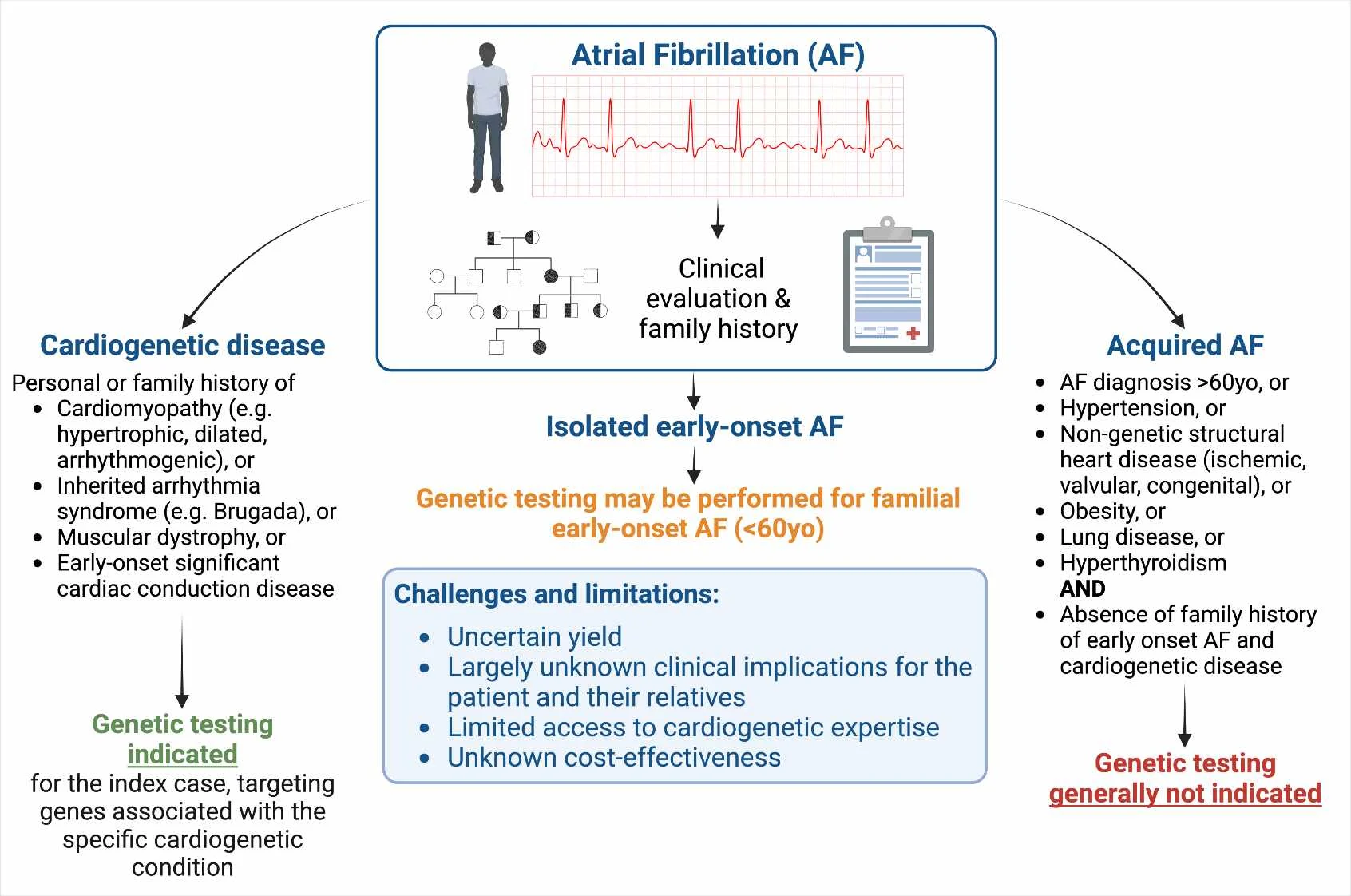
Caption: This figure outlines the decision-making approach to clinical genetic testing in atrial fibrillation (Credit: Canadian Journal of Cardiology).
Dr. Roberts states, "The vast majority of clinicians do not view AF as a genetic disorder and, except for certain specialty clinics, clinical genetic testing for AF is rarely performed. The notion that AF may have underlying genetic contributors will hopefully encourage clinicians to perform careful family histories, particularly in early onset forms of the condition wherein genetic contributors may be more prominent. Recognition that AF may potentially arise secondary to genetic variants that can also cause life-threatening ventricular arrhythmia and cardiomyopathy syndromes will hopefully guide clinicians to carefully clinically screen for these conditions, particularly in early onset AF cases that develop in the absence of identifiable clinical risk factors."
This White Paper was written by a group assembled by the CCS AF Guidelines Committee, which judged that the area of clinical application of AF genetics merited particular consideration. The writing group consisted of the chairs of the most recent AF Guidelines Committee, along with experts in clinical arrhythmia genetics and AF pathophysiology.
Notes for editors
The article is “Clinical Genetic Testing for Atrial Fibrillation: Are We There Yet? A CJC White Paper,” byJason D. Roberts, MD, MAS, Brandon Chalazan, MD, PhD, Jason G. Andrade, MD, Laurent Macle, MD, Stanley Nattel, MD, and Rafik Tadros, MD, PhD (https://doi.org/10.1016/j.cjca.2023.11.022opens in new tab/window). It appears online ahead of the Canadian Journal of Cardiology, volume 40, issue 4, (April 2024) published by Elsevier.
The article is openly available at https://www.onlinecjc.ca/article/S0828-282X(23)01949-9/opens in new tab/window.
Full text of the article is also available to credentialed journalists upon request. Contact Astrid Engelen at +31 6 14395474or [email protected]opens in new tab/window for a copy of the PDF or more information. Journalists wishing to speak to the authors should contact Dr. Jason Roberts at +1519 630 5732 or [email protected]opens in new tab/window, or Geneviève Bettez at +1 514 216 3006 or [email protected]opens in new tab/window.
About the Canadian Journal of Cardiology
The Canadian Journal of Cardiologyopens in new tab/window is the official journal of the Canadian Cardiovascular Societyopens in new tab/window. It is a vehicle for the international dissemination of new knowledge in cardiology and cardiovascular science, particularly serving as a major venue for the results of Canadian cardiovascular research and Society guidelines. The journal publishes original reports of clinical and basic research relevant to cardiovascular medicine as well as editorials, review articles, case reports, and papers on health outcomes, policy research, ethics, medical history, and political issues affecting practice. www.onlinecjc.caopens in new tab/window
About the Editor-in-Chief
Editor-in-Chief Stanley Nattel, MD, is Paul-David Chair in Cardiovascular Electrophysiology and Professor of Medicine at the University of Montreal and Director of the Electrophysiology Research Program at the Montreal Heart Institute Research Center.
About the Canadian Cardiovascular Society (CCS)
The CCSopens in new tab/window is the national voice for cardiovascular clinicians and scientists, representing more than 2,300 cardiologists, cardiac surgeons and other heart health specialists across Canada. We advance heart health for all by setting standards for excellence in heart health and care, building the knowledge and expertise of the heart team, and influencing policy and advocating for the heart health of all Canadians. For further information on the CCS visit https://www.ccs.caopens in new tab/window.
엘스비어 소개
엘스비어는 첨단 정보와 의사결정 지원 분야의 글로벌 선도 기업으로 100년 넘게 과학과 헬스케어의 발전을 지원하며 인류 진보에 기여해 왔습니다. 우리는 170개국 이상에서 학술 및 기업 연구 커뮤니티, 의사, 간호사, 미래의 의료 전문가와 교육자들을 지원합니다. 근거에 기반한 신뢰할 수 있는 과학·의학 콘텐츠와 최첨단 AI 기술을 결합해 중요한 통찰과 혁신적인 솔루션을 제공해, 의미있는 성과를 이루도록 돕고 있습니다. 또한 다양성과 지속 가능성을 제품과 기업 문화 전반에 내재화하며, 우리가 속한 커뮤니티와 협력합니다. 엘스비어 재단opens in new tab/window은 전 세계에서 연구와 보건 파트너십을 지원합니다.
엘스비어는 전문가 및 기업 고객에게 정보 기반의 분석과 의사결정 도구를 제공하는 글로벌 기업 RELXopens in new tab/window의 일원입니다. 자세한 내용은 www.elsevier.com에서 확인할 수 있으며, 소셜미디어 @elsevierconnect를 통해 최신 소식을 받아보실 수 있습니다.
연락처
AE