
Excitatory-inhibitory neurotransmitter imbalance precedes psychosis
2023년 5월 11일
|
Philadelphia
Dysregulation of the dopamine neurotransmitter system has long been associated with schizophrenia and other forms of psychosis, but recently researchers have begun to examine the glutamate and GABA systems as well. Studies have shown that an excitatory-inhibitory imbalance begins with improperly functioning NMDA-type glutamate receptors (NMDAR) in temporal regions of the brain, but much of the evidence comes from studies of the brains of psychotic people, leaving in question whether the imbalance results from psychotic symptoms or precedes them.
Now, a new studyopens in new tab/window in people with the copy variant number 22q11.2 deletion syndrome (22q11DS) probes the excitatory-inhibitory neurotransmitter system prior to the onset of psychosis. The study appears in Biological Psychiatryopens in new tab/window, published by Elsevier. Deletion carriers have a strong predisposition for psychiatric illnesses including anxiety and mood disorders, and they have a 30% lifetime risk of developing psychotic disorders, including schizophrenia, by adulthood. These carriers present a unique opportunity for longitudinal studies on neuropsychiatric illnesses because of the possibility of study and follow-up before and after the onset of such illnesses.
Researchers led by Valentina Mancini, PhD, at the University of Geneva School of Medicine, used magnetic resonance imaging (MRI) together with proton magnetic resonance spectroscopy (MRS) to estimate levels of the excitatory neurotransmitters glutamate and glutamine (Glx), and the inhibitory neurotransmitter GABA in the brains of 60 individuals with 22q11DS and 45 healthy controls. They focused on three brain regions implicated in schizophrenia pathophysiology: the anterior cingulate cortex (ACC), superior temporal cortex (STC), and hippocampus.
Deletion carriers had higher levels of Glx in hippocampus and STC, but not in the ACC, compared to controls. Carriers also had significantly lower levels of GABA in the hippocampus, but not the ACC or STC. Importantly, among 22q11DS carriers, those with psychosis also had higher Glx levels in the hippocampus, suggesting that changes in the hippocampus may drive downstream pathology.
Atrophy of the hippocampus has also been observed in the brains of people with schizophrenia. In the current study, Glx concentration was associated with greater atrophy, perhaps pointing to an elevated vulnerability of the hippocampus.
“Our results highlight that temporo-limbic regions, and in particular the hippocampus, undergo a progressive shift in the ratio between the concentration of excitatory and inhibitory neurotransmitters,” said Dr. Mancini. “Moreover, we found that those individuals with higher levels of excitatory neurotransmitter also had a higher extent of hippocampal volume loss over time. These individuals also started to experience psychotic symptoms, such as hallucinations and delusions. Our study provides novel insight into potential mechanisms underlying hippocampal atrophy in individuals at risk for psychosis and links these neural abnormalities to the emergence of psychotic symptoms.”
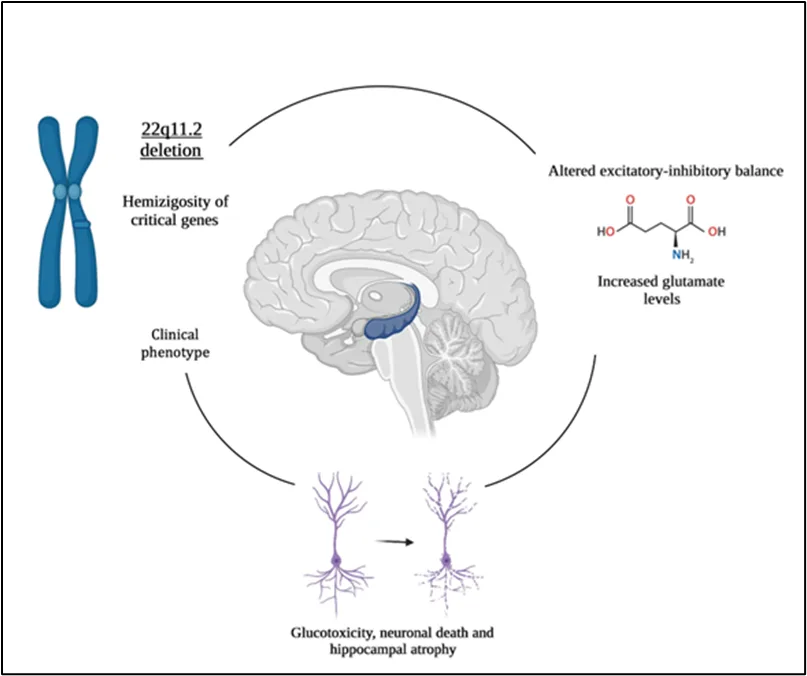
Caption: Proposed model of hippocampal pathology in subjects at genetic risk for psychosis. Hemizygosity of critical genes, together with additional genomic variants and environmental factors can lead to increased levels of excitatory neurotransmitters in the hippocampus. Protracted levels of excitatory neurotransmitters in the hippocampus can cause neuronal death and atrophy, which could reflect the reduction of hippocampal volume that we observed with neuroimaging techniques. These structural and functional abnormalities of the hippocampus can explain the worsening of cognitive symptoms (Credit: Biological Psychiatry).
John Krystal, MD, Editor of Biological Psychiatry,said of the work, “This study of 22q.11 deletion syndrome, a syndrome with increased risk for schizophrenia, elegantly builds on prior findings linking excessive glutamate release to smaller cortical volumes, suggestive of atrophy. This form of atrophy may contribute to cognitive and functional impairments.”
The work may have clinical implications, Dr. Mancini added. “The current findings can inform novel treatment strategies targeting early glutamatergic dysfunction in individuals at risk for psychosis. Given the essential role of the hippocampus in memory processes, preventing excitatory-inhibitory imbalance and volume loss could potentially mitigate the cognitive decline typically observed in psychotic patients.”
---
Notes for editors
The article is “Excitatory-inhibitory imbalance underlies hippocampal atrophy in individuals with 22q11.2 deletion syndrome with psychotic symptoms,” by Valentina Mancini, Muhammad G. Saleh, Farnaz Delavari, Joëlle Bagautdinova, and Stephan Eliez (https://doi.org/10.1016/j.biopsych.2023.03.021opens in new tab/window). It appears as an Article in Press in Biological Psychiatryopens in new tab/window, published by Elsevier.
It is openly available at https://www.biologicalpsychiatryjournal.com/article/S0006-3223(23)01172-1/fulltextopens in new tab/window.
Copies of this paper are also available to credentialed journalists upon request; please contact Rhiannon Bugno at +1 254 522 9700 or [email protected]opens in new tab/window. Journalists wishing to interview the authors may contact Valentina Mancini, PhD, at [email protected]opens in new tab/window.
The authors’ affiliations and disclosures of financial and conflicts of interests are available in the article.
John H. Krystal, MD, is Chairman of the Department of Psychiatry at the Yale University School of Medicine, Chief of Psychiatry at Yale-New Haven Hospital, and a research psychiatrist at the VA Connecticut Healthcare System. His disclosures of financial and conflicts of interests are available hereopens in new tab/window.
About Biological Psychiatry
Biological Psychiatryopens in new tab/window is the official journal of the Society of Biological Psychiatryopens in new tab/window, whose purpose is to promote excellence in scientific research and education in fields that investigate the nature, causes, mechanisms and treatments of disorders of thought, emotion, or behavior. In accord with this mission, this peer-reviewed, rapid-publication, international journal publishes both basic and clinical contributions from all disciplines and research areas relevant to the pathophysiology and treatment of major psychiatric disorders.
The journal publishes novel results of original research which represent an important new lead or significant impact on the field, particularly those addressing genetic and environmental risk factors, neural circuitry and neurochemistry, and important new therapeutic approaches. Reviews and commentaries that focus on topics of current research and interest are also encouraged.
Biological Psychiatry is one of the most selective and highly cited journals in the field of psychiatric neuroscience. It is ranked 12th out of 155 Psychiatry titles and 14th out of 274 Neurosciences titles in the Journal Citation ReportsTM published by Clarivate Analytics. The 2021 Impact Factor score for Biological Psychiatry is 12.810. https://www.biologicalpsychiatryjournal.com/opens in new tab/window
엘스비어 소개
엘스비어는 첨단 정보와 의사결정 지원 분야의 글로벌 선도 기업으로 100년 넘게 과학과 헬스케어의 발전을 지원하며 인류 진보에 기여해 왔습니다. 우리는 170개국 이상에서 학술 및 기업 연구 커뮤니티, 의사, 간호사, 미래의 의료 전문가와 교육자들을 지원합니다. 근거에 기반한 신뢰할 수 있는 과학·의학 콘텐츠와 최첨단 AI 기술을 결합해 중요한 통찰과 혁신적인 솔루션을 제공해, 의미있는 성과를 이루도록 돕고 있습니다. 또한 다양성과 지속 가능성을 제품과 기업 문화 전반에 내재화하며, 우리가 속한 커뮤니티와 협력합니다. 엘스비어 재단opens in new tab/window은 전 세계에서 연구와 보건 파트너십을 지원합니다.
엘스비어는 전문가 및 기업 고객에게 정보 기반의 분석과 의사결정 도구를 제공하는 글로벌 기업 RELXopens in new tab/window의 일원입니다. 자세한 내용은 www.elsevier.com에서 확인할 수 있으며, 소셜미디어 @elsevierconnect를 통해 최신 소식을 받아보실 수 있습니다.