
Dynamic expression of brain serotonin receptors across the menstrual cycle provides clues about premenstrual dysphoric disorder
2023년 2월 23일
|
Philadelphia
A new studyopens in new tab/window in Biological Psychiatryopens in new tab/window, published by Elsevier, explores the interplay between the serotonin system and estradiol in the brain, showing that the central nervous system in patients with premenstrual dysphoric disorder (PMDD) seems to increase serotonin transporter density from the periovulatory phase (when estradiol levels are high) to premenstrual cycle phase (when both estradiol and progesterone are decreasing). The findings have the potential to advance the clinical treatment of PMDD.
Premenstrual syndrome (PMS), which can include physical symptoms as well as depression and anxiety, affects about half of menstruating individuals a few days before the onset of menstruation. About 3 to 8% of people who menstruate experience PMDD, a far less recognized diagnosis. PMDD is also associated with mood swings, depression, and anxiety, but its symptoms are more severe and can last for up to two weeks at a time. The lifetime toll of PMDD is comparable to that for people with major depressive disorder.
Previous studies that compared fluctuations in ovarian hormones between women with PMDD and healthy women interestingly found no substantial differences, suggesting that dysregulated hormones in the periphery are not the underlying cause of the disorder. An alternative idea is that the brain’s response to normal endogenous hormonal changes differs in patients with PMDD, although how that happens remains unclear. Treatment of PMDD with selective serotonin reuptake inhibitors, or SSRIs, results in remarkably rapid alleviation of symptoms – on the order of hours or days, rather than weeks as in treatment for depression.
In the current study, led by Julia Sacher, MD, PhD, from the Max Planck Institute for Human Cognitive and Brain Sciences, Leipzig, Germany, examined 30 patients with PMDD and 29 unaffected control women over the course of two menstrual cycles. The researchers used positron emission tomography (PET) imaging to visualize availability of the serotonin transporter protein in the brain throughout the cycle, reflecting short-term changes in its expression.
“We found a significant increase of serotonin transporter from periovulatory to premenstrual phase in patients with PMDD – an 18% change in the midbrain, a brain region with the richest serotonin transporter expression. This increase was associated with the severity of depressed mood premenstrually,” said Dr. Sacher.
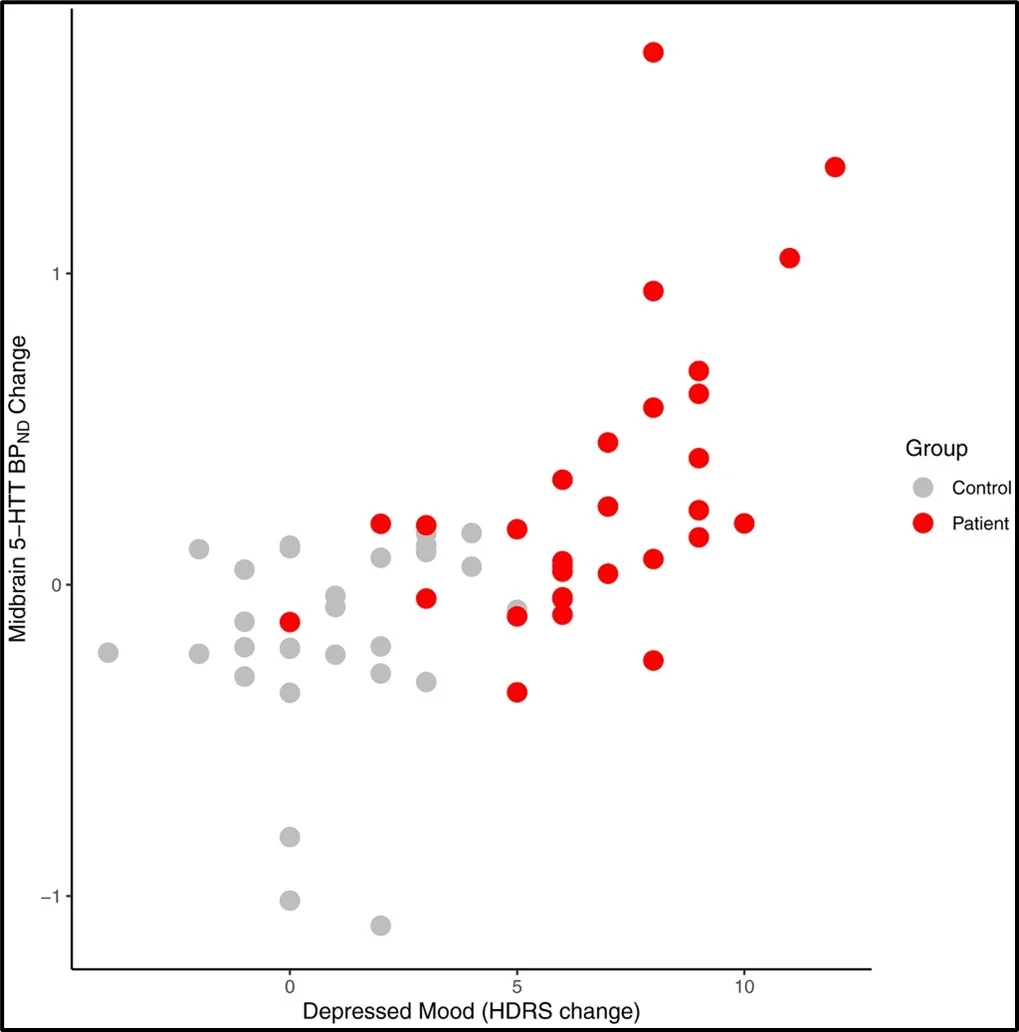
Caption: Serotonin transporter binding (5-HTT BPND) in midbrain across the menstrual cycle correlates with the severity of depressed mood in patients with PMDD (red circles) (Credit: Biological Psychiatry).
Unexpectedly, Dr. Sacher and colleagues also found a decrease in midbrain serotonin transporter density in healthy women, which could point to a protective mechanism of the healthy female brain in the midst of a changing hormonal environment.
“Typically, it is assumed that serotonin transporter density is an individual trait, with only an approximately 10% change over a decade as the human brain ages, rather than a state that changes within shorter periods of time. However, studies in patients with seasonal affective disorder (SAD) show seasonal changes of serotonin transporter,” Dr. Sacher explained. “Although the reports of serotonin transporter availability in depression have been mixed, this may be due to the heterogeneity of that disease. In more homogenous types of affective disorders, such PMDD or SAD, relatively rapid dynamics of serotonin transporter availability seem to play an important role.”
John Krystal, MD, editor of Biological Psychiatry, said of the work, “This technically demanding study identifies a new potential mechanism contributing to negative premenstrual mood states in some women. It also supports the use of SSRIs to treat premenstrual dysphoric mood.”
The findings provide evidence that individuals with PMDD experience short-term changes in serotonin transporter density throughout the menstrual cycle, which suggests that patients might benefit from taking SSRIs at specific times during the cycle to best target these changes.
---
Notes for editors
The article is "Increase in serotonin transporter binding in patients with premenstrual dysphoric disorder across the menstrual cycle: a case-control longitudinal neuroreceptor ligand PET imaging study," by Julia Sacher, Rachel G. Zsido, Claudia Barth, Franziska Zientek, Michael Rullmann, Julia Luthardt, Marianne Patt, Georg A. Becker, Pablo Rusjan, A. Veronica Witte, Ralf Regenthal, Abhay Koushik, Juergen Kratzsch, Beate Decker, Petra Jogschies, Arno Villringer, Swen Hesse, and Osama Sabri (https://doi.org/10.1016/j.biopsych.2022.12.023opens in new tab/window). It appears as an Article in Press in Biological Psychiatryopens in new tab/window, published by Elsevier.
Copies of this paper are available to credentialed journalists upon request; please contact Rhiannon Bugno at +1 254 522 9700 or [email protected]opens in new tab/window. Journalists wishing to interview the authors may contact Julia Sacher at [email protected]opens in new tab/window.
The authors’ affiliations and disclosures of financial and conflicts of interests are available in the article.
John H. Krystal, MD, is Chairman of the Department of Psychiatry at the Yale University School of Medicine, Chief of Psychiatry at Yale-New Haven Hospital, and a research psychiatrist at the VA Connecticut Healthcare System. His disclosures of financial and conflicts of interests are available hereopens in new tab/window.
About Biological Psychiatry
Biological Psychiatryopens in new tab/window is the official journal of the Society of Biological Psychiatryopens in new tab/window, whose purpose is to promote excellence in scientific research and education in fields that investigate the nature, causes, mechanisms and treatments of disorders of thought, emotion, or behavior. In accord with this mission, this peer-reviewed, rapid-publication, international journal publishes both basic and clinical contributions from all disciplines and research areas relevant to the pathophysiology and treatment of major psychiatric disorders.
The journal publishes novel results of original research which represent an important new lead or significant impact on the field, particularly those addressing genetic and environmental risk factors, neural circuitry and neurochemistry, and important new therapeutic approaches. Reviews and commentaries that focus on topics of current research and interest are also encouraged.
Biological Psychiatry is one of the most selective and highly cited journals in the field of psychiatric neuroscience. It is ranked 12th out of 155 Psychiatry titles and 14th out of 274 Neurosciences titles in the Journal Citations ReportsTM published by Clarivate Analytics. The 2021 Impact Factor score for Biological Psychiatry is 12.810. www.sobp.org/journalopens in new tab/window
엘스비어 소개
엘스비어는 첨단 정보와 의사결정 지원 분야의 글로벌 선도 기업으로 100년 넘게 과학과 헬스케어의 발전을 지원하며 인류 진보에 기여해 왔습니다. 우리는 170개국 이상에서 학술 및 기업 연구 커뮤니티, 의사, 간호사, 미래의 의료 전문가와 교육자들을 지원합니다. 근거에 기반한 신뢰할 수 있는 과학·의학 콘텐츠와 최첨단 AI 기술을 결합해 중요한 통찰과 혁신적인 솔루션을 제공해, 의미있는 성과를 이루도록 돕고 있습니다. 또한 다양성과 지속 가능성을 제품과 기업 문화 전반에 내재화하며, 우리가 속한 커뮤니티와 협력합니다. 엘스비어 재단opens in new tab/window은 전 세계에서 연구와 보건 파트너십을 지원합니다.
엘스비어는 전문가 및 기업 고객에게 정보 기반의 분석과 의사결정 도구를 제공하는 글로벌 기업 RELXopens in new tab/window의 일원입니다. 자세한 내용은 www.elsevier.com에서 확인할 수 있으며, 소셜미디어 @elsevierconnect를 통해 최신 소식을 받아보실 수 있습니다.