
Despite environmental trade-offs, dairy milk is a critical, low-impact link in global nutrition
2023년 6월 26일
|
Philadelphia
A recent analysis in the Journal of Dairy Science® provides a holistic understanding of dairy milk’s environmental impact and its unique contribution to feeding a growing global population
Along with all global sectors, the dairy industry is working to reduce its environmental impact as we look toward a shared 2050 net zero future. Research is currently focused on greenhouse gas mitigation strategies that do not compromise animal health and production, but many discussions maintain that a radical transformation—involving reducing animal-based foods and increasing plant-based foods—is needed in our agriculture production systems in order to meet climate goals.
A group of researchers from Virginia Tech’s School of Animal Sciences is working to understand the trade-offs of this kind of transformation. Their new studyopens in new tab/window in the Journal of Dairy Science®opens in new tab/window, published by FASS Inc. and Elsevier, sets out to understand the dairy industry’s holistic impact, quantifying the contribution of dairy milk to human nutrition, along with associations with agricultural greenhouse gas emissions and water use.
The study’s lead investigator, Robin R. White, PhD, explained, “Global-scale assessments of the trade-offs associated with dairy production are required to better grasp the role of dairy in feeding the globe."
White’s team noticed that previous investigations of the environmental footprint of dairy systems have incompletely reported on dairy's contribution of critical vitamins and minerals to human health and have often presented outputs in terms of milk weight or energy/protein content only.
White continued, “We were interested in using network analysis methods to better understand the trade-offs between nutrition and environmental impact in the existing food systems, globally.”
White and co-author Claire B. Gleason, PhD, started with data collected by the United Nations Food and Agriculture Organization, which allowed them to evaluate data at country and continent levels, and to quantify global supplies of different foods as well as the environmental impacts of these systems. All of the data sets used in the analysis are available in the open-access Virginia Tech Data Repository (http://doi.org/10.7294/6y9v-gg39opens in new tab/window).
The data were then leveraged to better consider global-scale contributions of fluid milk to human nutrition (especially calcium) and the environmental impacts of food production, specifically emissions and water use. Foods were considered in their preprocessed forms only, and fluid milk from each dairy species was included. Total food supply was calculated using a simplified definition accounting for loss, waste, trade, and animal feed. These figures were then used as a reference supply of food that could be consumed by humans, factoring in nutrient requirements based on age and gender.
To understand how milk and meat products are associated with agricultural environmental impacts, supplies were also correlated with greenhouse emissions and blue water withdrawal for watering crops and livestock, using individual country data.
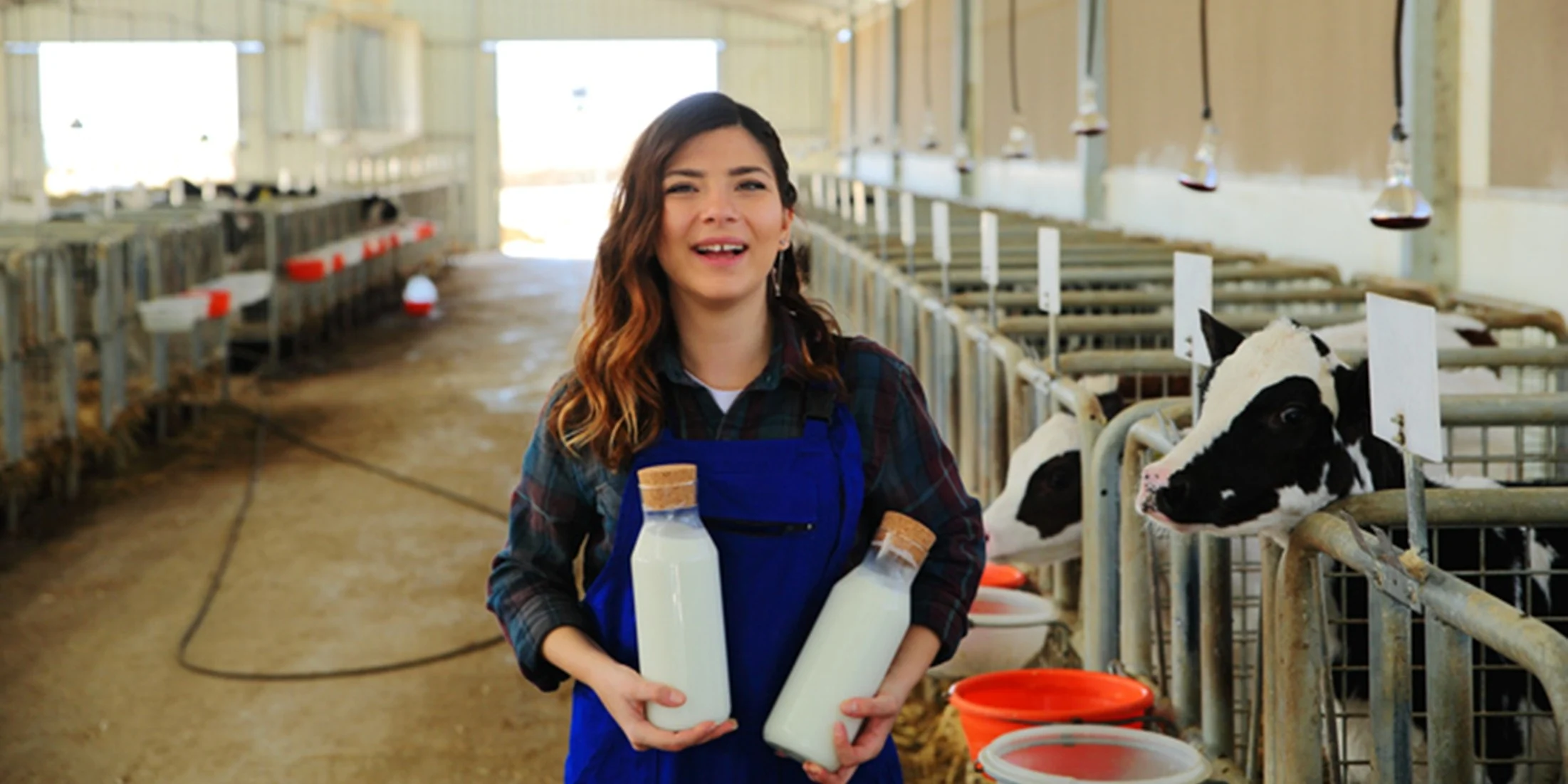
Data analysis demonstrates that, despite environmental impacts of dairy production, fluid milk provides a unique blend of important nutrients essential for human health worldwide (Credit: iStock.com/aydinmutlu).
Taken together, the data demonstrate how uniquely critical milk is within the global agroecosystem and to nutritional adequacy of foods produced from that system. Although there are environmental trade-offs associated with milk production, it provides an essential source of important vitamins and minerals, such as protein, riboflavin, vitamin B12, and phosphorus, while requiring relatively low energy.
White added, “Indeed,milk is one of the only low-energy sources of calcium available for human consumption, and our results suggest that 35% of the calcium available for human consumption globally is obtained from milk.”
Calcium is among the most inadequately consumed essential micronutrients in the world for all countries, regardless of income level.
White and Gleason are quick to point out that there are several limitations to the analysis and that more research is needed. “There are two general types of food systems research. This type considers the structure of the existing food system and how interventions in that system might support objectives like improved sustainability or reduced emissions. Although this approach is grounded in our knowledge of biological and physical constraints on agriculture, it can preclude identification of outside-the-box solutions and is best viewed in complement with the broader body of research.”
Considering these limitations, improving global milk availability, including coordinating distribution of milk among supply chains, may be important priorities for enhancing availability of critical nutrients within food systems worldwide.
---
Notes for editors
The article is “Global contributions of milk to nutrient supplies and greenhouse gas emissions,” by Robin R. White and Claire B. Gleason(https://doi.org/10.3168/jds.2022-22508opens in new tab/window). It appears in the Journal of Dairy Science, volume 106, issue 5 (May 2023), published by FASS Inc. and Elsevier.
The article is openly available at https://www.journalofdairyscience.org/article/S0022-0302(23)00141-8/fulltextopens in new tab/window and the PDF version is available at https://www.journalofdairyscience.org/action/showPdf?pii=S0022-0302(23)00141-8opens in new tab/window.
Full text of this study is also available to credentialed journalists upon request; contact Jess Townsend, American Dairy Science Association, at +1 217 239 3331, [email protected]opens in new tab/window, or Eileen Leahy at +1 732 238 3628, [email protected]opens in new tab/window. Journalists wishing to interview the authors should contact the corresponding author, Robin R. White, PhD, School of Animal Sciences, Virginia Tech, at [email protected]opens in new tab/window.
About the Journal of Dairy Science
The Journal of Dairy Science® (JDS), an official journal of the American Dairy Science Association®, is co-published by Elsevier and FASS Inc. for the American Dairy Science Association. It is the leading general dairy research journal in the world. JDS readers represent education, industry, and government agencies in more than 70 countries, with interests in biochemistry, breeding, economics, engineering, environment, food science, genetics, microbiology, nutrition, pathology, physiology, processing, public health, quality assurance, and sanitation. JDS has a 2021 Journal Impact Factor of 4.225 and five-year Journal Impact Factor of 4.987 according to Journal Citation Reports® (Source: Clarivate™ 2022). www.journalofdairyscience.orgopens in new tab/window
About the American Dairy Science Association (ADSA®)
The American Dairy Science Association (ADSA) is an international organization of educators, scientists, and industry representatives who are committed to advancing the dairy industry and keenly aware of the vital role the dairy sciences play in fulfilling the economic, nutritive, and health requirements of the world's population. It provides leadership in scientific and technical support to sustain and grow the global dairy industry through generation, dissemination, and exchange of information and services. Together, ADSA members have discovered new methods and technologies that have revolutionized the dairy industry. www.adsa.orgopens in new tab/window
About FASS Inc.
Since 1998, FASS has provided shared management services to not-for-profit scientific organizations. With combined membership rosters of more than 10,000 professionals in animal agriculture and other sciences, FASS offers clients services in accounting, membership management, convention and meeting planning, information technology, and scientific publication support. The FASS publications department provides journal management, peer-review support, copyediting, and composition for this journal; the staff includes several BELS-certified (www.bels.orgopens in new tab/window) technical editors and experienced composition staff. www.fass.orgopens in new tab/window
엘스비어 소개
엘스비어는 첨단 정보와 의사결정 지원 분야의 글로벌 선도 기업으로 100년 넘게 과학과 헬스케어의 발전을 지원하며 인류 진보에 기여해 왔습니다. 우리는 170개국 이상에서 학술 및 기업 연구 커뮤니티, 의사, 간호사, 미래의 의료 전문가와 교육자들을 지원합니다. 근거에 기반한 신뢰할 수 있는 과학·의학 콘텐츠와 최첨단 AI 기술을 결합해 중요한 통찰과 혁신적인 솔루션을 제공해, 의미있는 성과를 이루도록 돕고 있습니다. 또한 다양성과 지속 가능성을 제품과 기업 문화 전반에 내재화하며, 우리가 속한 커뮤니티와 협력합니다. 엘스비어 재단opens in new tab/window은 전 세계에서 연구와 보건 파트너십을 지원합니다.
엘스비어는 전문가 및 기업 고객에게 정보 기반의 분석과 의사결정 도구를 제공하는 글로벌 기업 RELXopens in new tab/window의 일원입니다. 자세한 내용은 www.elsevier.com에서 확인할 수 있으며, 소셜미디어 @elsevierconnect를 통해 최신 소식을 받아보실 수 있습니다.
연락처
JT
EL