
Brain imaging-based biomarker of depression identified
2023년 6월 27일
|
Philadelphia
Functional connectivity differentiates multiple disease subtypes, reports new research in Biological Psychiatry
Major depressive disorder (MDD) is not only among the most common mental illnesses, affecting over 8% of Americans, but it is also extremely variable from one person to another. Researchers have recently begun making strides toward understanding the neurophysiology underlying different subtypes of depression, which could speed development of better treatments, but much remains to be discovered. Now, a new studyopens in new tab/window in Biological Psychiatryopens in new tab/window, published by Elsevier, identifies multiple subtypes of MDD using brain imaging.
John Krystal, MD, Editor of Biological Psychiatry, said of the work, "We have long known that disorders like major depressive disorder are highly heterogeneous. This study in a large sample of depressed patients provides leads that can be pursued in subtyping depression on the basis of functional magnetic resonance imaging (fMRI) tests that measure the degree of coordination across brain regions, also known as ‘functional connectivity.’"
The researchers used resting-state fMRI collected at multiple clinical sites from a large cohort of more than 1,000 MDD patients and over 1,000 healthy controls (HC). The study used the so-called normative model, which uses data from a large reference population to quantify individual deviations, much like the growth charts used by pediatricians. The researchers examined the functional connectivity among brain regions and mapped individual functional deviations in the MDD patients compared to this normative prediction across the lifespan.
Senior author Mingrui Xia, PhD, from Beijing Normal University, said, “This approach led to the identification of two reproducible neurophysiological subtypes exhibiting distinct deviation patterns, depressive item scores, and longitudinal treatment predictability.”
One subtype of patients showed severe positive deviations – indicating increased brain connectivity – in the default mode network, limbic, and subcortical areas, and negative deviations in the sensorimotor and attention areas. The second subtype of patients featured a milder and opposite pattern of deviation, highlighting the heterogeneity of depression at the neurophysiological level. The authors speculate that the altered activity could be related to the tendency to ruminate in people with MDD.
The work is particularly exciting in that it moves the field toward finding biomarkers, or biological markers, of depression, which currently relies on patient-reported clinical symptoms for diagnosis, treatment, and prognostics. Biomarkers could offer a way to improve all these aspects of treatment for MDD.
Dr. Xia went on to say, “These findings shed light on the diverse neurobiological mechanisms from a connectomics perspective underlying the complex clinical heterogeneity observed in individuals with depression. The implications of this research are far-reaching, providing valuable insights into the development of imaging-based candidate biomarkers. These biomarkers have the potential to guide future precise diagnostic and treatment strategies tailored to each patient’s specific neurophysiological subtype.”
Dr. Xia noted, “By embracing the concept of neurophysiological subtypes, we can potentially revolutionize the field of mental health by enabling clinicians to personalize treatments based on an individual's unique connectome characteristics. This approach opens up new avenues for precision medicine and holds the promise of improving therapeutic interventions for depression.”
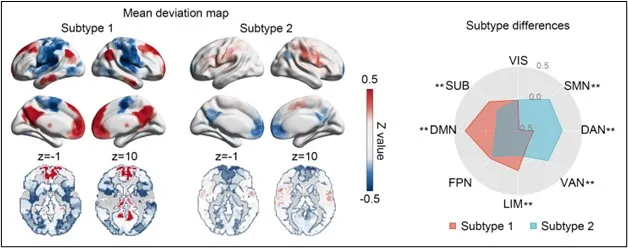
Brain imaging maps and a functional deviation map of the two depression subtypes across brain regions (Credit: Biological Psychiatry)
---
Notes for editors
The article is "Mapping Neurophysiological Subtypes of Major Depressive Disorder Using Normative Models of the Functional Connectome," by Xiaoyi Sun, Jiinrong Sun, Xiaowen Lu, Qiangli Dong, Liang Zhang, Wenxu Wang, Jin Liu, Qing Ma, Xiaoqin Wang, Dongtao Wei, Yuan Chen, Bangshan Liu, Chu-Chung Huang, Yanting Zheng, Yankun Wu, Taolin Chen, Yuqi Cheng, Xiufeng Xu, Qiyong Gong, Tianmei Si, Shijun Qiu, Ching-Po Lin, Jingliang Cheng, Yanqing Tang, Fei Wang, Jiang Qiu, Peng Xie, Lingjiang Li, Yong He, DIDA-MDD Working Group, and Mingrui Xia (https://doi.org/10.1016/j.biopsych.2023.05.021opens in new tab/window). It appears as an Article in Press in Biological Psychiatryopens in new tab/window, published by Elsevier.
Copies of this paper are available to credentialed journalists upon request; please contact Rhiannon Bugno at +1 254 522 9700 or [email protected]opens in new tab/window. Journalists wishing to interview the authors may contact Mingrui Xia at +86-010-58802036 or [email protected]opens in new tab/window.
The authors’ affiliations and disclosures of financial and conflicts of interests are available in the article.
John H. Krystal, MD, is Chairman of the Department of Psychiatry at the Yale University School of Medicine, Chief of Psychiatry at Yale-New Haven Hospital, and a research psychiatrist at the VA Connecticut Healthcare System. His disclosures of financial and conflicts of interests are available hereopens in new tab/window.
About Biological Psychiatry
Biological Psychiatryopens in new tab/window is the official journal of the Society of Biological Psychiatryopens in new tab/window, whose purpose is to promote excellence in scientific research and education in fields that investigate the nature, causes, mechanisms and treatments of disorders of thought, emotion, or behavior. In accord with this mission, this peer-reviewed, rapid-publication, international journal publishes both basic and clinical contributions from all disciplines and research areas relevant to the pathophysiology and treatment of major psychiatric disorders.
The journal publishes novel results of original research which represent an important new lead or significant impact on the field, particularly those addressing genetic and environmental risk factors, neural circuitry and neurochemistry, and important new therapeutic approaches. Reviews and commentaries that focus on topics of current research and interest are also encouraged.
Biological Psychiatry is one of the most selective and highly cited journals in the field of psychiatric neuroscience. It is ranked 12th out of 155 Psychiatry titles and 14th out of 274 Neurosciences titles in the Journal Citation Reports® published by Clarivate Analytics. The 2021 Impact Factor score for Biological Psychiatry is 12.810. https://www.biologicalpsychiatryjournal.com/opens in new tab/window
엘스비어 소개
엘스비어는 첨단 정보와 의사결정 지원 분야의 글로벌 선도 기업으로 100년 넘게 과학과 헬스케어의 발전을 지원하며 인류 진보에 기여해 왔습니다. 우리는 170개국 이상에서 학술 및 기업 연구 커뮤니티, 의사, 간호사, 미래의 의료 전문가와 교육자들을 지원합니다. 근거에 기반한 신뢰할 수 있는 과학·의학 콘텐츠와 최첨단 AI 기술을 결합해 중요한 통찰과 혁신적인 솔루션을 제공해, 의미있는 성과를 이루도록 돕고 있습니다. 또한 다양성과 지속 가능성을 제품과 기업 문화 전반에 내재화하며, 우리가 속한 커뮤니티와 협력합니다. 엘스비어 재단opens in new tab/window은 전 세계에서 연구와 보건 파트너십을 지원합니다.
엘스비어는 전문가 및 기업 고객에게 정보 기반의 분석과 의사결정 도구를 제공하는 글로벌 기업 RELXopens in new tab/window의 일원입니다. 자세한 내용은 www.elsevier.com에서 확인할 수 있으며, 소셜미디어 @elsevierconnect를 통해 최신 소식을 받아보실 수 있습니다.