
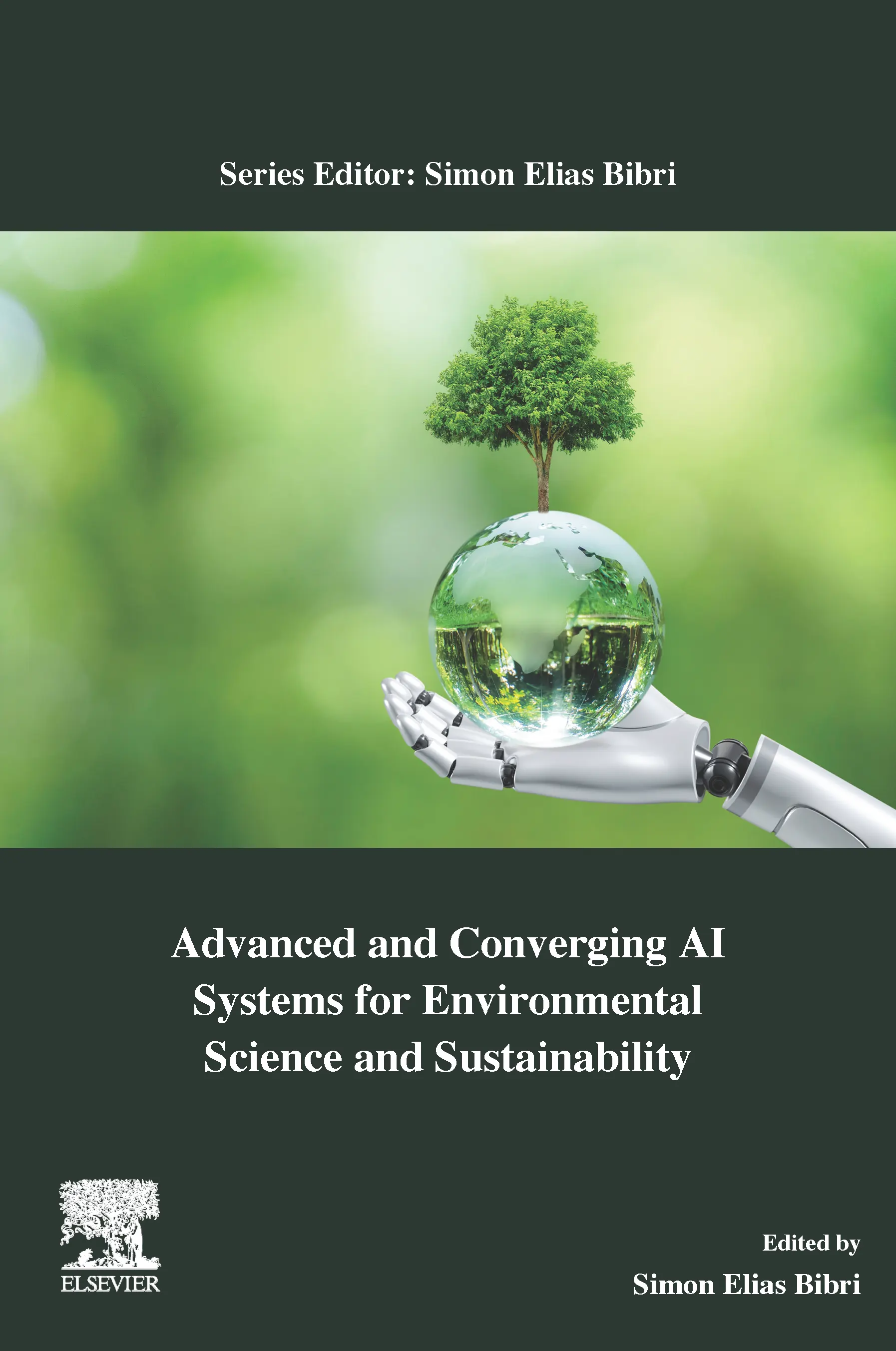
Advanced and Converging AI Systems for Environmental Science and Sustainability
Aim & scope
This book series aims to establish a dedicated, forward-looking scholarly platform at the intersection of environmental science, environmental sustainability, climate resilience, and socio-technical systems. Situated within the evolving landscape of next-generation technologies, the series addresses the convergence of these domains as driven and shaped by recent developments in predictive, generative, agentic, and quantum AI paradigms and their evolving integration and hybridization.
The primary goal is to provide an interdisciplinary and transdisciplinary scholarly platform that captures how these advanced and converging AI systems are reshaping the representation learning, modeling, simulation, monitoring, prediction, forecasting, optimization, control, decision-making, planning, and management of complex environmental and ecological socio-technical systems and their resilience. These systems include, but are not limited to, the following:
Climate-adaptive infrastructure systems
Climate risk and early-warning systems
Carbon management and climate mitigation systems
Earth observation systems
Environmental monitoring and management systems
Biodiversity and ecosystems
Socio-ecological systems
Nature-based solutions and ecological restoration
Atmospheric and air-quality systems
Environmental health and resilience systems
Disaster management systems
Renewable energy transition systems
Integrated energy management systems
Integrated water management systems
Resilient transportation systems
Circular and metabolic systems
Waste and resource-recovery systems
Agricultural and food systems
Forestry and natural-resource systems
Land-use and land-cover systems
Coastal, marine, and ocean systems
Environmental transition systems
Environmental governance and policy systems
Across these socio-technical systems, advanced and converging AI will be applied to accelerate scientific discovery in environmental science and enhance environmental sustainability and climate resilience under conditions of global change. Relevant models, systems, and computational paradigms include, but are not limited to, the following:
Predictive deep learning models, including convolutional, recurrent, and graph-based deep neural networks
Deep generative models, including generative adversarial networks, variational autoencoders, diffusion models, and autoregressive generative models
Foundation models spanning geospatial, spatiotemporal, time-series, language, vision-language, multimodal, Earth-system, brain-inspired remote-sensing, and scientific domains
World models and dynamics-aware, intervention-capable digital twin systems
Agentic planning, reasoning, and decision-making systems
Tool-augmented agentic AI systems, including autonomous workflow orchestration, tool use, retrieval-augmented generation and reasoning, code execution, and interaction with external scientific models, databases, and simulation environments
Generative agentic and agentic-generative AI systems, integrating large language and multimodal foundation models to enhance interpretation, contextual reasoning, interaction, knowledge generation, and autonomous agentic workflows
Adaptive, collaborative, and self-improving agentic AI systems, including multi-agent coordination, agent communication, memory-augmented learning, feedback-driven adaptation, and human–AI collaboration
Agentic digital twins and generative agentic digital twins
Quantum machine learning, quantum artificial intelligence, and hybrid quantum-classical systems
Quantum-enhanced deep generative and foundation models
Neuro-symbolic, causal, and embodied AI systems
Scientific machine learning and physics-informed AI systems
A key objective is to move beyond fragmented domain-specific and application-oriented approaches toward an integrated perspective that addresses how scientific advancement, technological innovation, and socio-technical transformation co-evolve in response to environmental and climate conditions and challenges. The series will provide a high-impact, authoritative reference point that consolidates knowledge across disciplines, scientific domains, and technological fields, integrating conceptual and theoretical foundations, computational procedures, mathematical formulations, empirical evidence, methodological approaches, applied architectures, operational frameworks, case studies, use cases, and real-world projects, while enabling stronger interdisciplinary collaboration and the development of coherent research agendas aligned with global sustainability priorities, goals, and visions. It will foster new research directions, stimulate research opportunities, facilitate practical implementations, and contribute to the development of environmentally sustainable and climate-resilient systems.
Audience
Primary: Researchers, academics, postdoctoral fellows, and graduate students working across environmental science, climate science, sustainability science, computer and data science, computational and geospatial science, socio-technical systems, sustainability and energy transitions, environmental governance, climate policy, and related interdisciplinary and transdisciplinary fields. The audience also includes applied scientists, technology experts, systems engineers, data engineers, solution developers, and project leaders engaged in environmental and climate systems, sustainable and resilient infrastructures, and biodiversity and ecosystem management.
Professional and institutional: Policymakers, regulatory authorities, governmental and intergovernmental organizations, international organizations, industry consortia, research institutes, international consultants, policy-oriented research communities, environmental sustainability practitioners, technology leaders, and innovators involved in environmental sustainability, climate resilience, and socio-technical system transformation.
Educational: The series may contribute to teaching and curriculum development across undergraduate and postgraduate programs, including courses addressing topics related to, or situated at the intersection of, advanced and converging AI systems, environmental science, environmental sustainability, climate resilience, and socio-technical systems. Individual volumes may serve as core or supplementary learning resources depending on their disciplinary and methodological focus.
Publish a book with Elsevier
Series Editor

Simon Elias Bibri, PhD
Senior Researcher, Scientific Coordinator, and International Expert
Institute of Computer and Communication Sciences (IINFCOM) and School of Architecture, Civil and Environmental Engineering (ENAC), the Swiss Federal Institute of Technology in Lausanne (EPFL), Switzerland
Read more about Simon Elias Bibri, PhD