
이 주제에 관심이 있으시다면, 엘스비어의 '고등교육을 위한 AI' 뉴스레터를 구독해 보시기 바랍니다.

귀하의 브라우저가 완벽하게 지원되지 않습니다. 옵션이 있는 경우 최신 버전으로 업그레이드하거나 Mozilla Firefox, Microsoft Edge, Google Chrome 또는 Safari 14 이상을 사용하세요. 가능하지 않거나 지원이 필요한 경우 피드백을 보내주세요.
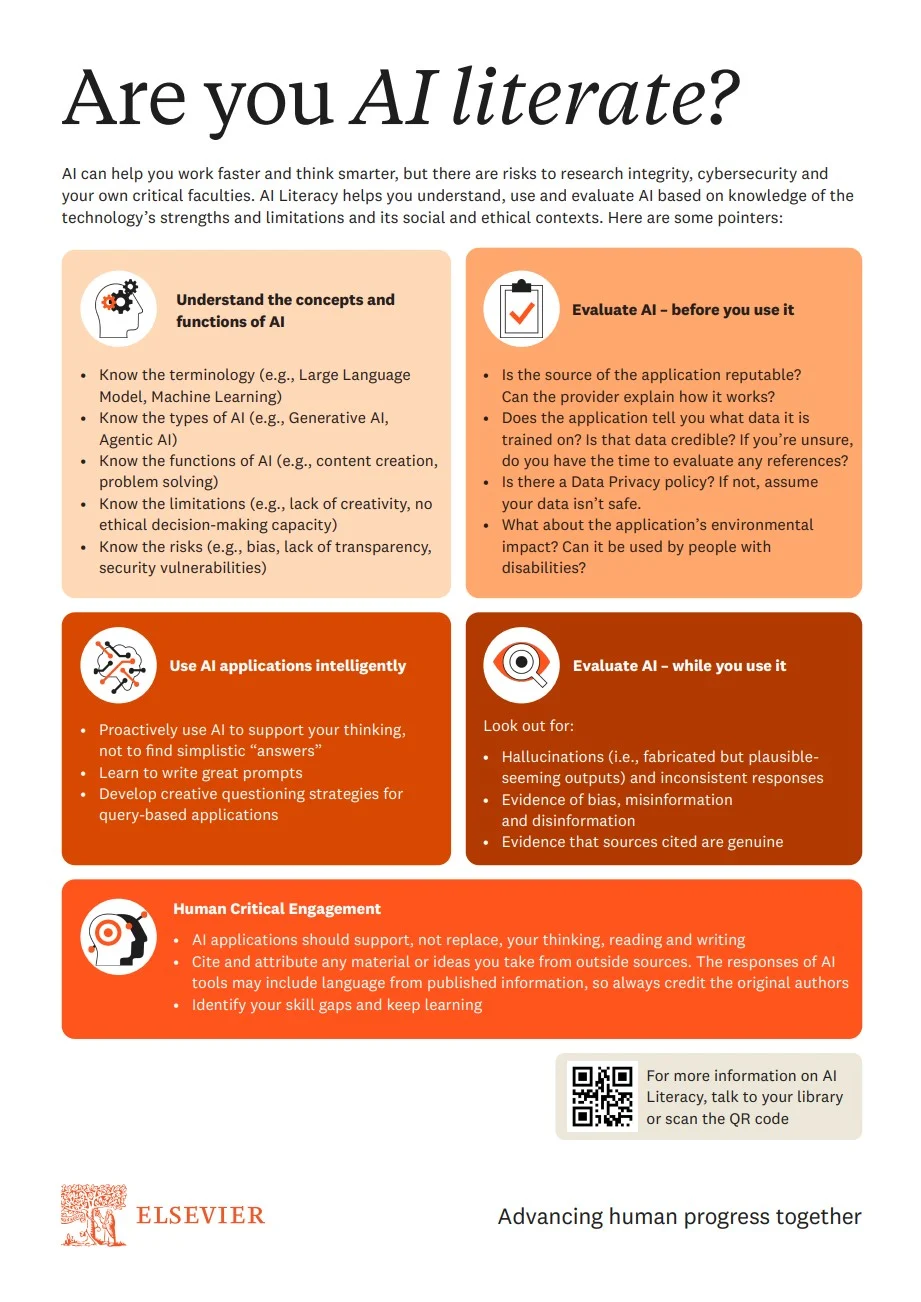
AI can help you work faster and think smarter, but there are risks to research integrity, cybersecurity and your own critical faculties.

AI Literacy helps you understand, use and evaluate AI based on knowledge of the technology’s strengths and limitations and its social and ethical contexts. Here are some pointers:
Know the terminology (e.g., Large Language Model, Machine Learning)
Know the types of AI (e.g., Generative AI, Agentic AI)
Know the functions of AI (e.g., content creation, problem solving)
Know the limitations (e.g., lack of creativity, no ethical decision-making capacity)
Know the risks (e.g., bias, lack of transparency, security vulnerabilities)
Is the source of the application reputable? Can the provider explain how it works?
Does the application tell you what data it is trained on? Is that data credible? If you’re unsure, do you have the time to evaluate any references?
Is there a Data Privacy policy? If not, assume your data isn’t safe.
What about the application’s environmental impact? Can it be used by people with disabilities?

Look out for:
Hallucinations (i.e., fabricated but plausible-seeming outputs) and inconsistent responses
Evidence of bias, misinformation and disinformation
Evidence that sources cited are genuine

AI applications should support, not replace, your thinking, reading and writing
Cite and attribute any material or ideas you take from outside sources. The responses of AI tools may include language from published information, so always credit the original authors
Identify your skill gaps and keep learning
Proactively use AI to support your thinking, not to find simplistic “answers”
Learn to write great prompts
Develop creative questioning strategies for query-based applications
Download the Information Literacy checklist as a PDF
Download 새 탭/창에서 열기