Unfortunately we don't fully support your browser. If you have the option to, please upgrade to a newer version or use Mozilla Firefox, Microsoft Edge, Google Chrome, or Safari 14 or newer. If you are unable to, and need support, please send us your feedback.

Elsevier
Publish with us

What matters most in R&D?

Exploring the challenges and opportunities facing today's R&D innovators.

Middle aged doctor talking on smartphone looking at medicine

R&D has always been about solving urgent challenges, taking innovation to the next level and, ultimately, enabling human progress.

But these leaps take time, and are the outcomes of years of work, trial and error, dead ends and discoveries. Researchers, innovators and change makers constantly work at the bleeding edge of science and tech; uncharted terrain full of unknowns and ambiguity, where the difference between success and failure often lies in the ability to stay focused and see clearly. 

However, R&D teams are pressed to move faster than ever before. Besides the constant pressures to meet business objectives and bring innovations to market, there is the ever-growing challenge of making sense of more data than ever before in the age of AI. Every decision is critical, and it’s more important than ever that at these key decision points, innovators are armed with all the information they need to move forward — with confidence that they have made the correct decision. 

Despite all these new and familiar pressures, and no matter the scale, innovators wake up every day with a focus on one key question as they take on the next challenge:  

What matters most?

A foundation of trusted information

R&D decisions are only as strong as the information behind them. When teams work from partial literature coverage, outdated regulatory intelligence or unverified data, the risks compound quickly:  

  • Duplicated research that wastes months and budget 

  • Missed prior art that exposes companies to IP disputes 

  • Blind spots in competitive or safety signals that surface only after a costly misstep

In an environment where R&D cycles are long, comprehensive, high-quality information is a foundational infrastructure for every downstream decision a research organization makes. When the cost of being wrong keeps rising, partnering with a source built on trust isn't just prudent — it's essential.


Precision AI delivers speed and context

As R&D teams turn to generative AI to accelerate literature review, hypothesis generation and competitive analysis, the upside is clear, but the risks also grow. General-purpose AI tools, trained broadly on the open web, weren't built to distinguish a peer-reviewed finding from an unverified blog post, and that can surface confident-sounding responses with no easy way to check them against the source. 

AI built on trusted, full-text content, with traceable citations, enables researchers to validate every response and change what can be done an AI in R&D. That’s the difference between AI and Precision AI; it bridges the gap between posing questions and making informed business decisions.

Expert assessment for confident decision-making

Even the most trusted information and precise AI can only take you as far as the people using it. That is where expert assessment comes in — it’s taking the entire world of scientific information and turning it into the key decisions that organizations need to make, quickly.

When AI is integrated into R&D, it is the people who remain in control of the experience — evaluating the evidence and making decisions without taking AI at its word. The right expertise can go as far as structuring the data for purpose-built, in-house AI, because not every organization’s needs are created equal. If an AI system is not the best fit for its R&D use case, then it won’t produce the best possible results.

“We were allowed by our internal team to test multiple different tools, and [LeapSpace] was the winner for my kind of work because I need the trustworthiness … It’s a basic necessity.” – Jan Erik Timmermann, Global Medical Lead, Orion Corp.

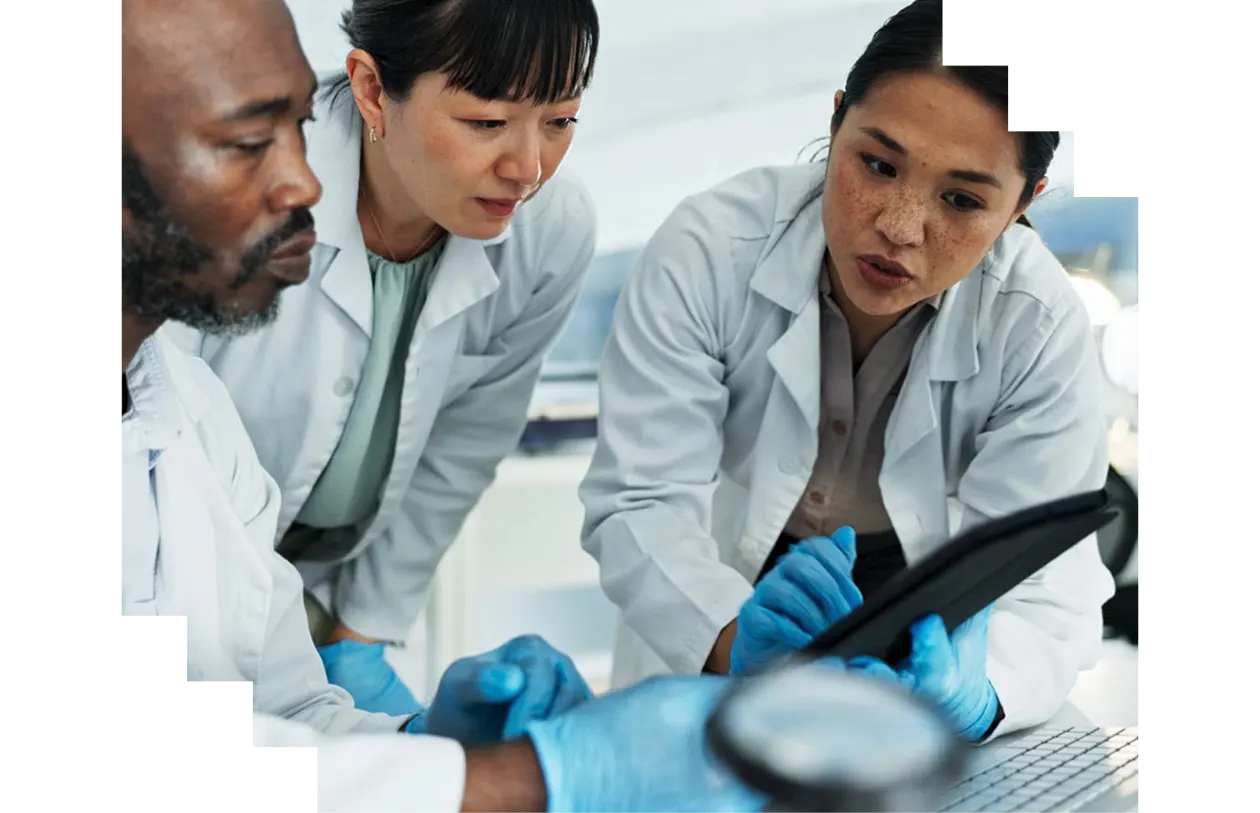
Three lab technicians collaborating