Online tools & resources

Reaxys - Providing insights into chemistry

demo_pricing_button           

REAXYS About

Providing solutions for every stage of the chemistry workflow

Reaxys is a unique workflow solution for chemistry research. Designed by expert chemists to support researchers in all sectors, Reaxys provides easy access to relevant and reliable information. Tools for planning and comparing synthesis pathways and refining, analyzing and communicating results cover your needs at every stage of your workflow. Regardless of your field of research, if you need insight into chemistry, Reaxys can support you.


bottom_line

Reaxys uncovers the data you need.

Reaxys gives you access to over 16,000 periodicals containing 500 million experimentally verified facts. It provides the ideal balance of deep and broad searching to bring you actionable chemistry and an overview of the research environment together. Reaxys extracts key chemistry, such as chemical formulas, physicochemical properties and experimental procedures from core journals and patents, and performs bibliographic searches with equal ease. It also provides access to other unique sources of chemistry, such as PubChem and eMolecules. With Reaxys, you never have to worry about missing crucial answers.

Reaxys


bottom_line

Key Benefits

Reaxys fits your workflow

Relevant and actionable results
Reaxys focuses on experimentally measured reaction and substance data that can be immediately applied, saving you time and preventing false starts. Reaxys extracts data that has a structure, experimental fact, and a credible citation, because trustworthy information is essential.

Superior coverage and organized answers
Reaxys gives you access to over 16,000 chemistry-related periodicals from every field of science. Thanks to the Reaxys Ranking Algorithm and state-of-the-art filtering tools, the most relevant extracted information is shown first, eliminating the need to scan through pages of results.

Multiple input options
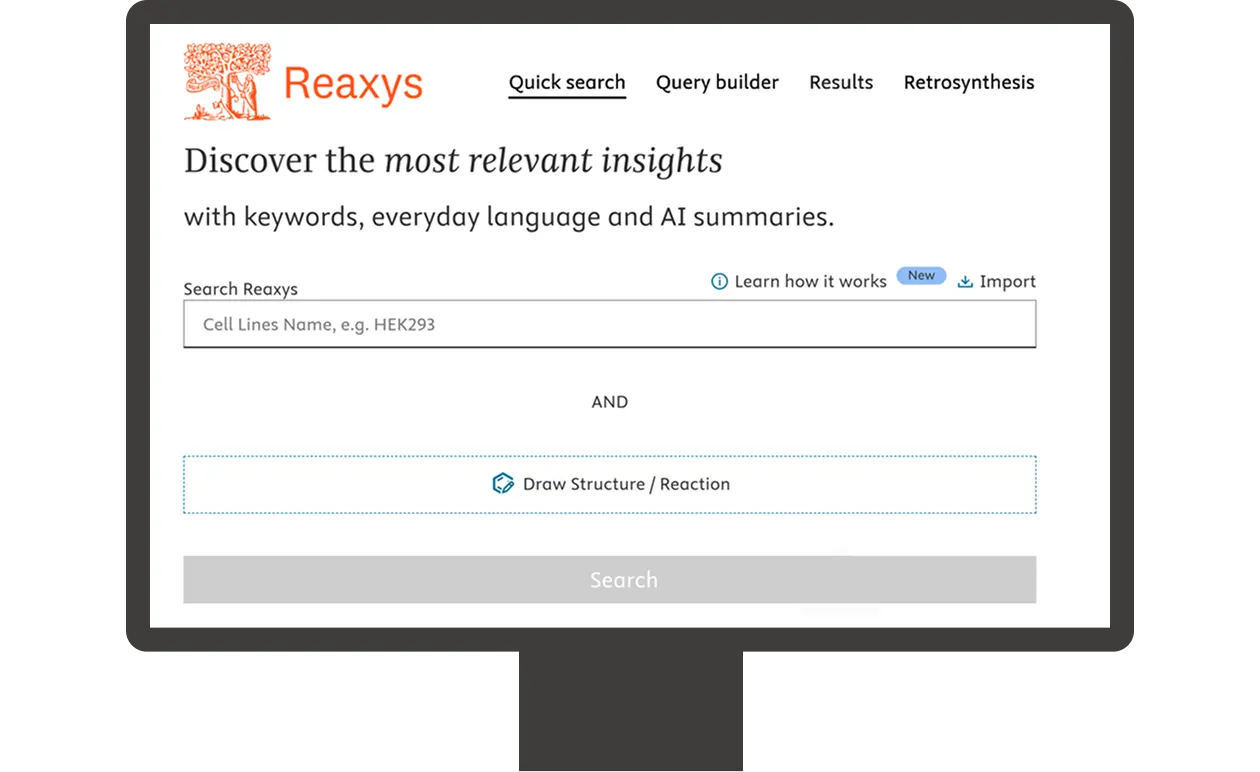
Reaxys allows you to pose your question in a number of ways using the text- and graphic-based interface. Multiple drawing tools are supported for maximum input flexibility.

Broad understanding of meaning
Using taxonomic association, Reaxys connects compound structures and all associated trade and common names and searches the literature for all references to them. The system also supports structural similarity searches based on graphic input.

No hidden costs
Essential chemistry is presented directly, and full papers are immediately available without extra cost. Flat rate access for your whole organization means that multiple researchers can access information simultaneously without seat-based delays or budgetary concerns about task-based searches.
Providing Interoperability
Reaxys values essential partnerships.
In order to give you even greater access to relevant information in a variety of contexts, Reaxys has interoperability with numerous sources of information within and outside of the Elsevier family of products.
  • PubChem — See bioactivity data from this renowned public database in the Reaxys interface alongside your search results.
  • eMolecules — Get additional information about synthesis pathways and purchase information, supporting the “synthesize or purchase” decision-making process.
  • Reaxys Medicinal Chemistry — Identify and prioritize drug candidates based on key information on molecular targets, pharmacological effects and target interaction data.
  • PharmaPendium — Go deeper into clinical and preclinical data and look at FDA and EMA approvals for pharmaceuticals.
  • Scopus — Enjoy easy access to important bibliometric information about your results.
  • ScienceDirect — Get full-text access to articles and textbooks chosen and curated with Elsevier expertise.
Reaxys workflow
Giving You Options
We recognize how you work.
Reaxys is a web-based chemistry discovery engine with a cutting-edge online interface and other content delivery options. We consult with expert chemists and information specialists to understand what will give you the best flexibility of access to suit your work.
  • State-of-the-art filter tools —Our filters allow you to fine-tune search results and ensure that the top results are the ones you need most. You can filter by author, publication year, research topic, journal title, affiliation or some combination thereof.
  • Electronic lab notebooks (ELNs) — Reaxys is compatible with ELNs from major suppliers, such as Accelrys, Perkin Elmer, and IDBS. Using an ELN eliminates transcription errors and allows comparisons between search results and in-house data.
  • Reaxys Structure Flat File (SFF) — You can incorporate your search results into your internal databases through the Reaxys SFF. This means everyone within your organization can access and use the Reaxys data.
  • Application Programming Interfaces (APIs) —The Reaxys API enables you to develop chemical reaction and substance information research applications that personalize and increase your search power.
 

bottom_line


Reaxys helps you answer essential chemistry questions

Does a compound exist?
Whether your search term is a drawing of the compound structure or one of its trade or common names, Reaxys will retrieve all of the literature that mentions the compound, giving information such as who has worked on the compound and how many citations refer to it. Reaxys also allows you to access PubChem and eMolecules to increase the power of your search.

What do we know about this compound?
Reaxys extracts the essential structural and experimental information, such as physicochemical properties and spectra data, from the core journals and textbooks and presents it in context, including illustrations. You can see the state of knowledge about the compound without having to read full articles. You can also immediately apply the information in your research, because Reaxys gives you experimentally measured and verified data.

How can I obtain this compound?
Thanks to the partnership with eMolecules, Reaxys presents you the best options for obtaining the compound of interest. Quick decisions about whether you should purchase or synthesize the compound save time and drive research forward.

What do we know about this area of research?
If you need to know more about a particular area of chemistry research, standard keyword searches such as “allylic alkylation”, "the biology of urea", "2+2 dimerization", "CO2 activation", or "copper catalysis" will retrieve abstract and citation information from all the articles mentioning the keywords, and extract experimental procedures and data from core literature.

Who else is working on this compound or reaction type?
You can organize structure and reaction search results by author, affiliation, and publication year to see who is working on particular compounds or reactions. Reaxys also allows you to find comprehensive information about a given author, both in terms of his work and partnerships and in terms of citations of his publications. Finally, Reaxys can help you quickly identify the core chemical research theme of a company, institution, or department.
Reaxys® and the Reaxys® trademark are owned and protected by Reed Elsevier Properties SA. All rights reserved.